
Materials

316L Stainless Steel Sheet Metal: Welded Corrosion

The L stands for low carbon, and it exists for one failure mode. When austenitic stainless sits in the 425-815 C range — which is what welding does to the metal beside the weld — chromium migrates to the grain boundaries as carbide, and the narrow zones around those boundaries are left too poor in chromium to resist corrosion. Lowering carbon removes the ingredient the reaction needs.

Reviewed by Tom, Senior Process Engineer·Dongguan source factory · 11+ years in precision sheet metal
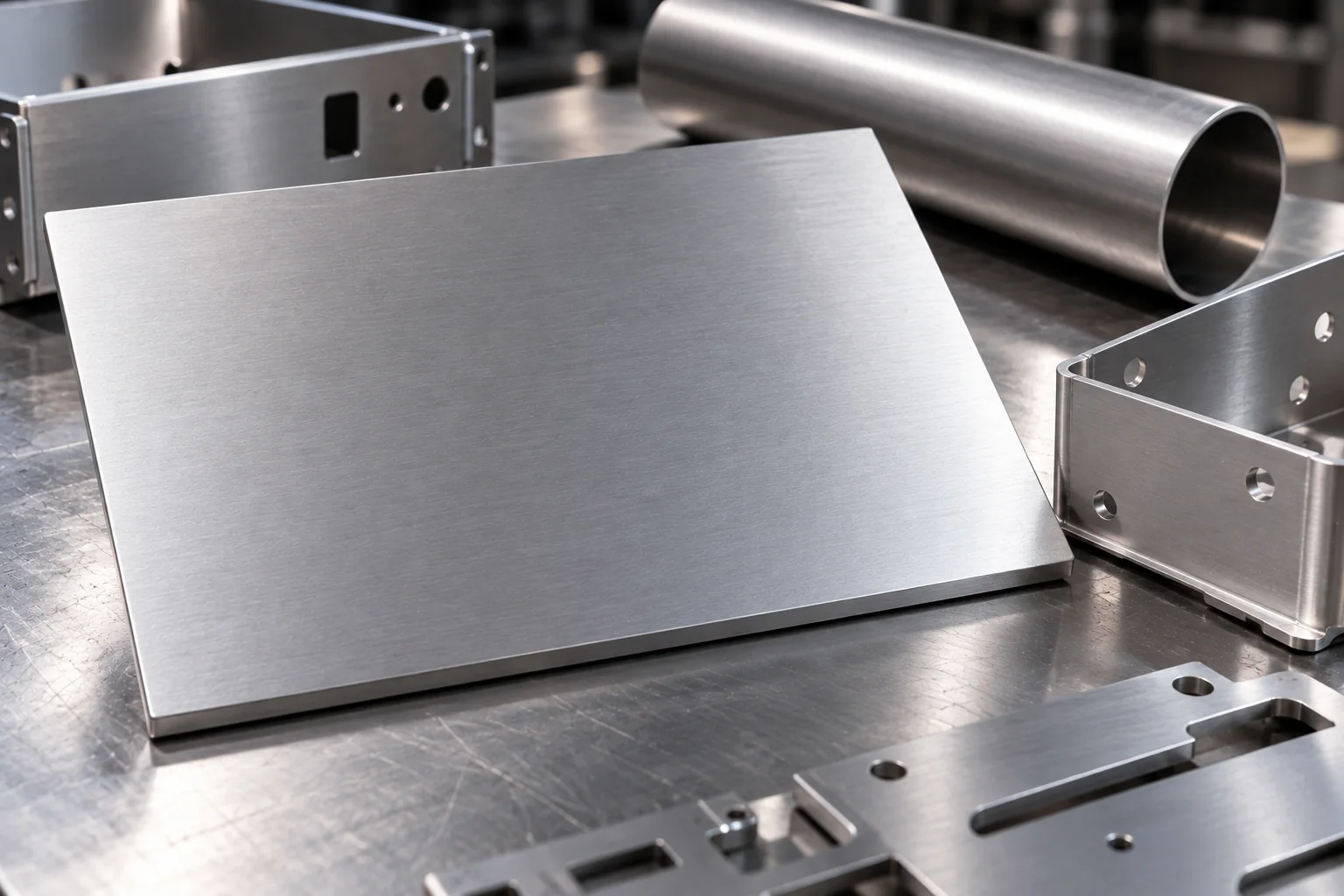
316l passivated parts machined — 316L stainless steel sheet metal
Short answer

316L is 316 with carbon capped at 0.03%, and that single change is the whole point: it prevents the chromium-carbide precipitation that leaves welded 316 vulnerable to intergranular corrosion. Specify it where the part is welded and thick enough to hold heat, or where it cannot be annealed afterwards. Otherwise 316 does the same job for less.

SUS316L

Mechanical Properties

Open in the data sheet
Density
8.00
Tensile Strength
560 MPa
Yield Strength
215 MPa
Elongation
50%
Weldability
Excellent
Corrosion Resistance
Excellent
Thickness Range
0.5mm – 4.0mm
Chemical composition
Cr: 16.0% – 18.0%, Ni: 10.0% – 14.0%, Mo: 2.0% – 3.0%, C: ≤0.030%, Mn: ≤2.0%, Fe: balance
Equivalent Grades
CN
022Cr17Ni12Mo2 / 00Cr17Ni14Mo2
US
ASTM A240 Type 316L / UNS S31603
JP
JIS G4305 SUS316L
EU
EN 1.4404 / X2CrNiMo17-12-2

What 316L actually changes

Austenitic stainless steels rely on chromium for corrosion resistance — roughly 16-18% in 316 — forming a passive oxide layer that heals itself in air. Carbon is normally an unavoidable trace element. Above about 0.03%, holding the steel in the sensitisation range lets carbon combine with chromium at the grain boundaries.

The carbides themselves are not the problem. The problem is that they draw chromium out of the narrow zones beside them, and those zones then fall below the ~12% chromium needed for a stable passive layer. The result is intergranular corrosion: the part looks sound and fails along its grain structure, often after a service period rather than immediately.

316L holds carbon at or below 0.03%, low enough that there is not sufficient carbon present to form meaningful carbide at the boundaries. Welding therefore does not sensitise the heat-affected zone, and a post-weld anneal becomes unnecessary — which matters most on parts too large for a furnace or too costly to re-finish after one.

Typical properties for engineering reference

Published typical values. Confirm against the mill certificate for the heat actually used on a project.

PropertyTypical value
Carbon content0.030% max (the defining limit)
Chromium / nickel / molybdenum16-18% Cr / 10-14% Ni / 2-3% Mo
Tensile strength (annealed)~485-580 MPa
Yield strength (annealed)~170-310 MPa
Elongation~40-55%
Density8.00 g/cm3
Magnetic responseNon-magnetic annealed; slight response after cold work
Sensitisation range425-815 C — avoided as a service temperature
316L stainless steel sheet — typical values

When the L grade earns its place

The premium over standard 316 is modest, but it buys nothing on a part that is never welded and never held hot. Three situations justify it: welded assemblies in corrosive service, thick sections where the weld holds heat long enough to sensitise adjacent metal, and parts that cannot be annealed afterwards because of size, distortion risk or a finish already applied.

The opposite case is equally clear. A bent bracket in 316 sheet, assembled with fasteners and seeing only atmospheric exposure, gains nothing from 316L — plain 316 or even 304 will outlast the product. Choosing the L grade by default inflates material cost without changing service life.

Fabrication notes

Forming and welding behave as they do for 316: higher work-hardening than carbon steel, so bends want a generous inside radius and a springback allowance. Laser cutting and TIG welding are the usual routes, with the weld dressed only where the finish demands it.

Where a part is welded and will meet chlorides or aggressive washdown, we normally recommend passivation after welding on any 3xx grade — it removes free iron and restores the passive layer on the weld and the heat-affected zone. Post-weld passivation supplements low carbon; it does not replace it.

Frequently asked questions

What is the difference between 316 and 316L?

Only the carbon limit: 316 allows up to 0.08%, 316L caps it at 0.03%. Chromium, nickel and molybdenum sit in the same ranges. The lower carbon is what prevents sensitisation during welding. Some mills add a little nickel to 316L to hold the austenitic balance, which marginally improves formability.

Does 316L need annealing after welding?

No, and that is the main reason the grade exists — the low carbon leaves no chromium carbide to dissolve, so the heat-affected zone keeps its corrosion resistance as welded. Standard 316 in a thick welded section may need a solution anneal to restore that zone, which in practice is often impossible on a finished part.

Is 316L more expensive than 316?

Slightly, and the gap widens when nickel prices are high because of the extra nickel some mills add. On a welded assembly in corrosive service the difference is trivial against the cost of a field failure. On a non-welded indoor part it is money spent for nothing.

Can 316L be used for food and medical equipment?

Yes — it is a standard choice for both: welded frames, tanks and instrument enclosures, usually combined with a sanitary surface finish and passivation. The low-carbon grade removes the weld-zone corrosion risk that repeated washdown would otherwise exploit.

Is 316L magnetic?

Annealed 316L is non-magnetic. Cold working — bending, forming, even laser-cut edges — can induce a slight magnetic response as some austenite transforms to martensite. Where a hard magnetic requirement exists, it has to be checked on the formed part rather than assumed from the grade.

Can 316L be substituted for 304?

Technically yes, since it is more corrosion resistant, but that is the wrong way to decide. 304 covers general indoor and atmospheric service at lower cost. 316L earns its premium through molybdenum and low carbon, which matter for chlorides and for welded corrosive service specifically.

Send the drawing, get a real answer

An engineer reviews your model for manufacturability and returns a costed quotation — with the DFM observations that would change the price.