
Sheet Metal Welding Design: Joints and Distortion
Welding is the operation most often specified by a phrase rather than a drawing. "Weld all round" and "weld as required" leave the joint type, size, finish and distortion control to whoever picks up the job — which is why welded parts vary more between suppliers than any other sheet metal work.
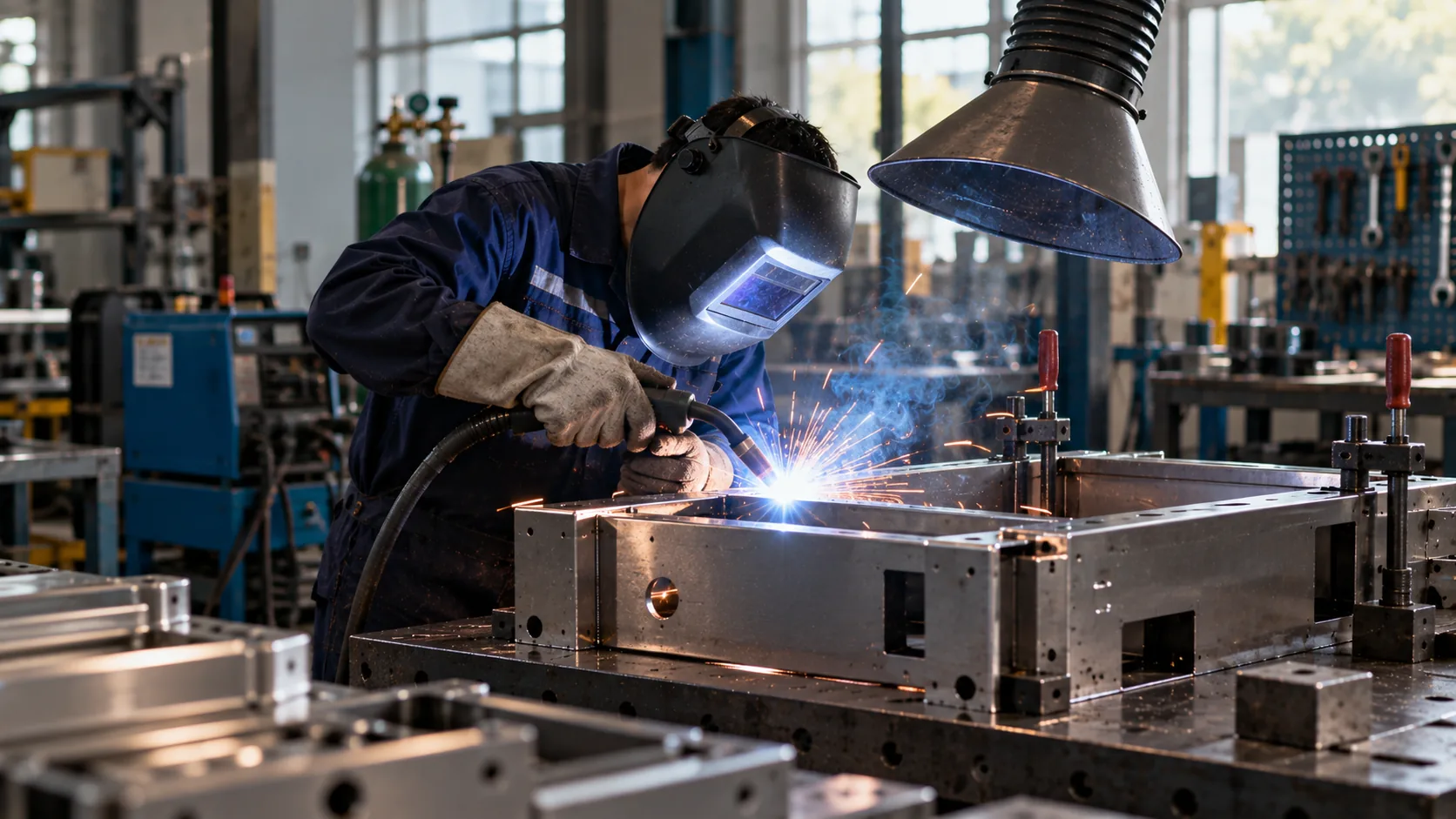
Designing for welding means three things: pick a joint the thickness can actually take, give the torch somewhere to reach, and plan the sequence so the part does not pull itself out of shape. A drawing that says "weld all round" answers none of them.
6 rows of reference data below — the summary above is the short answer, the tables are what you quote from.
Joint type follows thickness and access
On thin sheet — under about 1.5 mm — a full-penetration butt joint is difficult to achieve without blow-through, so most thin work is done as a fillet on a flanged or lapped joint, or with a corner welded from one side. As thickness rises the joint options widen, and a butt weld becomes practical.
Access decides as much as thickness. A fillet weld on the inside of a closed box is only possible if the box is welded before it closes, which is an assembly-sequence constraint rather than a welding one. TIG needs the most room because the torch and the filler are both at the joint; MIG needs less; laser welding needs a fixture and line of sight but almost no clearance.
| Joint | Thickness band | Notes |
|---|---|---|
| Lap / flange fillet, TIG | 0.8–2.0 mm | Most common thin-sheet joint; needs torch access to one side |
| Outside corner, TIG | 0.8–2.0 mm | Visible seams, minimal dressing, needs a tight butt gap |
| Spot weld on flanges | 0.8–2.0 mm zinc-coated | Fast and clean; not sealed, leaves witness marks |
| MIG fillet | 2.0 mm and up | Faster, more heat, more dressing required |
| Laser welded seam | 0.5–2.0 mm stainless | Very low distortion, needs a fixture and a clean joint |
| Butt weld | 3.0 mm and up | Full penetration; usually needs backing or a bevel |
Joint selection for sheet metal
Distortion, and why the sequence is the design
Welding heat expands the material and the surrounding cold metal resists it. When the weld cools and contracts, the part has moved. On a long seam this shows as bowing; on a closed frame it shows as a twist; on a thin panel it shows as oil-canning.
Tacking the assembly into a fixture before welding, working short passes on opposite sides alternately, and leaving the joint that closes the structure until last are the three controls that work. Where distortion cannot be tolerated — a frame carrying a machined interface, for example — the design answer is to weld oversize and machine after welding rather than to try to hold the dimension through it.
Cosmetic versus structural, and saying which
A structural weld is sized for load. A cosmetic weld is sized for appearance and often ground flush. They cost very different amounts, and a drawing that does not distinguish them will get whichever the welder judged appropriate.
Where a seam will be visible after finishing, say so and say whether it will be dressed. A ground weld in carbon steel shows as a witness line under a powder coat unless it is filled or the coat is textured; in stainless, dressing has to restore the grain or it reads as a polished stripe on a brushed panel.
- Mark weld symbols on the drawing, or describe each joint in words — but describe each one.
- State whether a weld is structural, sealing or cosmetic; they are three different requirements.
- Where a joint seals, say what it must keep out and whether it will be leak-tested.
- Plan the finish: dress, grind or leave as-welded, and whether the weld will be coated.
Frequently asked questions
What does "weld all round" actually mean in practice?
It leaves the joint type, size and finish to the welder. On a thin flanged joint it usually means a small TIG fillet all round, which is often exactly what was wanted — but on a sealing joint the same phrase can produce a weld that leaks. Specify the joint and the requirement instead.
How do you stop a welded panel from oil-canning?
By controlling heat input and, where the panel is large, adding stiffness. Several short passes worked alternately, letting the part cool between them, and avoiding a single long run across the panel all help. Where the panel must stay flat, a formed rib or a return flange gives the material a shape to hold.
Can zinc-coated steel be welded?
Yes, but the coating burns off at the weld and the fumes need extraction. The weld itself is usually slightly porous, and the bare area at the weld has to be protected afterwards — which is worth knowing before specifying galvanised material on a part that will be welded and then left uncoated.
Do you leak-test welded enclosures?
We can, where the requirement is stated. The test method matters — a water spray, a pressure decay test and a dye penetrant check all answer different questions — so tell us what the enclosure has to keep out and how you intend to verify it, and it becomes part of the process rather than an argument at delivery.
How much should I allow for weld distortion in a tolerance?
More than a drawing usually does. A welded assembly holds a wider band than the same parts before welding, so specify the post-weld dimension and accept a realistic band. Where that is not acceptable, the alternative is a post-weld machining or adjustment step, which is a design decision with a cost attached.
Send the drawing, get a real answer
An engineer reviews your model for manufacturability and returns a costed quotation — with the DFM observations that would change the price.