Table of Contents
Overview
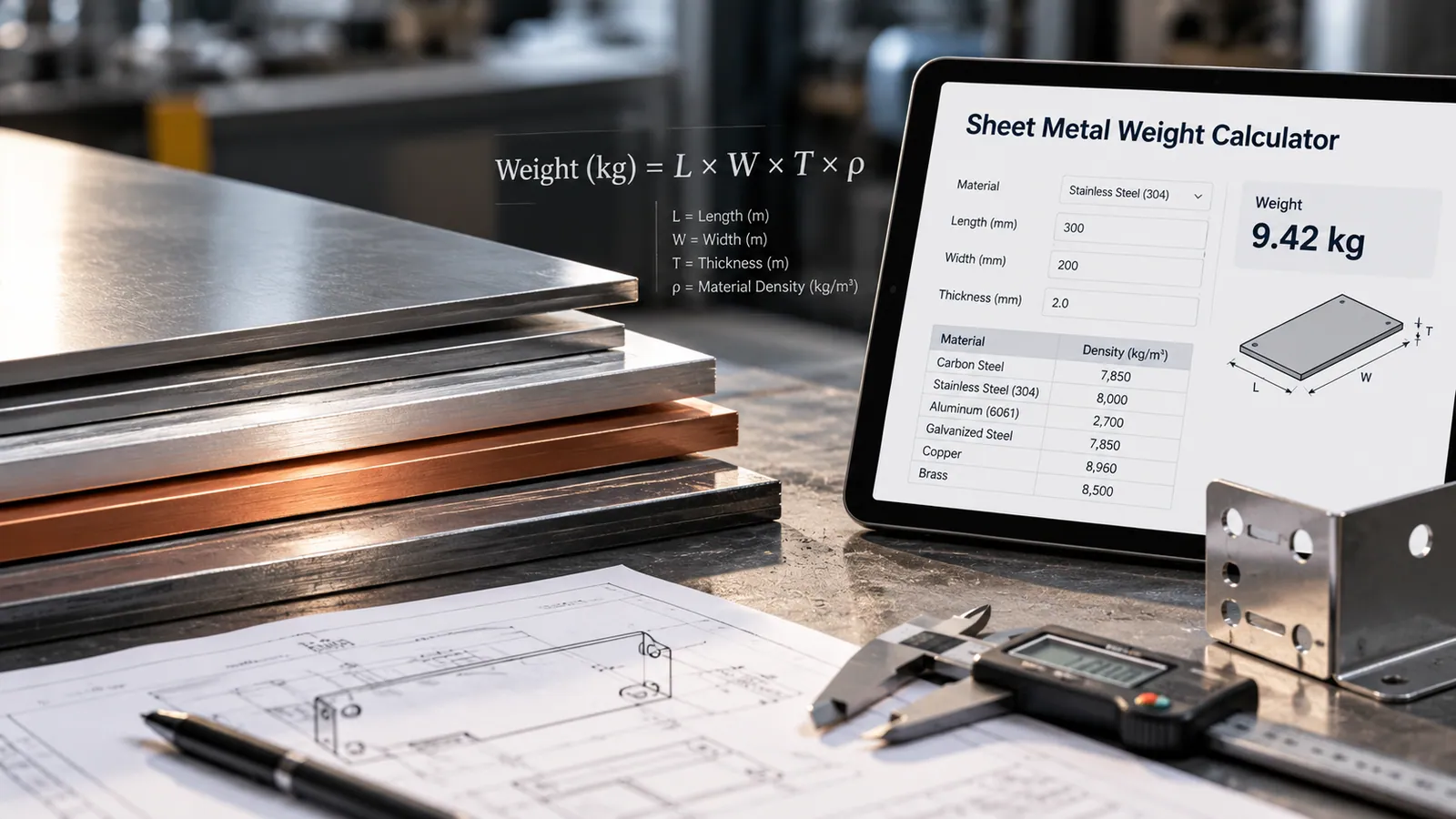
Quick answer: Sheet metal weight = length × width × thickness × material density. A 300 × 200 × 2 mm SPCC plate weighs 0.3 × 0.2 × 0.002 m × 7850 kg/m³, about 0.94 kg. The density table below covers steel, aluminum, stainless and more.
What is sheet metal weight?
Sheet metal weight is the mass of a flat or formed part, and it drives shipping cost, handling, structural load and material spend. A 1 mm thick, 1 m² steel plate is about 7.85 kg; the same area in 5052 aluminum is only 2.68 kg. Because density varies so much between metals, you cannot estimate weight from size alone — you must know the alloy. That is why a calculator asks for both dimensions and material, not just length and width.
Weight also changes after fabrication. Bending adds no material, but cutting, punching and laser cutting remove it; secondary operations like plating or anodizing add a thin, measurable layer. For quoting and logistics, use the net weight after processing, or add a small allowance for coatings.
What is the weight formula?
The formula is simple: weight = volume × density. For a rectangular blank, volume = length × width × thickness, so weight = L × W × T × ρ, where ρ is the material density. Keep every dimension in the same unit — metres and kg/m³, or millimetres and g/mm³ (1 g/mm³ = 1000 kg/m³). A rounded edge or small hole barely changes the total, so for a first estimate treat the part as a plain rectangle.
For a formed part, estimate from the flat blank, not the bent shape: the metal is simply redistributed, so the mass is unchanged by bending. If you need the weight of a specific bent geometry, flatten the developed length first, then apply the same L × W × T × ρ. Use the calculator for batch quantities — it multiplies one part weight by the order size.
Material Density Table
The table lists the density of common fabrication metals. Multiply your part volume by the density (kg/m³) to get the mass in kilograms. Values are typical; confirm the exact alloy with your supplier.
| Material | Density (g/cm³) | Density (kg/m³) | Notes |
|---|---|---|---|
| Low-carbon steel (SPCC) | 7.85 | 7850 | Most common structural steel |
| Stainless 304 | 7.93 | 7930 | Austenitic, corrosion resistant |
| Stainless 316 | 7.98 | 7980 | Marine grade |
| Stainless 430 | 7.70 | 7700 | Ferritic, magnetic |
| Aluminum 1100 | 2.71 | 2710 | Pure Al, very soft |
| Aluminum 3003 | 2.73 | 2730 | General purpose |
| Aluminum 5052 | 2.68 | 2680 | Marine alloy |
| Aluminum 6061 | 2.70 | 2700 | Structural alloy |
| Copper C11000 | 8.96 | 8960 | High conductivity |
| Brass C26000 | 8.53 | 8530 | Cartridge brass |
| Copper C22000 | 8.80 | 8800 | Commercial bronze |
| Mild steel A36 | 7.85 | 7850 | Structural plate |
| Galvanized steel | 7.85 | 7850 | Plus zinc coating |
| Titanium Grade 2 | 4.51 | 4510 | High strength-to-weight |
Reference: the densities above match the published datasheets on MatWeb — the place to check an unusual alloy or temper before you commit to a weight figure.
Worked Example
Work through one part. Take a 300 × 200 × 2 mm SPCC bracket. Convert to metres: 0.300 × 0.200 × 0.002 = 0.00012 m³. Multiply by SPCC density 7850 kg/m³: 0.00012 × 7850 = 0.942 kg per piece. For an order of 500, that is 471 kg total — useful for freight and pallet planning. The same bracket in 5052-O aluminum would be 0.00012 × 2680 = 0.322 kg, less than a third the weight.
Check your units if the number looks wrong. A common mistake is mixing mm and m: 300 mm is 0.3 m, not 300 m. If you calculate thousands of kilograms for a small bracket, recheck the unit conversion before trusting the result. The online calculator does the conversion for you, so you can enter millimetres directly.
How to Use the Calculator
Use the calculator early, before you finalize the design. Lighter material or a thinner gauge can cut both part cost and shipping, so compare two or three alloys on weight and price. Keep bends across the grain and holes away from edges so the part forms cleanly at the chosen thickness. When weight matters for shipping or structure, confirm the alloy with your supplier — “stainless” is not one number, and 304 versus 316 changes the result by a few percent.
For a production quote, send the drawing and we return weight, material and a DFM review together. The calculator is a planning tool; the quote reflects the exact alloy, thickness and any coatings you specify.
FAQ
Written by

Industrial & Product Design Engineer
Julia takes a product from the first sketch to a sheet metal design that can actually be made. She sits between the customer’s concept and our press brakes — modelling enclosures and brackets in CAD, running early DFM passes, and choosing the material and finish that will still look right two years down the line.
View profileParts we make for this topic
Ready to Start Your Project?
Get DFM feedback and a quote within 24 hours. No minimum order quantity.