
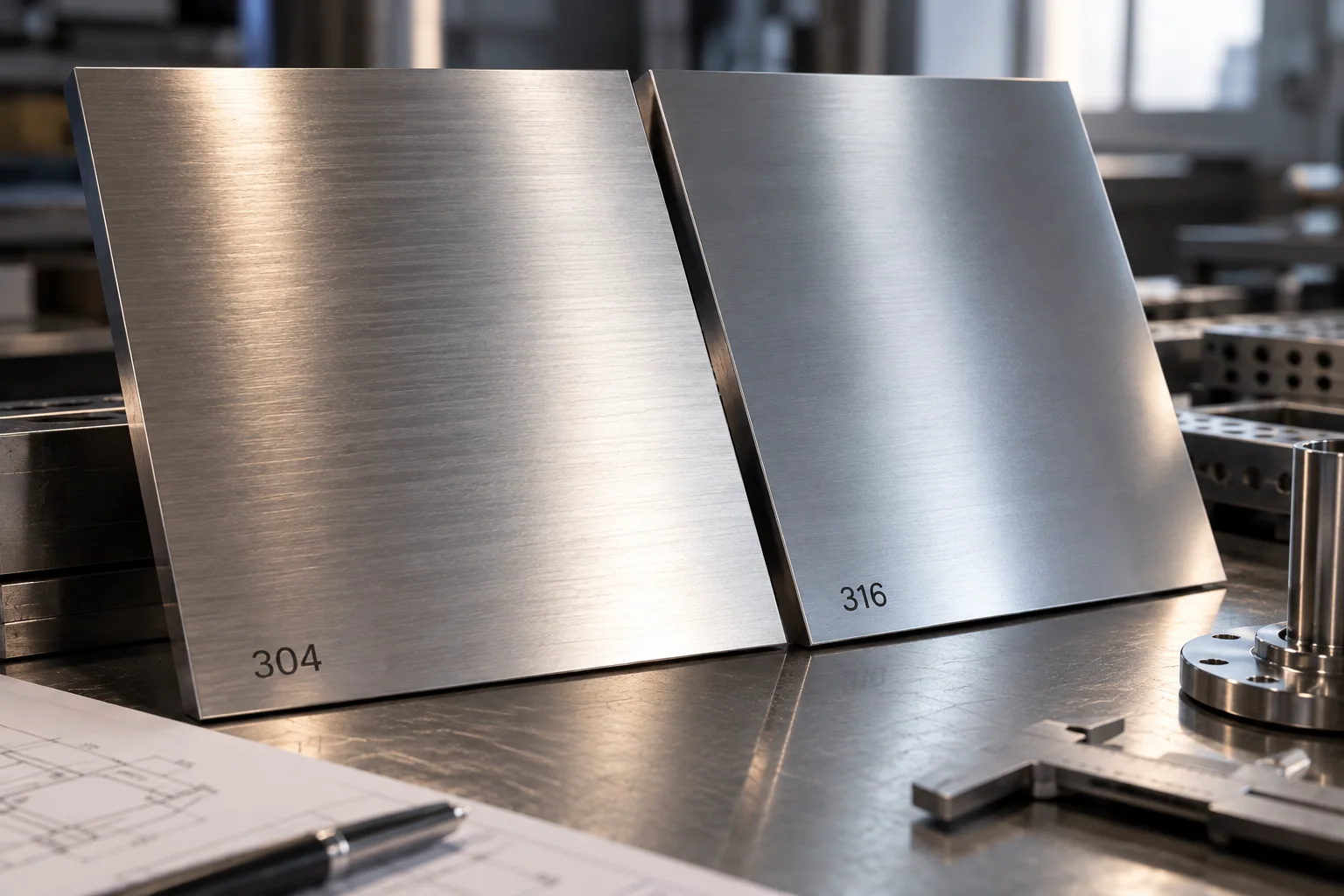
The difference, stated exactly
316 adds 2–3% molybdenum to 304's chromium–nickel recipe (and usually runs as the low-carbon 316L in welded aggressive service). Molybdenum stabilises the passive film against chloride attack specifically — it does not make the alloy "more stainless" in general, and against fresh water, mild acids or atmospheric exposure the two grades behave almost identically.
That specificity is the whole argument. Paying the 316 premium for an indoor part buys nothing, because there are no chlorides for the molybdenum to resist. Specifying 304 for a coastal cabinet saves money until the pitting starts, then costs several times the premium in replacement. Both mistakes are common, and both are avoidable with one honest sentence about the installation site.
Side by side
| Criterion | 304 | 316 / 316L |
|---|---|---|
| General atmosphere, indoor | The standard | No benefit — same behaviour |
| Inland outdoor | Standard choice | No benefit |
| Coastal / salt spray | Pits in time | The reason 316 exists |
| Chemical / aggressive washdown | Grade-dependent | Usually required |
| Food contact, dry & mild | Standard | For saline/acidic processing |
| Strength & formability | Essentially identical | Essentially identical |
| Laser cutting / bending / welding | Same processes | Same, marginally slower cutting |
| Relative cost | Reference | Higher — the premium is the molybdenum |
The environment test: five questions that decide
- Does the installation sit within sight of the sea, or in a building near one? → 316
- Does the part see road spray, de-icing salt or winter streets? → 316
- Is it washed with chlorinated or acidic chemicals on a schedule? → 316
- Does it touch brines, sauces or saline process fluids? → 316
- None of the above? → 304, and spend the difference on a better finish or a thicker gauge.
Where the grades meet fabrication
Both grades run the same thin-gauge laser window, the same bending rules (work-hardening on multi-bend parts, sequence planned from the flat pattern), and the same welding processes. Two practical notes belong to 316 specifically: laser cutting runs marginally slower — a small cutting premium, not a process change — and welded 316 for aggressive service quotes as 316L with matched filler, plus a passivation step after welding so the seam starts service with the same passive film as the parent metal.
On finishes, the menu is identical — brushed, bead-blasted, passivated, powder coated — with one emphasis difference: on a 316 marine or chemical part, the finish is part of the corrosion system, so scratch-free cosmetic faces and documented passivation carry real weight, while an indoor 304 enclosure can tolerate the cosmetic latitude a paint line provides.
The middle case: 304 with a better finish
A fair number of "should this be 316?" parts are honestly 304 parts with a specification gap. An inland outdoor enclosure in 304 with powder coating over pretreatment handles weather for years; the same part bare in a damp plant room is asking for tea-staining. Before stepping a grade, check whether the step is really about coating, drainage or crevice design — we will price both routes in one quotation so the decision is a comparison, not a guess.