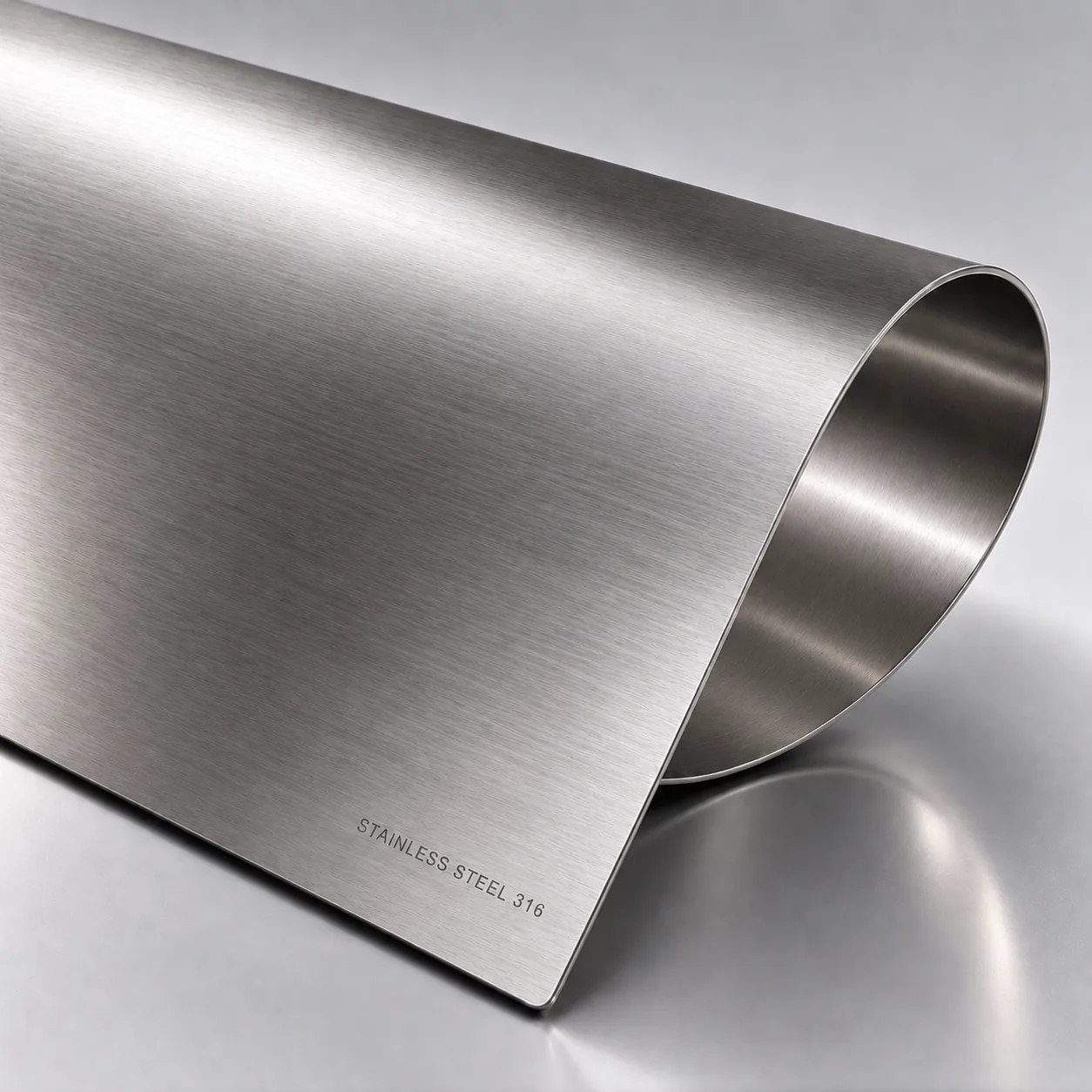
What 316 stainless steel is
316 is an austenitic stainless steel with the 304 recipe plus 2–3% molybdenum (German drawings: 1.4401/1.4404, the L variant for low carbon). The molybdenum stabilises the passive film against chloride attack — the specific corrosion mechanism that pits and crevice-corrodes standard stainless in salty or chemical environments.
The low-carbon 316L variant matters for fabrication: where a part is heavily welded and the service is aggressive, 316L avoids the sensitisation edge case that classic carbon levels carry. In practice, sheet for welded chemical or marine parts is quoted as 316L unless the drawing says otherwise, at essentially the same fabrication behaviour.
Typical properties for engineering reference
Typical annealed-sheet values below; 316 tracks 304 closely on strength. Confirm project-critical properties against the mill certificate.
| Property | Typical value (annealed sheet) |
|---|---|
| Density | 8.00 g/cm³ |
| Tensile strength | ≥515 MPa |
| Yield strength | ≥205 MPa |
| Elongation | ≥40% |
| Chloride resistance | The differentiator — resists pitting in salt and chemical service |
| Weldability | Excellent; 316L preferred for heavily welded aggressive-service parts |
| Forming behaviour | Tracks 304 — good formability, work-hardens |
Fabrication: same machines, slightly more attention
Laser cutting, bending and welding run the same program as 304, with one practical difference at the cutter: the molybdenum-bearing melt is slightly more viscous, so cutting speeds drop a little and the edge needs the same attention to dross settings as thicker 304. For the buyer this shows up as a small cutting premium, not a process change.
Welding deserves the specification detail: for chemical or marine parts we quote 316L and match the filler to the duty, and where the part is welded heavily we recommend the passivation step after welding so the whole surface — seam included — starts service with a uniform passive film. Skipping passivation on a welded 316 part leaves the heat-tint zone as the weakest link, which defeats the point of the alloy.
- Laser cutting: standard thin-gauge window, marginally slower than 304
- CNC bending: same rules as 304; work-hardening on multi-bend parts
- TIG welding with matched filler; 316L for heavily welded duty
- Passivation after welding: the standard recommendation for aggressive service
When the premium is justified — and when it is not
The honest version of this comparison: 316 is cheap insurance exactly once, and that is against chlorides. Coastal and offshore equipment, food processing with salt and washdown chemicals, pharmaceutical wet lines, marine hardware, de-icing-salt exposure — there, pitting in 304 is a when, not an if. In an office tower, a plant room or general industrial air, 316 buys nothing the environment will ever test.
| Service environment | Grade we recommend |
|---|---|
| Indoor, general industrial | 304 |
| Outdoor, inland atmosphere | 304 |
| Coastal outdoor / salt spray | 316 |
| Marine / offshore | 316L |
| Chemical processing, wet lines | 316L |
| Food processing with salt + washdown | 316 |
| Medical device housings | 304 standard; 316 for aggressive sterilisation |
Surface finishes that suit 316
The finishing menu matches 304 — brushed and bead-blasted mechanical finishes, passivation for corrosion performance, powder coating where colour is specified — and 316 takes them identically. The one 316-specific note is inspection emphasis: on a marine or chemical part, the finish is part of the corrosion system, so scratch-free cosmetic faces and a documented passivation step carry more weight than on an indoor 304 enclosure.
- Brushed (No. 4) for architectural and equipment panels
- Bead blasting + passivation as the standard marine-equipment pairing
- Electropolishing available through partners for pharmaceutical-grade surfaces
Sourcing and how to specify it
316 and 316L sheet are sourced through our supply chain against your drawing. Specify the variant explicitly — "SUS316L / 1.4404" for welded aggressive service — along with thickness, finish per face and any passivation or documentation requirement. If the duty involves specific chemicals, name them in the RFQ: the grade recommendation sometimes changes at the margins, and it costs nothing to ask before the material is ordered.
Where you are unsure whether the duty justifies 316, the cheapest path is a one-line email describing the installation environment. The answer is often "304 is fine", and that answer is worth the premium on every part in the order.