
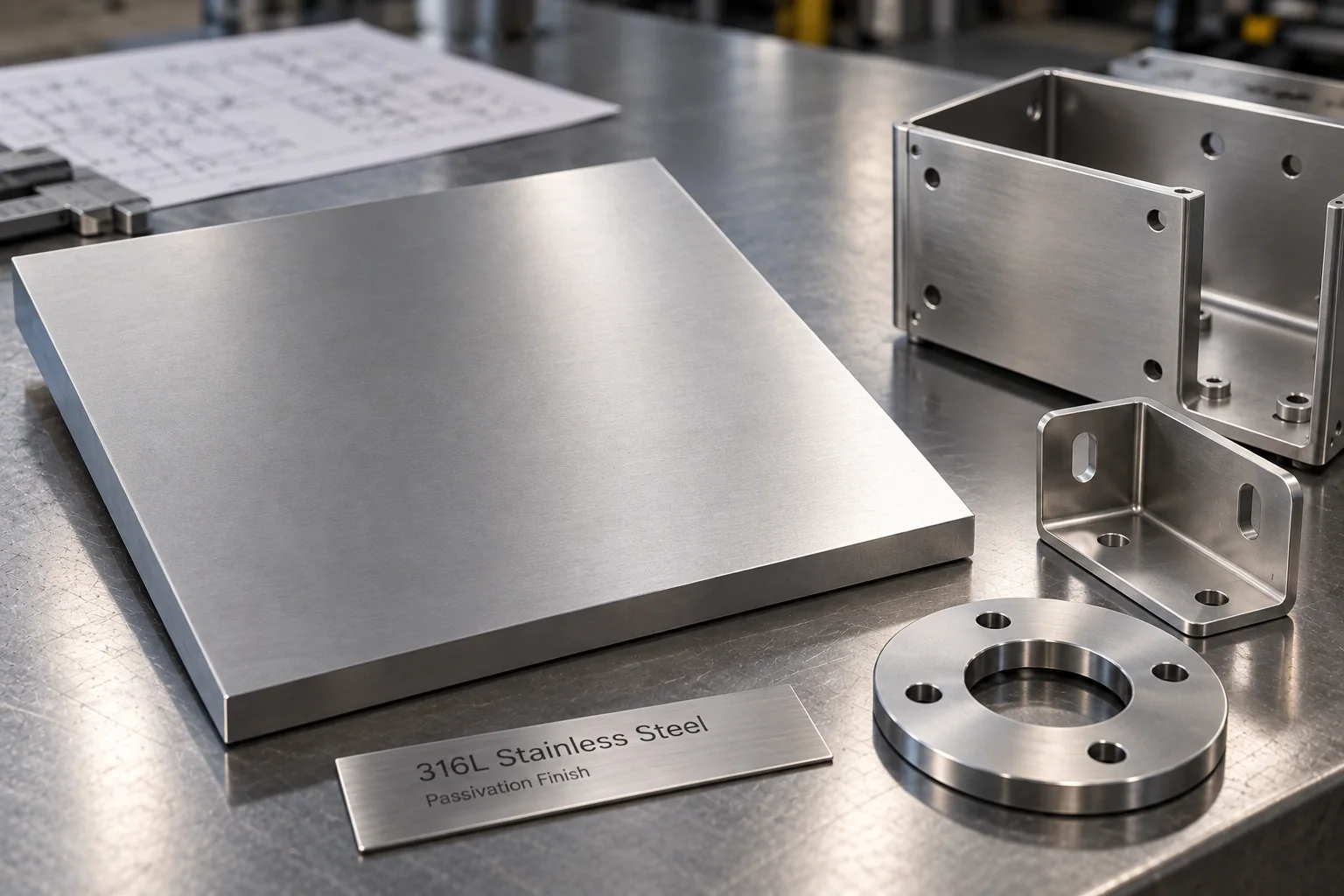
What passivation actually does
The bath dissolves free iron from the surface without attacking the stainless substrate meaningfully. With the contamination stripped, oxygen rebuilds the chromium-oxide passive film evenly across the whole part — weld seams, bend lines and cut edges included. Nothing is added: no layer is deposited, no dimension moves, and the metal keeps its look, which is why passivation pairs cleanly with tight-tolerance parts where plating or paint would complicate fits.
Because it is a clean rather than a coat, passivation does not disguise surface defects — scratches, weld spatter and heavy heat tint must still be addressed mechanically first. On fabricated assemblies the usual sequence is: form and weld, dress the welds, mechanically finish where specified (brushed or bead-blasted), then passivate as the final chemical step.
Citric vs nitric acid — the two ASTM A967 routes
| Criterion | Citric acid | Nitric acid |
|---|---|---|
| Standard status | Recognised method in ASTM A967 | The traditional method, recognised in ASTM A967 |
| Operator & environmental profile | Safer handling, milder waste stream | Stronger acid, more demanding handling |
| Batch behaviour | Excellent consistency on 300-series sheet | Long industrial track record across alloys |
| Typical use on our parts | Default for 304 / 316 sheet-metal fabrications | Where the drawing or legacy spec calls it out |
| Acceptance testing | Per ASTM A967 practice specified on the drawing | Per ASTM A967 practice specified on the drawing |
When welded parts need it most
Welding is the aggressive case. The heat-affected zone carries temper colours — a chromium-depleted layer that corrodes before the parent metal does — and a welded 304 or 316 part that skips passivation ships with its weakest point exactly where the strength matters. Our 316 material page says it directly: on marine or chemical parts, passivation after welding is the standard recommendation, because a documented passive film over the whole surface is what makes the alloy premium worth paying for.
It is not only for aggressive duty. Indoor 304 parts that are welded, then brushed or bead-blasted, also benefit: the mechanical finish reworks the surface, and the passivation step evens out the chemistry behind it. Cosmetic face + uniform passive film is the combination that keeps stainless equipment looking right after a year of wipe-downs.
How to specify it on your drawing
- Call out the standard and method: "Passivate per ASTM A967, citric" (or nitric) — method matters and is your choice to make
- On welded parts, state the sequence expectation: weld, dress, mechanically finish if specified, passivate last
- Name the acceptance test if you need documented results — ASTM A967 includes water-immersion / high-humidity type practices
- Do not combine passivation with coating callouts on the same surface — it is either a passive stainless surface or a coated one
- If your spec system still references legacy nitric-only documents, say so at RFQ — we reconcile to the current standard before quoting
Where passivation fits against the other finishes
Passivation changes chemistry, not appearance or dimension — that is its role and its limit. Where corrosion demand exceeds what a passive film delivers, the escalation path is a coating: zinc plating on carbon steel, or powder coating when colour and a thicker barrier are wanted. On aluminium, passivation does not apply at all — anodizing is that metal's equivalent, growing its own oxide on purpose. The grade pages map each alloy to the finish stack that makes sense for it.