
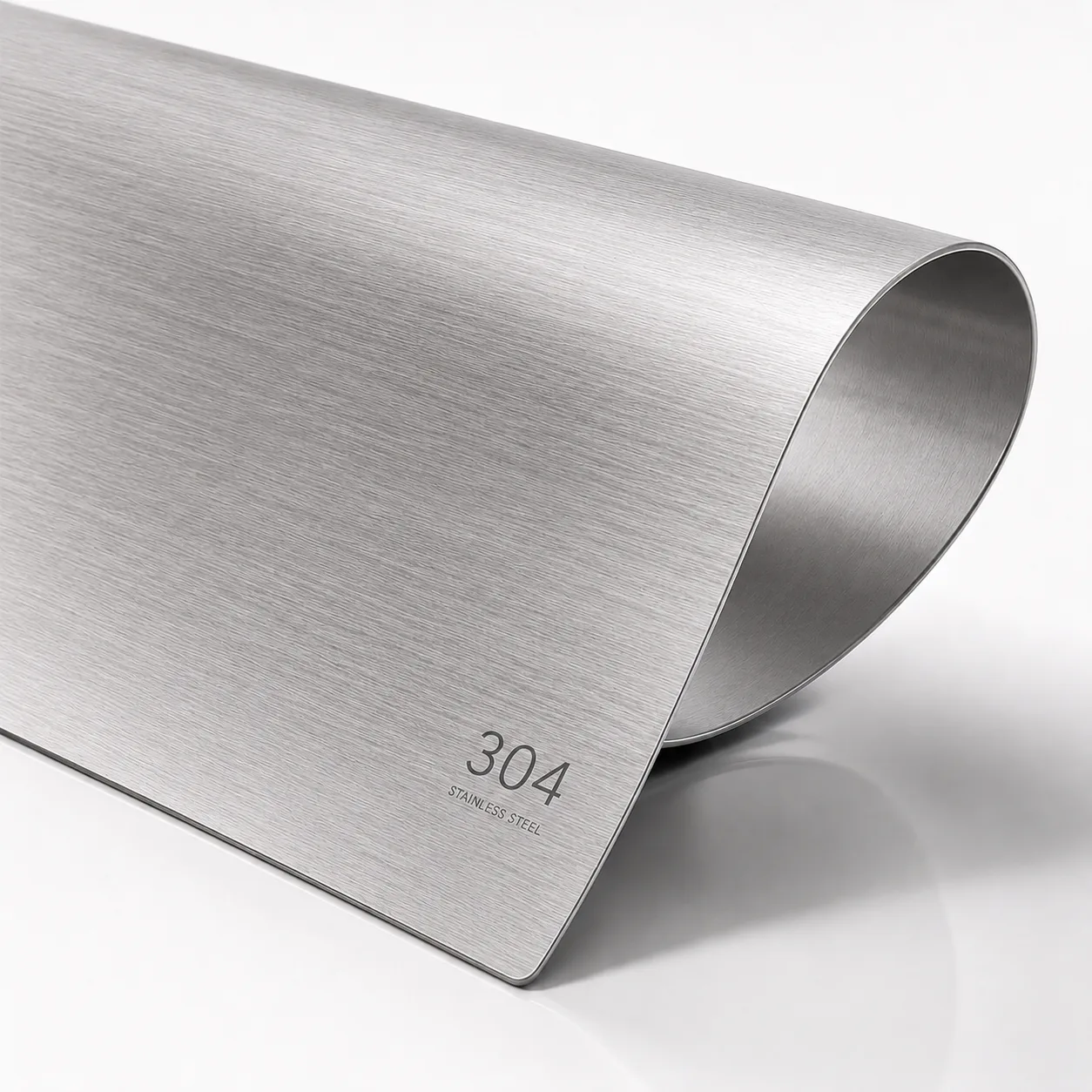
What 304 stainless steel is
304 is an austenitic chromium–nickel stainless steel — nominally 18% chromium, 8% nickel — which is why the European trade still calls it 18/8 and German drawings call it V2A (1.4301). The chromium forms the passive oxide film that resists corrosion; the nickel stabilises the austenitic structure that gives the alloy its formability and its non-magnetic character.
Two workshop-visible consequences follow. It work-hardens: bends and forming operations stiffen the material noticeably, which matters for multi-bend parts. And it picks up slight magnetism after cold work — a formed 304 enclosure corner will attract a magnet even though the flat sheet does not. That is metallurgy, not a grade substitution.
Typical properties for engineering reference
Typical annealed-sheet values are tabulated below. Confirm project-critical properties against the mill certificate — strength rises with cold work and varies with specification.
| Property | Typical value (annealed sheet) |
|---|---|
| Density | 7.93 g/cm³ |
| Tensile strength | ≥515 MPa |
| Yield strength | ≥205 MPa |
| Elongation | ≥40% |
| Corrosion resistance | General atmosphere, most acids, food contact — not chloride/seawater |
| Weldability | Excellent — TIG, MIG, spot and laser all standard |
| Magnetism | Non-magnetic annealed; slightly magnetic after forming |
How 304 behaves through fabrication
Laser cutting is the entry point for most 304 work — our laser line cuts stainless typically in the thinner window, holding ±0.1 mm on profiles, with a clean edge that usually goes straight to finishing. The laser edge on 304 is one of the reasons stainless enclosures can skip edge preparation that carbon steel would demand.
On the press brakes 304 forms well but work-hardens: a deep box with many bends is noticeably stiffer by the last bend than the first, and aggressive re-bending a feature that is already work-hardened is where 304 cracks. Plan the bend sequence once, from the flat pattern, rather than correcting on the machine. Welding is where 304 is genuinely easy — TIG for thin cosmetic seams, spot for enclosure bodies, laser welding for visible joints with minimal heat mark.
- Laser cutting: thin-gauge window, clean burr-light edges
- CNC bending: excellent formability, mind work-hardening on multi-bend parts
- TIG/spot/laser welding: all standard; distortion control on long seams
- Deep drawing: good draw behaviour for cups, housings and covers
Surface finishes that suit 304
304 is the standard substrate for the brushed (No. 4 / hairline) finish that defines stainless appliance and elevator panels, and bead blasting before passivation gives the uniform matte look common on equipment housings. Because 304 is steel, not aluminium, anodising does not apply — its protective-finish equivalents are passivation for corrosion performance and powder coating for colour.
One specification detail worth stating on the drawing: whether cosmetic surfaces must be protected with peel-coat film through fabrication. Brushed faces scratch, and protecting them through laser, bending and welding is a planning step, not an accident.
- Brushed finish (No. 4 / hairline): the signature stainless look
- Bead blasting + passivation: uniform matte with maximised corrosion performance
- Powder coating: when colour is required on a stainless body
304 vs 316 vs 201: the three stainless decisions
Three comparison questions cover almost every grade choice. Against 316: if the part sees chlorides — seawater, salt spray, de-icing salt, bleach or persistent condensation in a coastal install — 316's molybdenum earns its premium; otherwise 304 is the rational choice. Against 201: the low-nickel economy grade looks identical and costs less, but its corrosion reserve is thinner, and it is a false economy anywhere moisture sits. Both comparisons have their own page.
| Criterion | 304 | 316 | 201 |
|---|---|---|---|
| General atmosphere / indoor | Standard choice | Over-specification | Acceptable, dry indoor only |
| Chlorides / coastal / marine | Not recommended | The reason 316 exists | Not recommended |
| Food contact / medical | Standard choice | For aggressive washdown | Not recommended |
| Relative cost | Reference | Higher | Lower |
| Weld behaviour | Excellent | Excellent | More operator-sensitive |
Sourcing and how to specify it
304 sheet is sourced through our manufacturing supply chain in annealed 2B finish as standard, and in brushed or polished substrate when the finish schedule calls for it. On the drawing: "SUS304 / 1.4301", thickness, finish per face, and the note that matters most for cost — which faces are cosmetic and which are structure. A grade called "stainless" with undefined cosmetic faces is how brushed panels arrive scratched.
If the duty involves chlorides, washdown or outdoor coastal service, mention it in the RFQ rather than in the claim afterwards — the material conversation is cheapest at quotation and most expensive after anodised-looking rust bloom appears in the field.