
Sheet Metal Fabrication Cost: What Drives It
Nobody can quote a sheet metal part from the drawing alone, and any supplier who does is quoting a guess. What you can do is understand exactly which levers move the number, so you know which ones to pull. This page is the cost structure our own estimators work through on every RFQ.
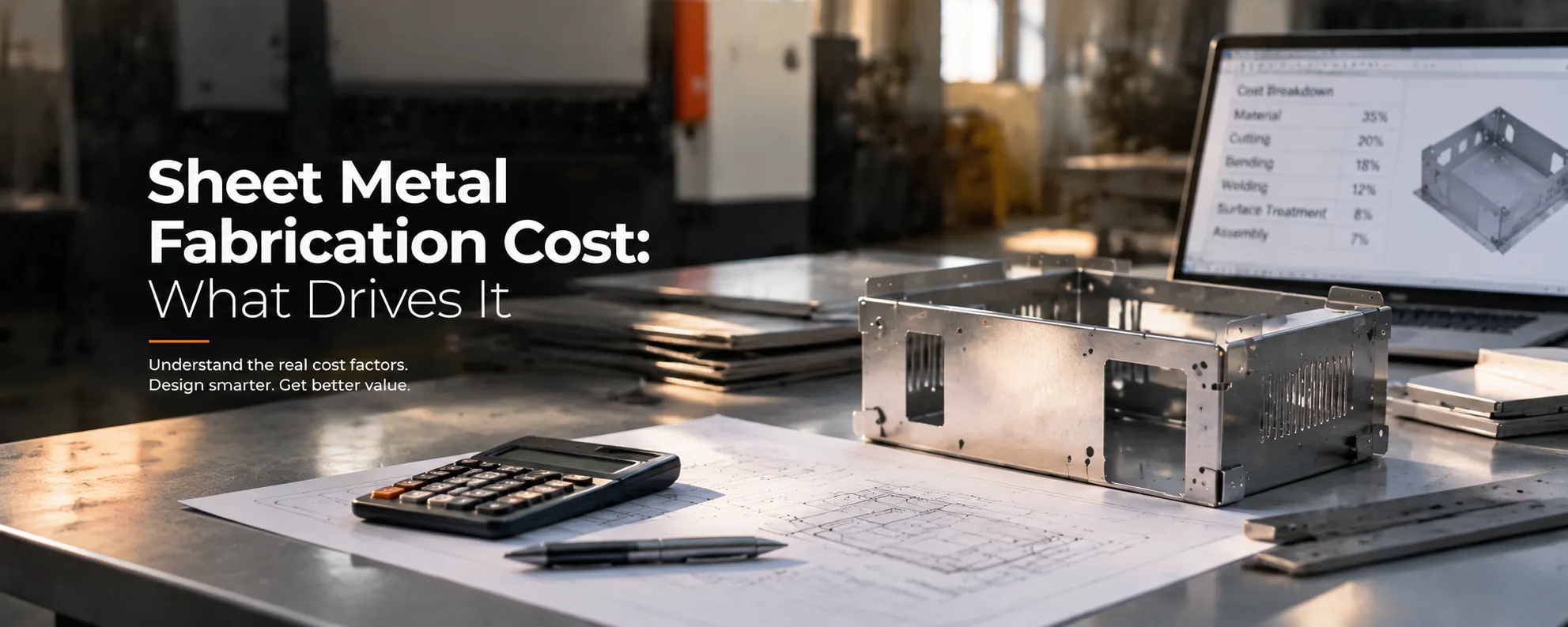
Sheet metal fabrication cost is the sum of material, cutting, forming, welding, finishing, tolerance, tooling, inspection and logistics. Material and cutting dominate thin flat parts; forming dominates parts with many bends; tooling dominates small quantities because a die is amortised over the batch.
Why is there no fixed price per sheet metal part?
Two identical-looking brackets can differ threefold in price depending on how many bends they carry, whether the drawing asks for ISO 2768-m general tolerances or ±0.1 mm on every dimension, and whether the order is 50 pieces or 5,000. Price is a function of the geometry, the quantity and the drawing, not of the material name.
That is why we publish drivers rather than a rate card. A published per-kilogram or per-bend rate would be wrong for most enquiries and misleading for the rest, and it would go stale the moment steel prices moved.
What are the nine cost elements in a sheet metal quote?
Every price we issue decomposes into the same nine elements. Understanding them is how you audit a quote from any supplier — including us.
| Cost element | What drives it | How it is reduced |
|---|---|---|
| Material | Grade, thickness, blank size and how well the nest uses the sheet | Right-size the thickness; allow parts to be nested together |
| Cutting | Total cut length, thickness, pierce count, nesting utilisation | Fewer holes, larger radii, group like-thickness orders |
| Forming | Number of bends, bend length, tooling changes, handling | Remove bends structurally; keep flanges to standard tooling |
| Welding / joining | Weld length, joint access, distortion control and clean-up | Design for the weld you can actually reach; avoid cosmetic welds |
| Finishing | Process, masked area, colour changes, batch size | Standard RAL colours; batch parts into one finish run |
| Tolerance | How tight the drawing asks for, and how much measuring it implies | Specify ISO 2768-m unless a feature genuinely needs tighter |
| Tooling | One-off die, fixture or programme cost, amortised over the quantity | Prototype without tooling; commit to a die only above break-even |
| Inspection | Sampling vs full FAI vs CMM reporting | Agree the inspection plan up front instead of defaulting to "report everything" |
| Packaging & logistics | Protection level, carton design, destination, Incoterm | Design packaging around the actual handling risk |
Why is material usually the largest cost element?
For a flat laser-cut part, material is typically the biggest line. Two decisions dominate: which alloy, and how much of the sheet ends up in the part rather than the scrap bin.
The second decision is often invisible on a drawing and worth more than the first. Nesting software packs parts onto a standard sheet, and total material utilisation across the sheet is what sets the real material cost per piece — not the theoretical weight of the part. Designing a bracket so it tessellates with its neighbours is a legitimate cost reduction, and worth discussing rather than discovering.
| Material | Typical use in sheet metal | Cost effect |
|---|---|---|
| Cold-rolled steel (SPCC) | Brackets, internal panels, chassis | Lowest material cost; needs a finish if exposed |
| Galvanised / zinc-coated (SGCC, SECC) | Outdoor and electrical enclosures | Small premium over bare steel; can remove a plating step |
| 304 stainless | Food, medical, outdoor, corrosion-critical | Material premium; harder on tooling and finishing |
| 316 / 316L stainless | Marine, chemical, sterilised equipment | Highest of the stainless grades; slower cutting |
| 5052 aluminium | Enclosures, housings, panels needing a light part | Material premium over steel; excellent formability |
| 6061 aluminium | Structural brackets and machined-and-formed parts | Higher than 5052; more prone to bend cracking |
| Copper / brass | Busbars, shielding, decorative parts | Highest material cost; usually specified for a function |
Why do buyers underestimate how quantity affects price?
Almost every cost element above has a fixed component. Setup, programming, tooling, first article and finishing batch preparation do not scale with quantity, so the price per part falls steeply at first and then flattens once the fixed cost is spread thin.
This produces a counter-intuitive result: two orders of the same part placed as 100 + 100 can cost materially more in total than a single order of 200. If demand is predictable, batching is one of the simplest ways to reduce unit cost without touching the design.
What we will not do
- Quote from a description without the CAD file and a quantity — the answer would be fiction.
- Publish a "typical" price per part, because the number depends entirely on the part.
- Hide tooling inside a per-piece rate to make a unit price look competitive. One-off cost is itemised, so you can see what you are buying.
How do you get an accurate sheet metal quote?
Send the 3D model or a dimensioned 2D drawing, the material and thickness, the quantity, the expected repeat rate and any inspection or documentation requirement. Include the finish and the colour. That is enough for an engineer to review manufacturability and return a costed quotation with any DFM observations — normally within one working day.
Frequently asked questions
Can you give me a rough price without a drawing?
Only as a range and only with caveats. Material, quantity and the number of forming operations are enough to bracket the cost, but the drawing decides which bracket you land in — bend count, hole count and tolerance callouts routinely change a price by a factor of two.
Does the cheapest quote mean the cheapest part?
No. A price built on optimistic tolerances, unstated tooling or an assumed finishing step usually returns as a concession request, a rework charge or a late delivery. Compare quotes on what is included: material certificate, first article, inspection report, finish specification and packaging.
How much does tooling add?
For laser-cut and bent parts, tooling is normally zero — the geometry lives in the programme. For stamped parts, a die is a one-off cost that scales with part size, station count and tolerance, and it only makes commercial sense above a break-even volume we calculate with you.
Can tolerances be relaxed to reduce cost?
Usually yes, and it is the single most common DFM recommendation we make. ISO 2768-m general tolerances cover the overwhelming majority of sheet metal features. Reserving a tight callout for the one feature that genuinely needs it removes inspection cost and skips a rework path.
Why did the price change between two identical enquiries?
Because material prices, batch sizes and finishing minimums move. Steel and aluminium indices change monthly, and a colour that requires a dedicated powder batch has a different minimum from a standard RAL. Ask for the quote validity window and the assumptions behind it.
Send the drawing, get a real answer
An engineer reviews your model for manufacturability and returns a costed quotation — with the DFM observations that would change the price.