
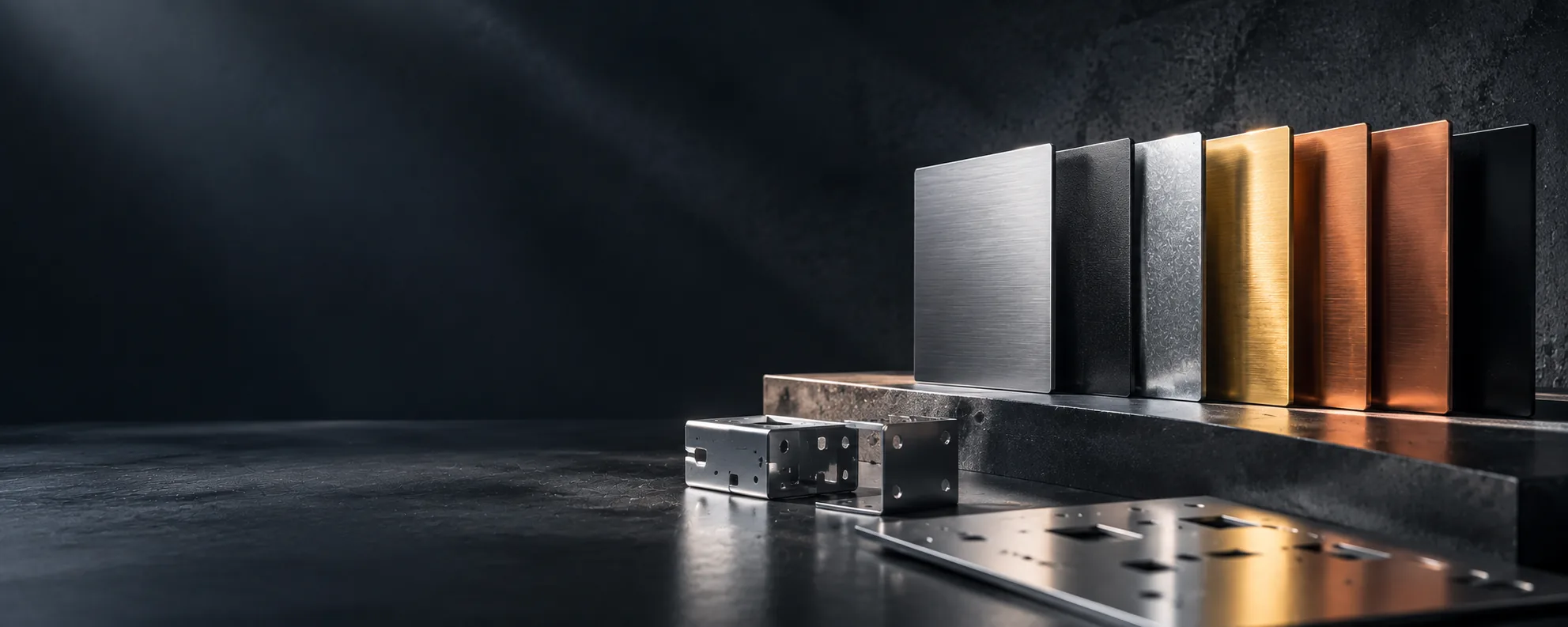
All 6 sheet metal finishes,
side by side
This page lists the specification of all 6 sheet metal finishes WERIX applies — powder coating, anodizing, electroplating, brushed, bead blasting and laser engraving — side by side: build-up, the base metals each suits, salt-spray and wear ratings, the standard each is worked to, and what to put on the drawing. Use it to shortlist a finish; open a finish for its substrate table, the specification notes and the masking it demands.
 Surface Finish Data Sheet
- 6
- finishes
- 8
- spec columns
- 1
- PDF sheet
The comparison matrix
The matrix below sets the six finishes against one another on the properties a drawing actually calls out. Open any finish afterwards for its substrate table and the masking its application demands — the detail pages carry the numbers the matrix can only summarise.
| Finish | Build-up | Base metals | Provides | Salt spray | Wear | Spec / standard | Key drawing note |
|---|---|---|---|---|---|---|---|
| Powder coating | 60–120 µm | Steel, stainless, aluminium, copper & brass | Exterior barrier + colour | 300–1000 hrs | High | Qualicoat-class systems; RAL / Pantone | Colour + finish type; mask threads, bores, earth |
| Anodizing | 5–25 µm (II) / 25–50 µm+ (III) | Aluminium only | Corrosion, wear, appearance | 336+ hrs (MIL-PRF-8625) | High | MIL-PRF-8625 (Type II / III) | Type II/III + thickness; sealing |
| Electroplating | Per ASTM B633 class (declared) | Steel, copper, brass | Sacrificial protection, conductivity, solderability, wear | 96–200 hrs (ASTM B456) | High | ASTM B633 (class + thickness) | Deposit + class + thickness; mask contacts; bake if high-tensile |
| Brushed | None — mechanical texture | Stainless, aluminium | Cosmetic grain only | Base-metal rating | Medium | No. 4 / hairline designation | Grain designation + direction |
| Bead blasting | None — surface texture | Stainless, aluminium, most metals | Cosmetic matte / prep | Base-metal rating | Medium | Bead media specification | Media (bead / ceramic), not "blasted"; Ra if needed |
| Laser engraving | 0.01–0.2 mm removal | All — anodised, steel, coated, plated | Permanent marking / traceability | n/a (mark only) | n/a | Depth + character height on drawing | Text + char height + font; depth; datum; before/after finish |
Powder coating
Powder coating is an electrostatic polymer film cured at temperature, typically 60–120 µm thick, giving the toughest chip-resistant finish on sheet metal. It covers laser heat marks and weld dressing, takes hundreds of RAL colours, and is the default exterior finish for steel enclosures.
Substrate suitability and the pretreatment it implies
| Substrate | Pretreatment | Notes |
|---|---|---|
| Cold-rolled steel (SPCC) | Degrease + phosphate conversion | The straightforward case; cut edges unprotected |
| Galvanised / zinc-coated (SGCC, SECC) | Degrease + zinc-matched conversion | Different chemistry from bare steel; skipping it causes blistering |
| Stainless 304 / 316 | Degrease + adhesion promoter | Coated for colour, not for corrosion protection |
| Aluminium 5052 / 6061 | Degrease + chromate conversion | Conversion layer required before powder for adhesion |
| Copper / brass | Degrease + adhesion promoter | Usually coated for appearance; plating is often the better route |
Worked to
- Film thickness 60–120 µm
- The range published on the finish spec; measured per batch
- Qualicoat-class powder systems
- Specification the coating product is selected against, not a certification WERIX holds
- RAL / Pantone colour reference
- Named on the drawing so the match is verifiable rather than interpretive
- ISO 9001 (WERIX)
- The only management-system certification held; finishing is partner-executed under our specification
What to put on the drawing
- Colour to a RAL or Pantone reference, with the finish type — gloss, satin, matt or textured.
- Film thickness range where the environment or a customer specification demands one.
- Which faces are cosmetic class A and which may be coated freely.
- Explicit masking for threads, bores, gasket lands, mating faces and earth points.
- Whether a conversion coating is required where the substrate demands it.
Anodizing
Anodizing converts the aluminium surface into an oxide layer rather than applying a film, typically 5–25 µm for Type II and 25–50 µm or more for Type III hard anodize. It is specified where appearance, corrosion resistance or wear resistance matters on aluminium.
Process type and the aluminium it suits
| Alloy | Type II | Type III | Notes |
|---|---|---|---|
| 5052 | Good — the usual choice for formed parts | Available | Best formability; clear or dyed |
| 6061-T6 | Good | Good | Colour takes differently from 5052 — cross-alloy matching has a limit |
| 3003 | Good | Limited | Soft, decorative applications |
| 7075 | Acceptable | Preferred | Hard anodize is the usual specification on high-strength grades |
| Cast / welded assemblies | Acceptable | Acceptable | Weld zones take colour differently from parent metal |
Worked to
- MIL-PRF-8625 Type II / Type III
- The specification the coating is worked to; not a certification held by WERIX
- Coating thickness 5–25 µm (II) / 25–50 µm+ (III)
- Measured and reported per batch
- Sealing stage
- Declared on the specification so the pores are closed, not assumed
- ISO 9001 (WERIX)
- Anodizing is partner-executed under our specification, inspection and delivery control
What to put on the drawing
- Type II or Type III, with the thickness range — the two are not interchangeable.
- Whether the finish is to be sealed.
- Colour to a standard where a dye is required, accepting a tolerance across alloys.
- Masking for threads, bores, mating faces and electrical contact areas.
- The dimensions that must survive the coating, so the growth is allowed for.
Electroplating
Electroplating deposits a metal layer — zinc, nickel, chrome, copper or tin — onto the sheet metal surface. It is the usual finish where electrical conductivity, solderability or sacrificial corrosion protection matters, and it is applied after forming, never before.
Deposit by function
| Deposit | Why it is specified | Note |
|---|---|---|
| Zinc | Sacrificial protection for steel | The default for enclosures; cut edges stay protected |
| Zinc-nickel | Higher corrosion resistance than zinc | Higher cost; for aggressive environments |
| Nickel | Wear resistance and appearance | Often specified on hardware and inserts |
| Chrome | Hardness and decorative brightness | Decorative chrome is thin; hard chrome is a different specification |
| Tin | Solderability and low-resistance contact | Common on busbars and connector tabs |
| Copper | Conductivity, or as an underlayer | Also selects for its thermal conductivity |
Worked to
- ASTM B633
- The zinc electrodeposit specification the coating is worked to, where the customer requires it
- Thickness and class designation
- Declared on the drawing and verified per batch
- Post-plating bake (high-strength steel)
- Specified where the material grade warrants it — see the embrittlement note
- ISO 9001 (WERIX)
- Plating is partner-executed under our specification and inspection
What to put on the drawing
- The deposit and, where a standard applies, the class and thickness.
- Which areas are masked and left bare — specifically every electrical contact and bonding face.
- Whether a post-plating bake is required, if the steel grade is high-tensile.
- That plating follows all forming operations, not precedes them.
- Any solderability or contact-resistance requirement that drove the deposit choice.
Brushed
Brushed finishing produces a directional satin grain by running an abrasive belt or wheel across the surface. It is the standard way to make weld dressing and handling marks disappear on stainless steel, and it produces a finish that fingerprints show less than on a polished surface.
Finish specified against substrate and purpose
| Finish | Typical substrate | Character |
|---|---|---|
| Hairline | 304 / 316 stainless | Fine, subtle directional grain |
| No. 4 | 304 / 316 stainless | Coarser, more visible grain; the industry default |
| Bead blasted | Stainless, aluminium | Non-directional matte; hides handling marks |
| 2B mill finish | Stainless (as supplied) | Smooth matte from the mill; no additional operation |
| Brushed over aluminium | 5052 / 6061 | Possible, but anodizing is usually preferred |
Worked to
- No. 4 / hairline grain designation
- Named on the drawing, since the two are not interchangeable
- Grain direction
- Specified per face; visible in the finished product
- Blending of dressed weld zones
- Required for a flush, single-texture appearance
- ISO 9001 (WERIX)
- Brushing is partner-executed where an industrial belt line is involved
What to put on the drawing
- Which faces are brushed and which are left at mill finish.
- The grain designation — hairline or No. 4.
- The grain direction, per face where it differs.
- Whether weld-dressed zones are to be blended to a single texture.
- Whether the environment requires a further treatment over the brushed surface.
Bead blasting
Bead blasting propels fine glass or ceramic beads at the surface to produce a uniform, non-directional matte finish. Unlike sand, which cuts, beads peen the surface — so the finish is softer, has no grain direction, and hides handling marks and tooling witness marks exceptionally well.
Blasting media and what each produces
| Media | Action | Typical result |
|---|---|---|
| Glass bead | Peening | Fine uniform matte; the default decorative blast |
| Ceramic bead | Peening | Longer media life; similar finish, more consistent over time |
| Aluminium oxide | Cutting | Coarser profile; used for adhesion preparation rather than appearance |
| Sand / silica | Cutting | Coarser finish, residue risk on stainless — avoid on corrosion-critical parts |
| Bead + anodize | Peening then conversion | Matte anodised appearance on aluminium |
Worked to
- Bead media specification
- Declared on the drawing where the surface is cosmetic
- Dedicated stainless media
- Process discipline; cross-contamination causes rust spotting
- Ra value
- Where a measurable surface roughness is required, specified and checked
- ISO 9001 (WERIX)
- Blasting is partner-executed where an industrial cabinet is involved
What to put on the drawing
- The media — bead, ceramic bead or abrasive — not simply "blasted".
- Which faces are blasted and which are protected.
- The Ra value where a measurable surface roughness matters.
- Whether the blasting is the final finish or a preparation for anodizing or coating.
- That stainless is blasted with dedicated media, if the part is corrosion-critical.
Laser engraving
Laser engraving marks the surface by removing or altering a shallow layer of material, typically 0.01–0.2 mm deep, leaving a permanent, high-contrast legend with no consumables. It is the standard way to apply part numbers, ratings, CE-style data plates and traceability marks that must survive the product life.
Mark type against substrate
| Substrate | Mark | Contrast |
|---|---|---|
| Anodised aluminium | Dye layer removed | High — pale mark on coloured surface |
| Bare stainless | Texture change | Moderate — reads under raking light |
| Powder-coated steel | Coating removed | High, but breaches the coating at that point |
| Bare steel | Surface displacement | Low until a colour fill or coating is applied |
| Plated steel | Deposit removed | Moderate; exposes the substrate at the mark |
Worked to
- Engraving depth
- Stated on the drawing; deep engraving needs multiple passes
- Character height and font
- Governs legibility and the minimum markable size
- Mark position datum
- Fixed from the same datum as the functional features, not from an edge
- ISO 9001 (WERIX)
- Laser marking is run in-house on our own fibre equipment
What to put on the drawing
- The exact text, character height and font, or the artwork file.
- Engraving depth, or a depth range, rather than "engraved".
- Mark position from a datum, not from a sheared edge.
- Whether the mark is applied before or after finishing — the order changes legibility.
- Whether a colour fill is required for contrast on a bare-metal substrate.
Common questions
Where next
Each finish page carries what the matrix cannot: the substrate table it applies to, the specification it is worked to, and the note it expects on your drawing.