
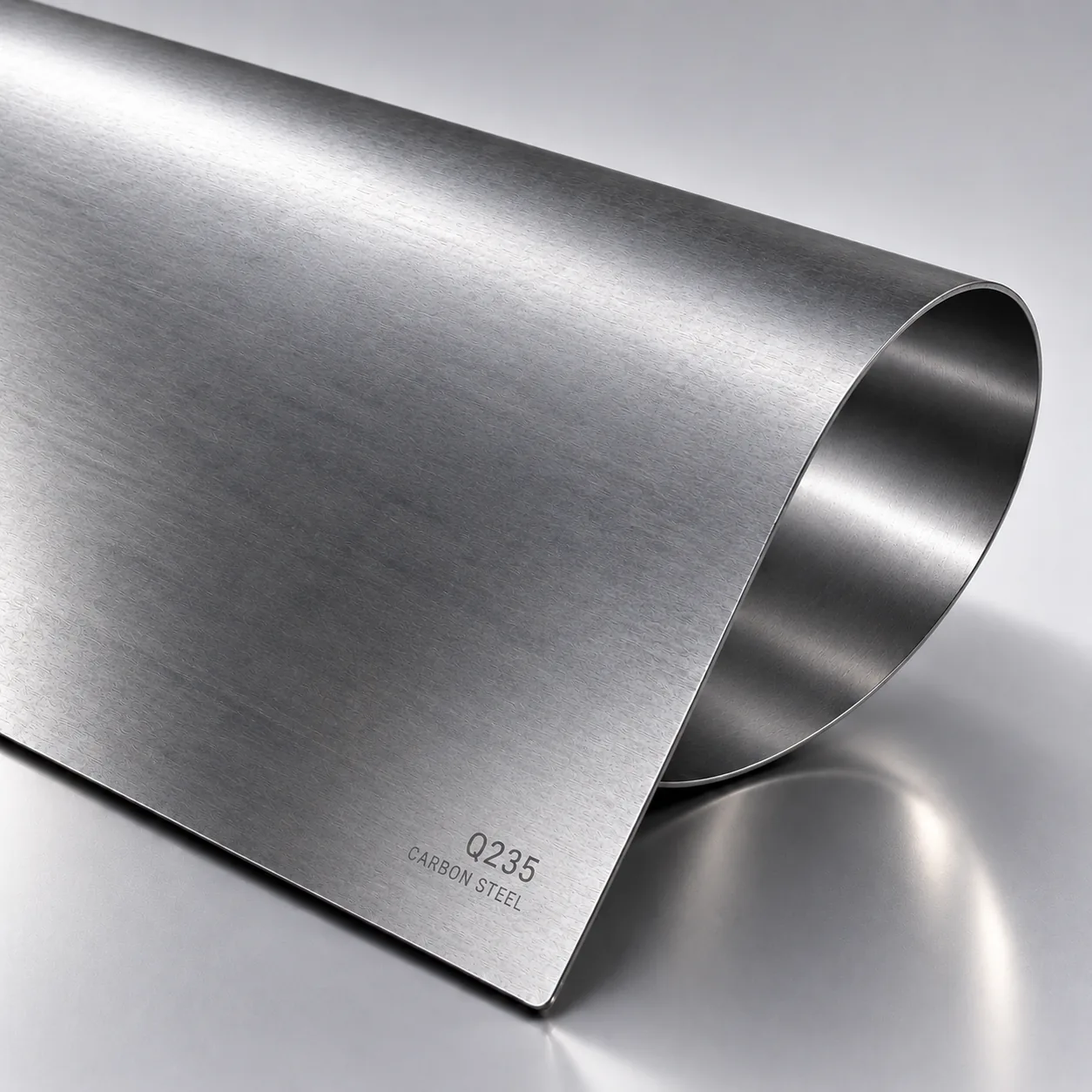
What Q235 is
Q235 is defined in GB/T 700, the Chinese standard for carbon structural steels. The designation is literal — Q for the Chinese word for yield, followed by the minimum yield strength in MPa — so Q235 guarantees at least 235 MPa yield, and Q345 guarantees 345 MPa. Quality grades (A, B, C, D) follow, controlling impact toughness and the allowable sulphur and phosphorus content; Q235B is the common general-purpose grade.
Chemically it is a plain carbon-manganese steel: low carbon, modest manganese, no deliberate alloying additions. That makes it cheap, weldable and predictable, but also means it will rust as soon as the surface protection fails — it has no inherent corrosion resistance of its own.
Cross-reference to common specifications
Grade equivalence is approximate: mechanical properties align, but the standards differ in chemistry limits and testing. Treat this as a starting point for a substitution discussion, not a certificate.
| Specification | Region | Notes |
|---|---|---|
| Q235 (GB/T 700) | China | The reference grade for this page; Q235B is the usual choice |
| S235JR (EN 10025-2) | Europe | Closest European equivalent in strength and role |
| A36 (ASTM A36) | United States | Similar structural role; slightly different chemistry limits |
| SS400 (JIS G3101) | Japan | Japanese structural equivalent |
| SPCC (JIS G3141) | Japan | Different material family — cold-rolled sheet for forming, not structural use |
Typical properties for engineering reference
Typical values for Q235 plate and sheet. Thickness affects the guaranteed yield, so confirm against the standard for the section being used.
| Property | Typical value |
|---|---|
| Minimum yield strength | 235 MPa |
| Tensile strength | ~370-500 MPa |
| Elongation | ~21-26% |
| Carbon content | Low carbon, no deliberate alloying |
| Density | 7.85 g/cm3 |
| Weldability | Good with standard processes |
| Corrosion resistance | None inherent — requires a coating, plating or paint |
| Typical thickness range | Wide; sheet gauges form well, heavier plate is structural |
Q235 against SPCC and Q345
Two comparisons come up constantly. The first is Q235 against SPCC: SPCC is a cold-rolled commercial-quality sheet, produced to tight thickness tolerance for forming, with no structural strength guarantee. Q235 is a structural steel. A bracket that carries a load wants Q235; a cosmetic cover formed from thin sheet usually wants SPCC. Confusing the two is how a part ends up either over-built or under-strength.
The second is Q235 against Q345. They are the same family, separated by yield strength, price and weldability — higher strength generally means more care in welding and forming. Specifying Q345 for a frame designed around Q235 is legitimate where weight matters, but it changes the welding procedure and is not a drop-in substitution.
Fabrication notes
Q235 cuts, bends, welds and machines without drama, which is exactly why it dominates structural work. Inside bend radii follow the usual relationship to thickness, and heavier plate may need a larger minimum radius or a hot forming route.
The one thing that cannot be skipped is surface protection. Bare Q235 will rust, so the specification needs a finish: powder coating, wet paint, zinc plating, or a hot-dip galvanised sheet grade where the application suits. Decide that at design stage — the finish choice affects edge quality and running geometry, not just appearance.