
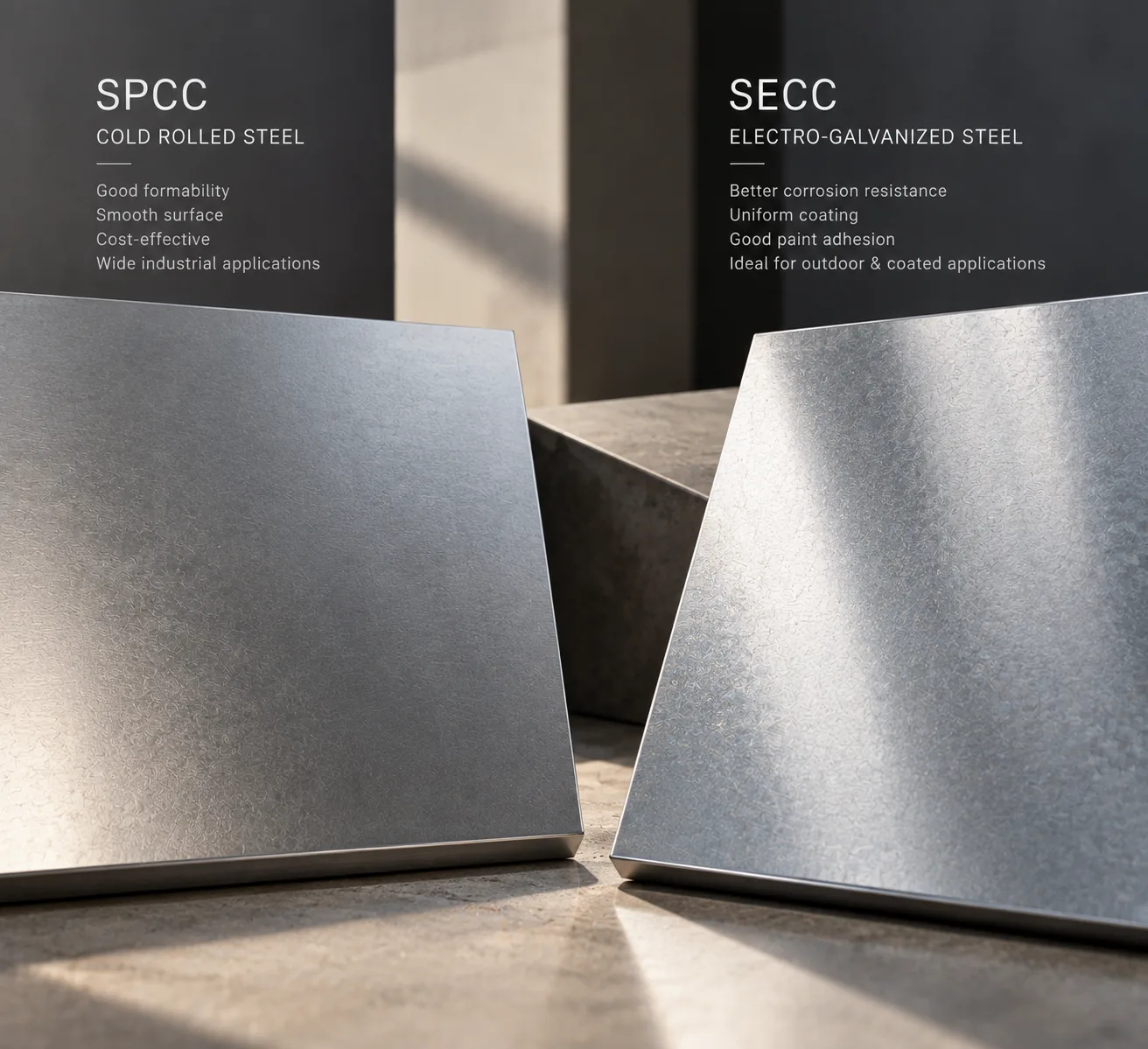
The one-decision framing
Bare SPCC has no corrosion protection of its own, so every SPCC part carries a finish: powder coat, zinc plating or a protected-oil state for customer-side processing. SECC short-circuits that choice for indoor duty — the zinc layer (a few microns per side) rides in from the mill, uniform and spangle-free, ready to weld, bend and paint.
So the question is never "which steel is better" — the base sheet is the same cold-rolled family. The question is whether protection arrives with the sheet (SECC) or is applied after fabrication (SPCC plus a finishing step). Volume, workflow and appearance decide that, not metallurgy.
Side by side
| Criterion | SPCC + finish | SECC |
|---|---|---|
| Base sheet formability | The benchmark — best-behaved bending we run | Same behaviour; coating survives SPCC-class radii |
| Corrosion protection | Whatever the applied finish provides | Built-in zinc, thin — indoor duty |
| Workflow | Fabrication → pretreat → finish (a plating batch if unpainted) | Fabrication → (paint optional) — plating step deleted |
| Paint result | Excellent over pretreatment | Excellent; uniform zinc makes an even base |
| Welding | Simplest | Standard with zinc-fume extraction |
| Outdoor duty | Only with heavy coatings | No — step up to SGCC |
| Sweet spot | Painted indoor enclosures, brackets, stamped parts at volume | Electronics chassis, thin walls, unpainted conductive-look hardware |
Where SPCC plus paint wins
When the part is painted anyway — and most indoor enclosures are — bare SPCC plus powder coating is the economic default. The paint is the protection; the sheet is the cheapest, best-forming steel available; and adding a zinc layer under paint on an indoor part rarely buys service life the paint was not already providing.
The other SPCC stronghold is stamped volume work: progressive dies run SPCC strip by the kilometre, its stretching behaviour is the most predictable, and the finish decision is made once for the whole production run downstream.
Where SECC wins
Electronics hardware is SECC's home: rack chassis, subracks, network cabinets and EMC-minded enclosures where the walls are thin, the parts are often unpainted inside, and the conductive zinc finish is either the intended look or a functional grounding surface. The coating tolerates tight bends without whitish flaking, so thin-gauge forming runs exactly like bare steel.
The second SECC argument is workflow economics: deleting a plating batch removes a supplier touch, its minimum charges and its lead time. At enclosure volumes that frequently nets cheaper than "SPCC plus zinc plate" — even where the sheet itself costs a little more.
The honest limit: electro-zinc is thin. It protects indoor duty and paint systems; it is not an outdoor grade. If the install description mentions weather, the comparison is not SPCC vs SECC — it is SECC vs SGCC, and SGCC wins outdoors.
Practical notes from the floor
- Laser-cut SECC edges are bare steel — fine indoors (the surrounding zinc protects them sacrificially), worth noting on drawings for humid duty
- Welded seams on SECC are bare after welding; indoor painted parts usually skip touch-up, humid-duty parts quote a zinc-rich pen mark
- Spot welding both grades is routine shop work; SECC just runs extraction for the zinc fumes
- Paint both grades over the same pretreatment line — the chemistry is shared