
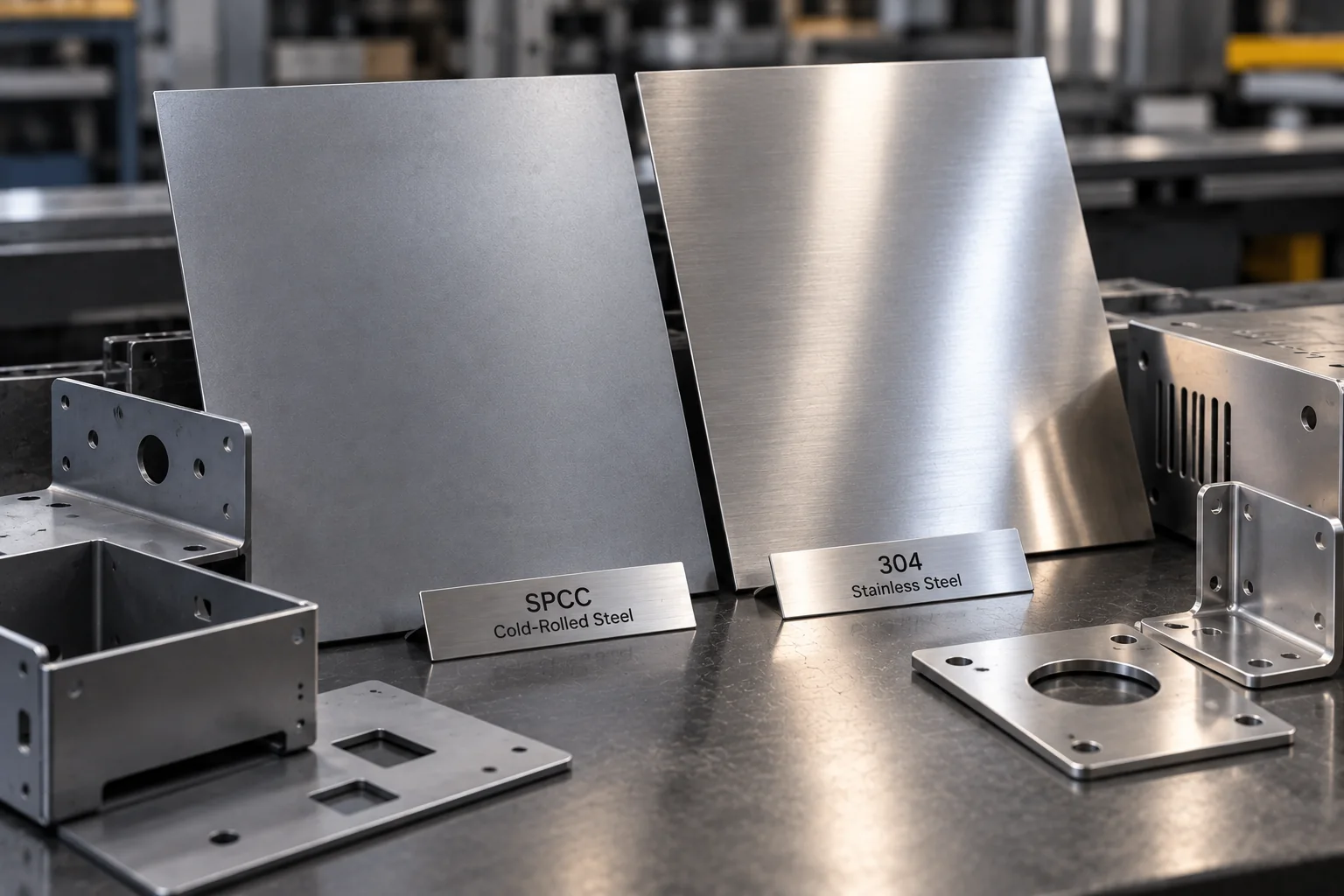
What SPCC steel is
SPCC is the Japanese Industrial Standards (JIS G 3141) designation for cold-rolled carbon steel sheet — the "CC" is cold-rolled commercial quality. Cold rolling gives the sheet its characteristics: tight thickness tolerance, smooth surface, and a fine-grained structure that bends and stretches predictably. It is the same family as the European DC01 and the German-led drawing designations some standards still carry, so a Western drawing calling DC01 or "cold rolled steel" is, in our supply chain, sourcing the same metal.
Two spec-level variants matter at quotation. SPCC-SD is the standard surface finish, and annealed (soft) condition is what bending work normally receives. The suffix letters on some drawings — SPCC-SB, SPCC-SD — describe skin-pass and surface state, and they change surface appearance and forming behaviour at the margins, not the essential material.
Typical properties for engineering reference
Typical values for commercial-quality SPCC are tabulated below. Mechanical properties vary with condition and thickness; confirm project-critical values against the mill certificate.
| Property | Typical value |
|---|---|
| Density | 7.85 g/cm³ |
| Tensile strength | ≥270 MPa |
| Yield strength | ~140–200 MPa (commercial quality) |
| Elongation | ≥36–38% — good forming behaviour |
| Corrosion protection | None — bare SPCC rusts; a finish is part of the spec |
| Bending / stamping | Excellent — the grade's reason to exist |
| Weldability | Excellent — spot, MIG, TIG all standard |
How SPCC behaves through fabrication
SPCC is the material that makes every process on our floor look its best. On the laser it cuts in the thickest window — mild steel runs up to around 5 mm on our line — with fast speeds and clean edges. On the press brakes it forms with the most forgiving behaviour of any material we run: tight radii, hems, and the multi-bend sequences that enclosure bodies demand. In the stamping shop it is the default strip material for progressive dies, where its consistent stretching behaviour is what a die designer is really buying.
Welding is equally unremarkable — in the good sense. Spot welding runs at settings refined over decades of carbon steel work, and TIG or MIG on brackets and frames needs no alloy-specific care. The one place SPCC asks for thought is the finish interface: weld spatter, laser oxide and press-brake marks all need to come off before coating, which is why the finishing workflow includes pretreatment as a standard step, not an optional one.
- Laser cutting: fastest and thickest window of our common materials
- CNC bending: most forgiving formability; hems and tight radii routine
- Progressive die stamping: the default strip material
- Welding: all processes standard; pretreatment before finishing
Finishes: the other half of the specification
Because SPCC has no corrosion protection of its own, the finish decision is a material decision. Powder coating is the volume answer — durable colour in any RAL, and the standard pairing for indoor enclosures and brackets. Zinc plating protects parts that stay bare-coloured or sit indoors in humidity, and pairs with the clear, yellow or black passivations. For outdoor duty, the galvanised family (SECC, SGCC) replaces the plating step with the coating built into the sheet, which is usually the cheaper path at volume.
The decision table below is the one we apply at quotation. Its logic is duty first, appearance second, process cost third — in that order.
| Duty | Finish we quote | Why |
|---|---|---|
| Indoor enclosure, colour required | Powder coating | Durable, any RAL, hides handling marks |
| Indoor bracket, no colour | Zinc plating | Corrosion protection without paint |
| Outdoor part | Switch sheet to SGCC | Coating built into the sheet beats applied coatings outdoors |
| Electronics chassis, thin walls | Switch sheet to SECC | Uniform thin zinc layer, welds and paints well |
| Automotive-adjacent, severe duty | E-coat or zinc + topcoat | Layered protection for demanding cycles |
SPCC vs SECC vs SGCC: choosing the steel family
The three grades are one family seen from the coating side: SPCC is bare cold-rolled steel, SECC is the same base electro-galvanised with a thin uniform zinc layer, SGCC is hot-dip galvanised with a substantially thicker zinc layer. The comparison pages cover the pairwise decisions; the short version is indoor-painted → SPCC, electronics-thin → SECC, outdoor → SGCC.
Sourcing and how to specify it
SPCC is sourced through our manufacturing supply chain against your drawing's grade callout and thickness; where a Western drawing names DC01 or a generic "mild steel CR4", we map it and confirm the equivalence at quotation. Specify the finish on the same line as the material — "SPCC-SD 1.5 mm, powder coat RAL 7035" — because a bare-steel callout without a finish is an incomplete spec, and we would rather complete it with you than assume.
For stamped volumes, the thickness decision is worth a minute with the cost model: material dominates flat stamped parts, and one gauge step down — where stiffness allows — usually saves more than any process change downstream.