
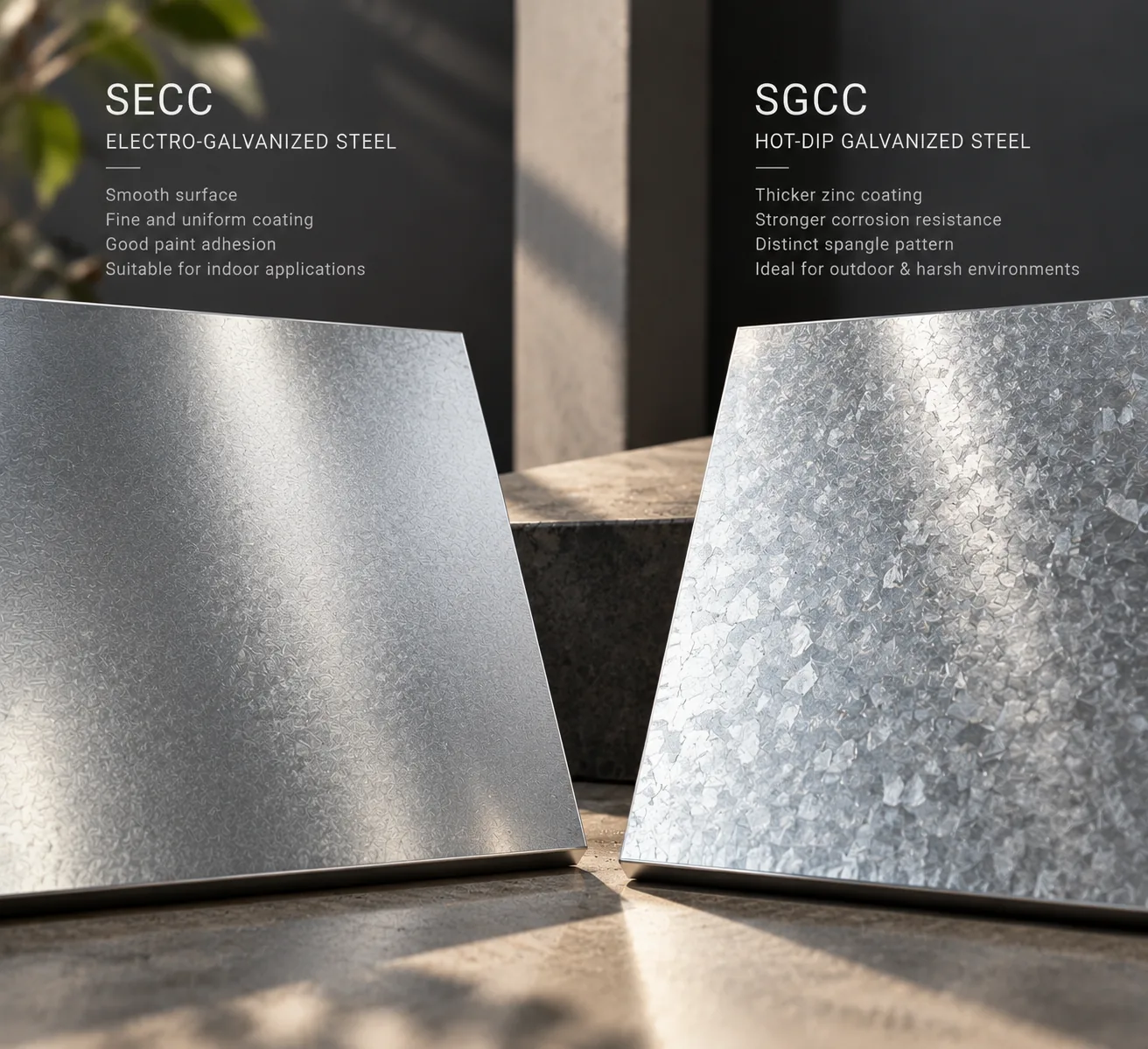
Two coatings, two purposes
SECC's electro-zinc (around Z04–Z10, a few microns per side) exists to be unobtrusive: thin enough to weld, bend and paint exactly like bare steel, uniform enough that electronics manufacturers made it the indoor default. Its protection reserve is real but shallow — sized for indoor air and paint systems.
SGCC's hot-dip layer (Z80 and heavier classes) exists to survive: a metallurgically bonded zinc blanket that corrodes slowly outdoors and, crucially, sacrifices itself at scratches and cut edges to protect the exposed steel. That sacrificial mechanism is why galvanised parts tolerate real-world damage far better than painted bare steel — the coating keeps working after a chip that would doom a painted part.
Side by side
| Criterion | SECC (electro) | SGCC (hot-dip) |
|---|---|---|
| Coating | A few µm per side, uniform, spangle-free | Z80+ — ~10× thicker, metallurgically bonded |
| Corrosion mechanism | Barrier — thin reserve | Barrier + sacrificial at damage |
| Indoor electronics duty | The default | Overkill; heavier coating at tight bends |
| Outdoor duty | Not designed for it | The purpose — inland at Z80, heavier for coastal |
| Bending | SPCC-class radii, no flaking | Radii ≥ 1× thickness to respect the coating |
| Surface | Bright, uniform — paint or bare as designed | Spangle pattern; usually painted outdoors |
| Welding | Standard with extraction | Standard with extraction; touch-up at welds outdoors |
The outdoor line, drawn precisely
SECC outdoors fails in the predictable way: the thin reserve consumes itself, first at scratches and cut edges, then generally. The timeline depends on the climate, which is why we quote duty rather than a blanket year count — but the design intent is unambiguous. SGCC is the grade for weather.
Within SGCC, the coating class is the specification that matters. Z80 covers typical inland outdoor enclosure duty; coastal, industrial-aggressive or severe-exposure projects quote heavier classes. Naming the installation site in the RFQ sizes the coating correctly — it is the cheapest line item on the drawing and the one that decides field life.
Indoor, the comparison mostly evaporates
Indoors, both grades protect adequately, and the decision reverts to fabrication and appearance. SECC's uniform bright finish and thin coating make it the better citizen for thin walls, tight bends and paint systems. SGCC's spangle telegraphs through thin paint films and its coating stiffens very tight bends — both manageable, both reasons the electronics industry standardized on SECC for interior hardware.
Cost sits in the same register for both; the coated-sheet premium over bare SPCC is similar, and either grade's real economic comparison is against "SPCC plus a plating step" rather than against each other.
Fabrication notes that matter to buyers
- Both grades laser-cut and weld in the standard mild-steel window with zinc-fume extraction
- SGCC cut edges and weld zones get zinc-rich touch-up on outdoor parts — a two-minute step that keeps the sacrificial network continuous
- SGCC bend radii stay at or above one material thickness; SECC takes SPCC-class radii
- Painted outdoor parts are "SGCC substrate + powder top coat", with pretreatment and film build specified per project — two layers doing two jobs