
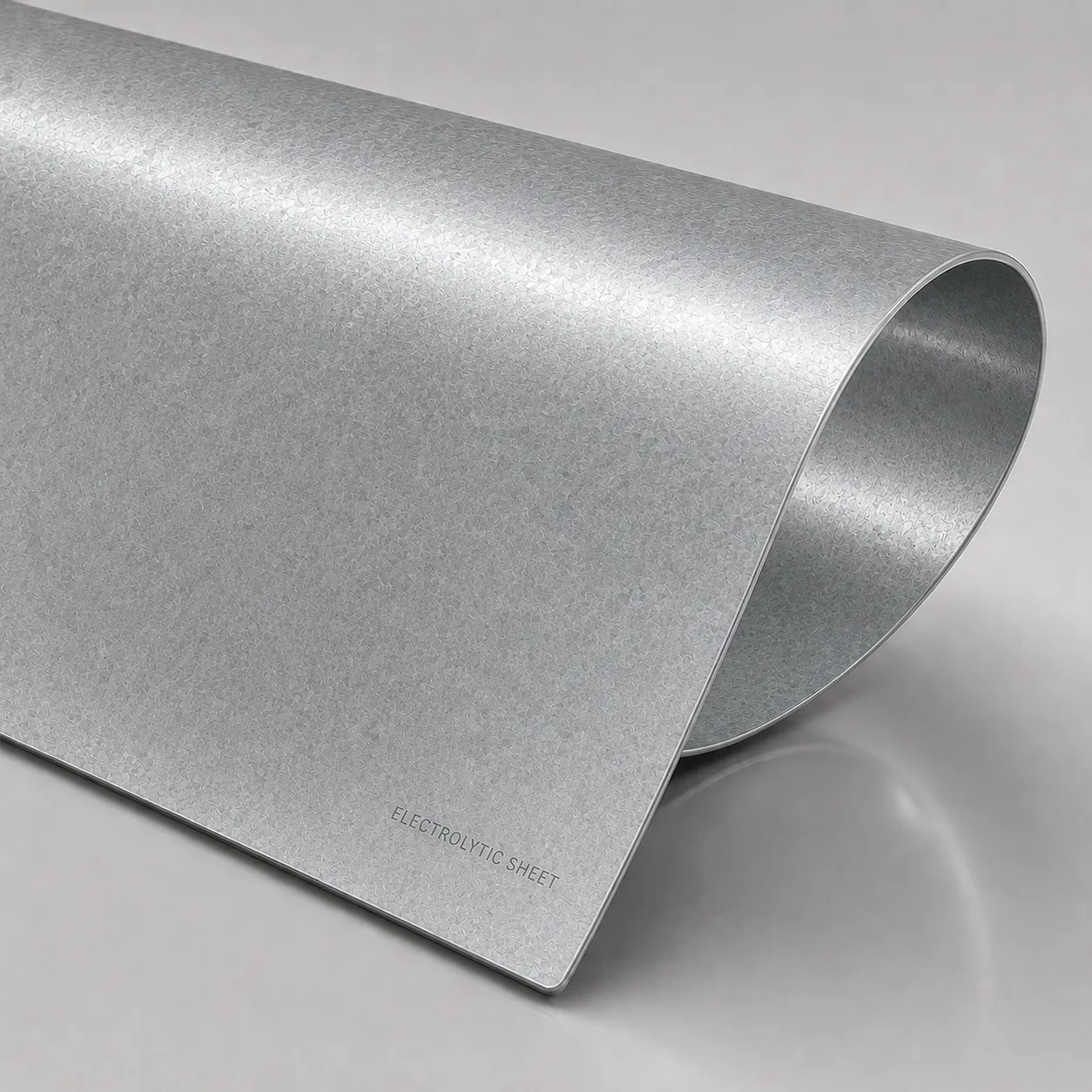
What SECC steel is
SECC is electro-galvanised cold-rolled steel per JIS G 3313: an SPCC-family base sheet with zinc applied electrolytically, typically in coatings around Z04 to Z10 — a few microns per side. Because the zinc is deposited rather than dipped, the layer is thin, uniform and spangle-free, which is precisely what painting, welding and tight forming want.
The trade against hot-dip galvanised (SGCC) is corrosion reserve: microns of electro-zinc protect indoor duty and paint systems well, but cannot match the 60–80+ g/m² hot-dip layer outdoors. The trade against bare SPCC plus plating is workflow: the zinc arrives with the sheet, so the part skips a plating batch — fewer supplier touches, no plating minimums, and no plated-edge inconsistencies at holes.
Typical properties for engineering reference
The base sheet carries SPCC-class mechanical properties; the coating adds the corrosion layer and a few points of specification detail below.
| Property | Typical value |
|---|---|
| Base sheet | SPCC-family cold-rolled steel |
| Coating | Electro-zinc, ~Z04–Z10 (microns per side), uniform, spangle-free |
| Tensile strength | ≥270 MPa (base sheet) |
| Corrosion duty | Indoor and painted systems; not an outdoor grade |
| Forming behaviour | Bends like SPCC; coating tolerates tight radii without flaking |
| Welding | Spot and MIG standard — zinc fume extraction is the house rule |
| Paint behaviour | Excellent adhesion over the standard pretreatment |
How SECC behaves through fabrication
Forming is the pleasant surprise for first-time specifiers: the electro-zinc layer is thin and adherent enough that SECC bends at SPCC radii without whitish flaking at the bend line, which is the visual tell that separates it from thicker hot-dip coatings. Enclosure bodies, chassis and rails are therefore bent, hemmed and clinched exactly as bare steel would be.
Welding has one house rule worth knowing as a buyer: zinc vaporises at welding temperature, so spot and MIG work on SECC runs with extraction and slightly adjusted settings. It is routine work — every electronics chassis in the industry welds zinc-coated steel — but it is the reason weld areas on SECC parts are sometimes specified bare or re-zinc-touch-up after welding, and it is why the drawing should note whether weld seams are cosmetic.
Powder coating over SECC is the standard finish route: the uniform zinc makes an even base under paint, and the pretreatment chemistry is the same line bare steel runs on. Brushed finishes do not apply — there is no bare-steel grain to brush — so cosmetic SECC parts are usually painted or clear-coated.
- Laser cutting: standard mild-steel window; cut edges are bare steel and take touch-up
- CNC bending: SPCC radii, no coating flaking at the bend
- Spot/MIG welding: standard with zinc-fume extraction; note cosmetic seams
- Powder coating: the default finish; any RAL
SECC vs SPCC vs SGCC: the three-way decision
The three grades are a decision about where corrosion protection lives. Bare SPCC pushes protection entirely into the finish — right for painted indoor parts and maximum economy. SECC builds a thin zinc layer into the sheet — right for electronics hardware, thin sections and paint systems that want a uniform base. SGCC builds a thick layer in — right for outdoor duty. The pairwise comparisons are on their own pages; the table is the summary we work from.
| Criterion | SPCC + finish | SECC | SGCC |
|---|---|---|---|
| Corrosion protection | Whatever the finish provides | Thin, uniform, built-in | Thick, built-in |
| Outdoor duty | Only with heavy coatings | No | Yes |
| Electronics enclosure (indoor) | Fine when painted | The default | Overkill + heavier coating at bends |
| Welding | Simplest | Standard with extraction | Standard with extraction |
| Workflow | Coating step after fabrication | No plating step | No plating step |
Sourcing and how to specify it
SECC is sourced through our supply chain against coating weight and base-sheet spec; the common callouts (SECC-Z10, SECC-N5 with the N indicating a zinc–nickel variant for slightly higher corrosion reserve) map to your drawing at quotation. Specify coating class where the drawing carries one, and note whether cut edges and weld seams need zinc-rich touch-up — on indoor painted parts they usually do not, and skipping that line item is real savings at volume.
If the duty is indoor electronics hardware, SECC is probably already the right answer and we will confirm it fast. If the drawing says SECC but the install is outdoor, flag it in the RFQ — one grade step to SGCC at quotation is cheap; a rusted chassis in the field is not.