
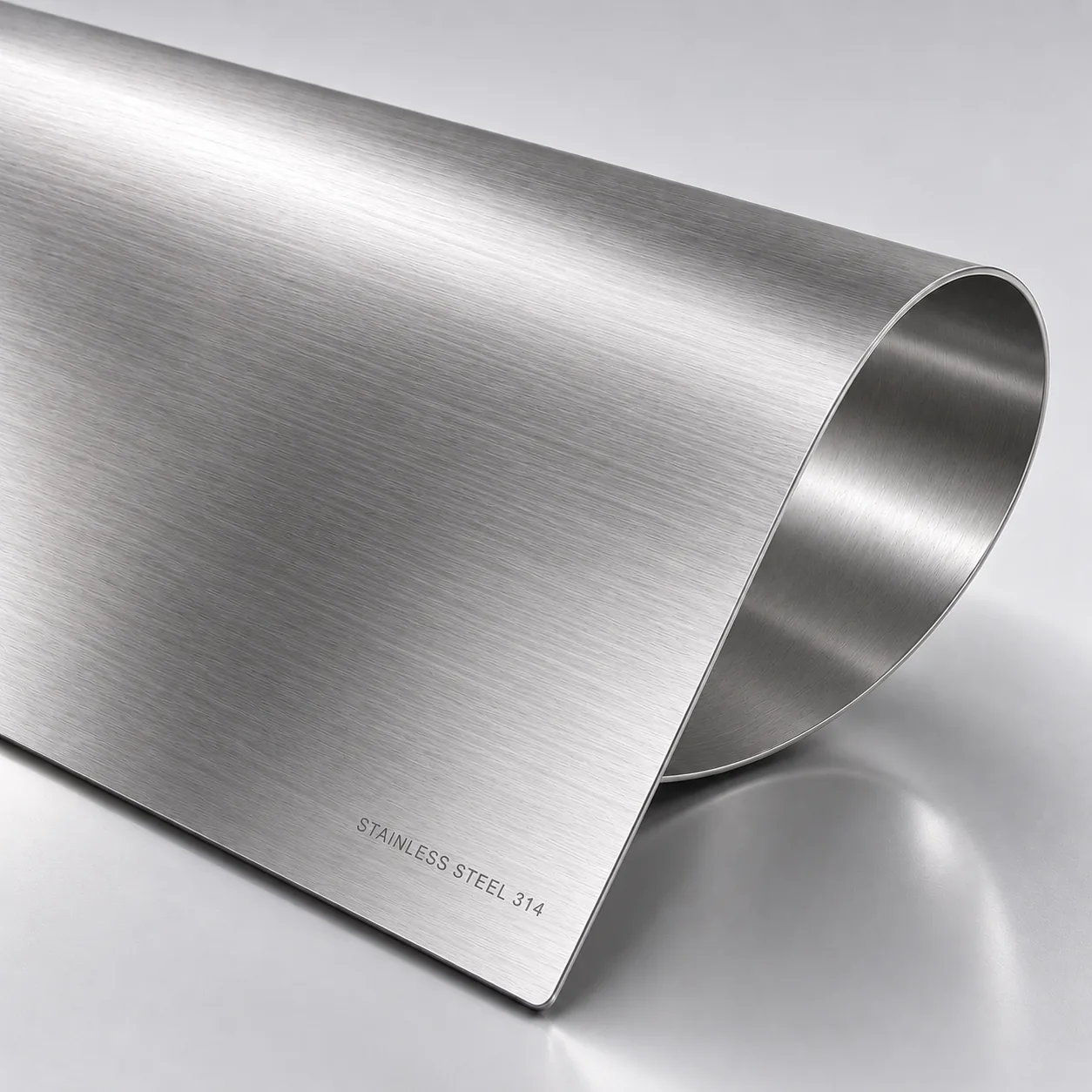
What 314 stainless is
314 is a high-chromium, high-nickel austenitic stainless with deliberate silicon addition, sitting in the same family as 310 and 309. The austenitic structure gives it the same formability and weldability behaviour as 304 and 316, and the same corrosion behaviour: good in general atmospheric conditions, without the molybdenum that makes 316 a chloride grade. It is not a corrosion grade. It is a heat grade.
The silicon — 1.5% to 3.0%, against effectively zero in 304 — is what separates it. Silicon promotes a compact, adherent chromium-rich oxide scale that grows slowly and does not spall as the part cycles through temperature. That scale is the reason 314 holds its oxidation resistance where 304 begins to attack noticeably above roughly 800°C and 316 starts to creep in continuous service above about 900°C.
Typical properties for engineering reference
The figures below are typical values for annealed 314 sheet as used for service-temperature selection. Actual properties vary with supplier, specification, thickness, product form and applicable standard, so project-critical requirements should be confirmed against the material certificate and against the actual service temperature profile.
| Property | Typical value (annealed) |
|---|---|
| Density | 7.98 g/cm³ |
| Tensile strength | ~620 MPa |
| Yield strength | ~310 MPa |
| Elongation | ~40% |
| Continuous service in oxidising atmospheres | Up to about 1100°C |
| Oxidation/scale behaviour | Adherent, slow-growing silica-plus-chrome scale |
| Weldability | Good — matching 309/312 filler; preheat not normally required |
| Corrosion resistance | General (austenitic); no molybdenum, so not a chloride grade |
How 314 behaves through fabrication
On the shop floor 314 is unremarkable, which is the point: it cuts, bends and welds much like 310 and better than many people expect. On the laser it runs in the same thin-gauge window as 304 and 316. On the press brake it forms readily — the austenitic structure is ductile, and the silicon does not interfere with forming at the gauges we normally quote.
The one real caution is high-temperature welding. Because 314 is a heat-resistant grade, welding it into a part that will see continuous high temperature requires the filler to match — 309 or 312 are the standard choices, and using a 304 filler on a 314 joint is a downgrade that will show up as a corrosion or oxidation site in the heat-affected zone. For a room-temperature part that merely happens to be 314, welding behaves well with normal austenitic procedures.
- Laser cutting: same thin-gauge window as 304 and 316
- CNC bending: ductile austenitic forming; no special radii needed
- Welding: matching 309/312 filler for high-temperature service; normal procedures otherwise
- Not a deep-draw grade in practice — 314 parts are formed, not drawn
The honest comparison: 314 vs 304 and 316
The failure mode we most often see is 314 specified where 304 would have done, because a drawing inherited the grade from a hot-looking assembly that turned out to run at ambient temperature. That specification is not dangerous, it is just expensive: 314 carries a substantial premium over 304, and the premium buys nothing at room temperature.
Against 316, the question is whether the service is hot, wet, or both. If the duty is continuous heat, 314 wins outright and 316 is the wrong answer regardless of price. If the duty is chloride exposure at moderate temperature, 316 wins and 314 offers no chloride resistance advantage at all — its molybdenum-free chemistry is 304-level in that environment. Parts that see both, in a marine or chemical setting at elevated temperature, are a genuine engineering conversation rather than a catalogue pick, and we would rather have it early.
| Duty | Correct grade | Why |
|---|---|---|
| Continuous high temperature, above ~900°C | 314 | Silicon-bearing scale resists oxidation where 304 and 316 do not |
| Hot atmosphere, moderate temperature | 304 usually sufficient | 314's advantage narrows below its useful range |
| Chloride exposure, ambient or moderate heat | 316 | Molybdenum content, not silicon — 314 gives no chloride advantage |
| Marine atmosphere, room temperature | 316 | Same reason: 314 is a heat grade, not a chloride grade |
| Dry indoor, room temperature, no heat | 304 | 314 is a pure over-specification here |
| Cost-sensitive hot part with no moisture | 310, or 304 if temperature is moderate | Depends entirely on the true service temperature |
Finishes and what to specify with the RFQ
Because the duty is heat rather than appearance, 314 parts are usually specified bare or with a passivation step after welding, not with a decorative finish. A passivation pass restores the passive film disturbed by the weld heat-affected zone, and on a high-temperature part it is the sensible default. Decorative finishing is possible but rarely the point, and a coating that will fail at service temperature is worse than no coating at all.
The most useful thing to send with an RFQ is the service profile rather than the grade: the working temperature, how continuous it is, whether the atmosphere is oxidising or reducing, and whether the part sees moisture. Send the drawing with 314 called out and no temperature information, and the specification conversation will happen anyway — having it before quoting is simply faster.
- Passivation after welding: the sensible default on high-temperature parts
- Bare scale: normally acceptable on continuous-heat parts — the scale is the protection
- Decorative finishing: possible, but specify the service temperature before choosing it
Sourcing and how to specify it honestly
314 sheet is sourced through our manufacturing supply chain like every other grade on this page; the specification question is never stock, it is fitness. If a drawing names 314 and the part runs at room temperature, we will raise it — the correct grade is usually 304, and the saving is significant. If a drawing names 304 and the part sits in continuous heat, that is a service failure waiting to happen, and it is worth catching at the quotation stage rather than at the first inspection.
That is the whole argument for specifying by duty instead of by habit: for a grade like 314 the gap between the right answer and the habitual one is not a small price difference, it is the difference between a part that lasts and one that scales away.