
Metal Stamping Cost: Tooling, Volume and Break-Even
Stamping is the cheapest way to make a metal part at volume and one of the most expensive ways to make one at all. The entire commercial question is where your quantity sits relative to the tooling break-even — and the answer is a calculation, not an opinion.
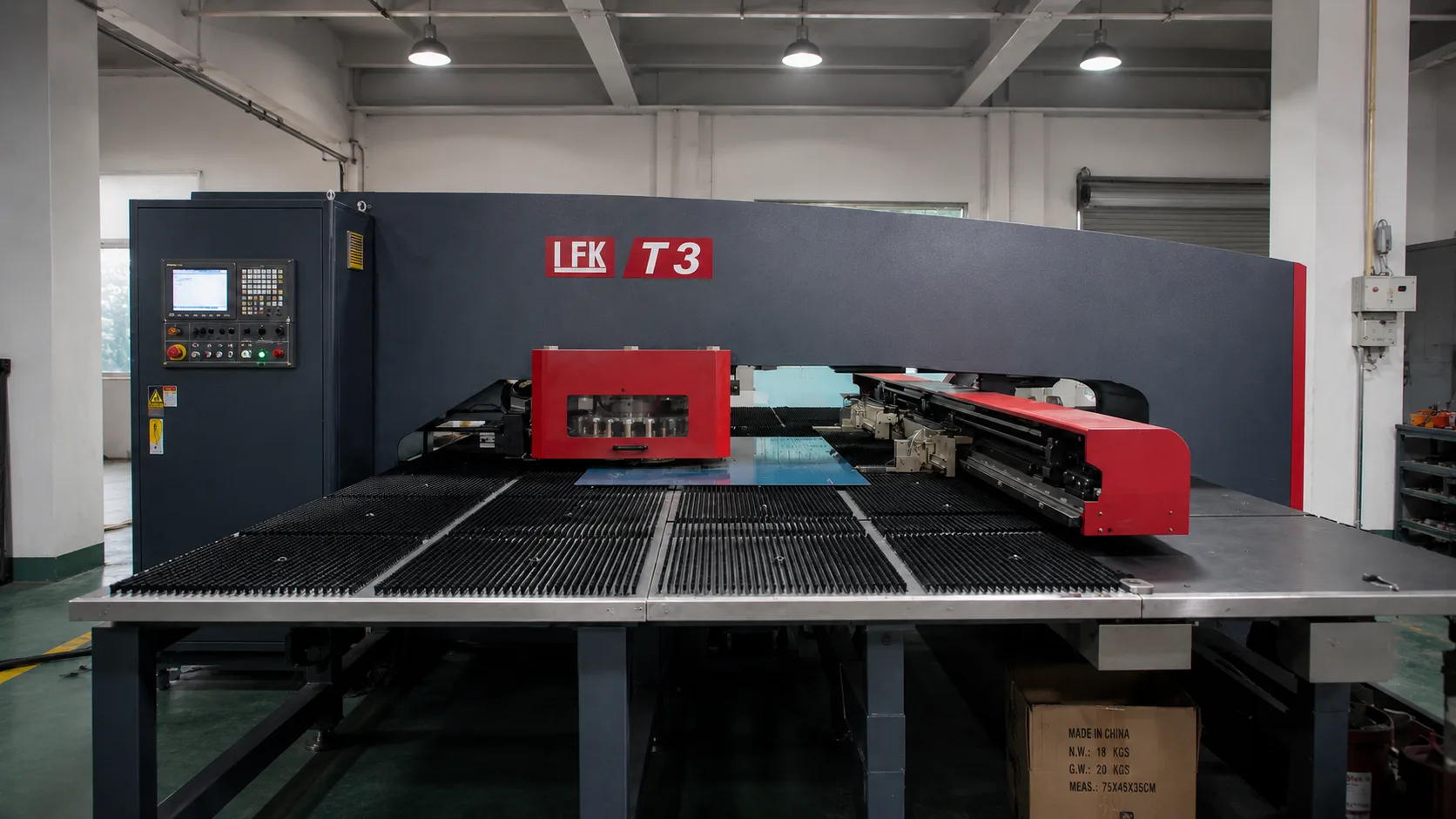
Metal stamping cost has two parts: a one-off tooling cost to build the die, and a per-part cost that falls as volume rises. Below the break-even volume, laser cutting or bending is cheaper; above it, stamping wins because machine cycle time no longer scales with feature count.
What makes up a stamping part’s price?
Every stamped part carries a die. That die is designed, cut, assembled, tried and maintained, and its cost is a one-off payable once. The per-part price then reflects material, press time, any secondary operations and inspection.
Because tooling is fixed, the amortised tooling cost per piece falls as quantity rises, while the per-part cost falls more slowly (driven by material and cycle time). Plotted against quantity, the total cost per part drops steeply and then flattens — and the point at which it crosses the bending or laser route is your break-even.
What drives the cost of a stamping die?
| Driver | Why it matters |
|---|---|
| Part size and press tonnage | Bigger parts need bigger presses, larger die sets and more material per station |
| Number of stations | Each forming or piercing operation needs its own station; more stations, more die |
| Tolerance and edge quality | Tight tolerances need more stations, better guides and more try-out time |
| Material and thickness | Harder and thicker material accelerates wear, requiring better die materials |
| Feature complexity | Deep draws, undercuts and fine details increase design and try-out effort |
Tooling cost drivers
Which stamping method should you choose?
The tooling type is chosen from geometry and volume. A progressive die spreads the operations across stations and delivers a finished part per stroke, which suits high volumes of small to medium parts fed from coil. A compound die performs blanking and piercing in one stroke, which suits flat parts needing accuracy and modest volumes. Transfer dies handle large parts that cannot be fed as a strip. Fine blanking produces a smooth, clean-cut edge and tight tolerances in one stroke, removing secondary machining but requiring a purpose-built press.
Choosing wrongly is expensive in both directions: a progressive die on a part with no volume wastes tooling money, while a compound die on a million-piece family wastes cycle time on every stroke for years.
Why do secondary operations belong in the stamping cost model?
A stamped part is rarely finished when it leaves the press. Deburring, tumbling, tapping, insert pressing, plating, painting, assembly and packing all add cost, and several of them are batch operations with their own minimums. A part that needs a dedicated plating batch is not a cheap part no matter how fast it stamps.
The same applies to inspection. High-volume parts are normally controlled by sampling and gauges, but a first article is done on the die and any customer-specific reporting is priced in. Agreeing the inspection plan before tooling is cut prevents the awkward conversation later.
When should you not choose stamping?
- Annual volume below the break-even against laser cutting and bending — the die will never pay for itself.
- Design not yet frozen — every engineering revision after the die is cut is a die modification.
- Part geometry that changes with every customer configuration, unless the common features can be handled by a common die and the differences by a secondary operation.
- Very low quantities of very large parts, where a transfer die is uneconomic and forming from flat stock is adequate.
Frequently asked questions
How is a stamping die quoted?
From the strip layout, the number of stations, the part size and the tolerance. A sound quote includes design, die materials, manufacture, try-out and the first article. We itemise tooling separately from the per-part price so you can see what you are paying for and what you own.
Who owns the tooling?
This is agreed contractually before work starts, and we recommend being explicit. Where a customer pays for a die, the ownership, storage and handover terms should be written down, along with how many parts the die is expected to produce between services.
How do I know the break-even volume?
It is tooling cost divided by the saving per part versus the alternative process. Give us the drawing and your annual volume and we will run the comparison against laser cutting and bending, with the die included and with it amortised.
What is the difference between progressive and compound tooling?
A progressive die performs one operation per station per stroke and produces a finished part every stroke, which suits volume. A compound die performs blanking and piercing simultaneously in a single stroke, which suits flat parts that need accuracy at lower volumes.
Can a stamping die be modified later?
Usually to a degree — adding a station, changing a form or adjusting a trim can often be done. What cannot be fixed cheaply is the strip layout, because it is built into the die and the feed. Locking the layout at design stage is what protects the programme.
Send the drawing, get a real answer
An engineer reviews your model for manufacturability and returns a costed quotation — with the DFM observations that would change the price.