
Materials

H62 Brass Sheet Metal: Strength vs Formability

Brasses are not one material — they are a spectrum, and the copper-to-zinc ratio picks the position on it. H62 sits toward the stronger, harder end: enough copper to keep the warm gold colour and reasonable corrosion behaviour, enough zinc to bring strength and machinability up, and less ductility than the 65/35 and 70/30 grades.

Reviewed by Tom, Senior Process Engineer·Dongguan source factory · 11+ years in precision sheet metal
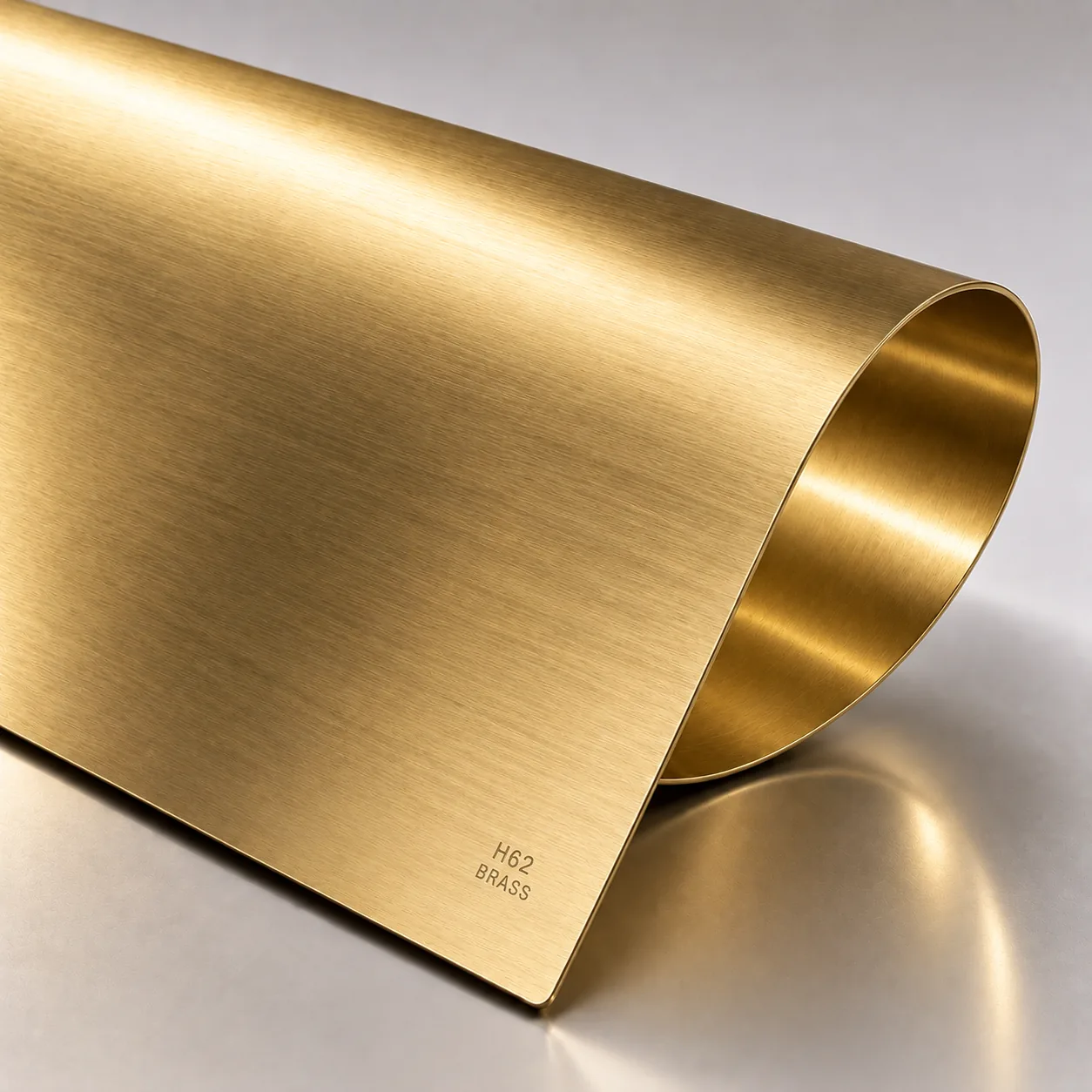
brass h62 sheet sample — H62 brass sheet metal
Short answer

H62 is a brass with roughly 62% copper and 38% zinc. Compared with the higher-copper brasses it is stronger and harder, and correspondingly less ductile — so it suits terminals, connectors, fittings and decorative hardware where strength and machinability matter more than deep drawing. It is the Chinese national-standard designation; the equivalent family in Western designations is the 62/38 brass group.

H62

Mechanical Properties

Open in the data sheet
Density
8.43
Tensile Strength
410 MPa
Yield Strength
150 MPa
Elongation
40%
Weldability
Fair
Corrosion Resistance
Good
Thickness Range
0.3mm – 5.0mm
Chemical composition
Cu: 60.5% – 63.5%, Zn: balance, Pb: ≤0.15%, Fe: ≤0.15%, Sn: ≤0.05%
Equivalent Grades
CN
H62
US
ASTM B36 C28000 (approx.)
JP
JIS H3100 C2800
EU
EN CW509L / C28000

What H62 is

H62 is designated under GB/T 5231, the Chinese standard for wrought copper alloys. The H stands for the Chinese word for brass, and 62 gives the nominal copper content: approximately 62% copper, balance zinc, with a small allowance for impurities. Western designations do not map one-to-one, but the composition sits in the 62/38 brass family.

The practical consequence of that ratio is the property balance. Moving from 70% copper down to 62% raises tensile strength and hardness, improves machinability, and reduces the elongation that deep drawing depends on. Nothing is free: H62 trades formability for strength, and that trade is the reason both H62 and higher-copper brasses remain in use.

Typical properties for engineering reference

Typical values for H62 in sheet and strip form. Temper has a large effect on the mechanical figures, so specify it.

PropertyTypical value
Nominal composition~62% Cu, balance Zn
Tensile strength (soft / half-hard)~370-420 MPa / ~490-570 MPa
Elongation (soft)~35-45%, falling sharply with temper
Density~8.4-8.5 g/cm3
ColourWarm yellow-gold; darkens to brown over time if untreated
MachinabilityGood — improves as zinc content rises
Corrosion resistanceGood in most atmospheres; caution with ammonia and chlorides
Typical usesTerminals, connectors, fittings, decorative hardware, name plates
H62 brass sheet — typical values

H62 against the higher-copper brasses

The comparison that matters is with the 65/35 and 70/30 brasses, including the C26000 cartridge brass used for deep-drawn parts. Those grades are more ductile, which makes them the right answer for stamping a cup or a drawn shell in one operation, and their higher copper content gives a slightly richer colour.

H62 answers a different question: a connector tab, a fitting, a bracket or a decorative plate that needs strength or a stiffer spring temper rather than a deep draw. In those roles the lower ductility is irrelevant and the higher strength and lower copper cost are both advantages.

Fabrication notes

H62 machines and forms well in moderate operations — bending, blanking, light drawing — but it is not the grade for a deep draw that a 70/30 brass would take in one pass. Where more forming is needed, an intermediate anneal restores ductility and lets the work continue.

Joining follows normal copper-alloy practice. Soft soldering is straightforward and common on electrical parts; brazing also works. Where the part carries current and is assembled by welding, note that brass is not the ideal welding material and a design that avoids welded brass joints is usually the better engineering choice.

The other item to specify is surface treatment. Untreated brass tarnishes in service, so parts exposed to handling or weather should have a clear lacquer, a plating such as nickel, or a powder-coated finish — and that choice interacts with any soldering or brazing step, so the sequence matters.

Frequently asked questions

What is H62 brass?

H62 is a wrought brass designated under GB/T 5231 with a nominal copper content of about 62%, the balance being zinc. It is stronger and harder than the 65/35 and 70/30 brasses and correspondingly less ductile, which makes it a good fit for terminals, fittings, connectors and decorative hardware rather than deep-drawn shells.

How does H62 differ from C26000 brass?

Copper content. C26000 cartridge brass is 70/30 — around 70% copper — and is prized for exceptional deep-drawing ductility. H62 sits near 62% copper, giving higher strength and hardness with less elongation. Choose C26000 when the operation is a deep draw, H62 when the part needs strength in service. Both keep the characteristic brass colour.

Does H62 brass tarnish?

Yes. As the zinc content rises, brass loses some of the tarnish resistance that pure copper has, and H62 will darken toward brown in normal handling and atmosphere. For parts where appearance matters, specify a clear lacquer, a plated finish such as nickel, or a powder-coated coating, and choose the finish together with the assembly sequence.

Can H62 brass be welded?

It can be soldered and brazed readily, and both are common on electrical parts. Fusion welding is a different matter: zinc volatilises at welding temperatures, which causes porosity and fume, so a design that avoids welded brass joints is usually the better engineering answer. Mechanical joints, soldering or brazing are the practical routes.

What is H62 brass used for?

Electrical terminals and connectors, fittings, and decorative or architectural hardware — anywhere the part needs moderate strength and a warm metal appearance. It is also used for name plates and bezels, where its colour and its response to brushing and plating are the reasons for choosing it.

Is H62 suitable for marine environments?

With caution. Brasses in this range are less resistant to dezincification than the high-copper or admiralty grades, and chlorides plus ammonia are the conditions that attack them. For permanent marine exposure, a higher-copper brass, a bronze such as C5191 phosphor bronze, or a protective plating is the safer specification.

Send the drawing, get a real answer

An engineer reviews your model for manufacturability and returns a costed quotation — with the DFM observations that would change the price.