
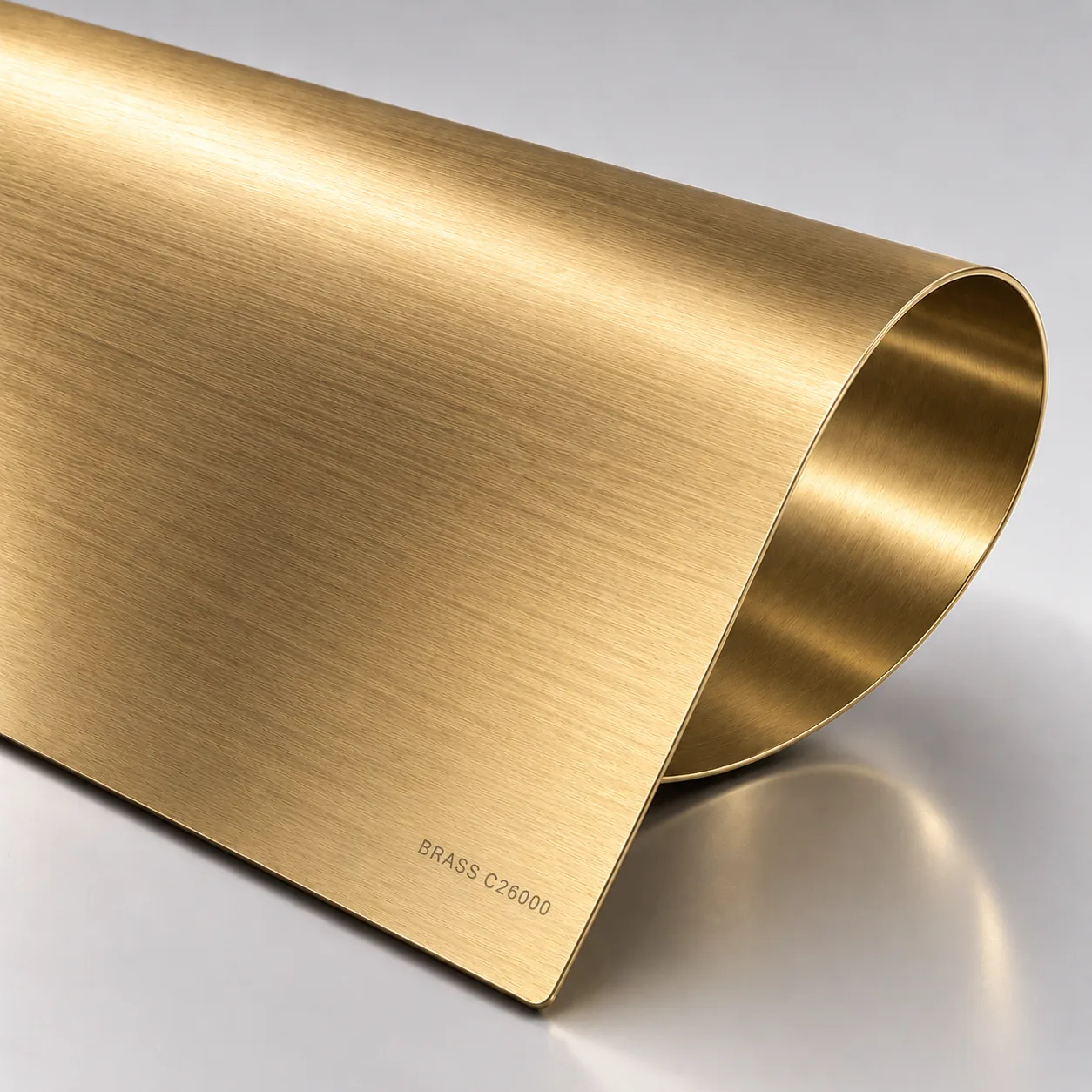
Which brass, and why the designation matters
C26000 is the UNS designation for 70/30 brass — 68.5–71.5% copper, balance zinc. It is the grade usually called cartridge brass, and it is the most ductile of the common sheet brasses, which is why it is the default when a part has to be deep drawn or bent tightly.
C2680 is the JIS designation used across Asia for a slightly leaner brass, roughly 64–68% copper. The two are related, not identical: the extra zinc in C2680 makes it a little cheaper and a little less ductile, and it shifts the colour very slightly redder. A drawing that says "brass" without a designation is leaving that choice to the shop, and the site itself uses both numbers in different places, which is normal for a Guangdong source factory buying to JIS stock while quoting to UNS.
Properties at a glance
The values are typical engineering reference figures for the annealed condition. Because both grades work-harden rapidly, the properties of a formed part depend far more on the amount of cold work it has seen than on the mill certificate — a half-hard temper can be twice the tensile strength of the same alloy annealed.
| Property | C26000 (CuZn30) | C2680 (CuZn35) | Note |
|---|---|---|---|
| Copper content | 68.5–71.5% | 64.0–68.0% | The zinc balance is the whole difference |
| Density | 8.53 g/cm³ | 8.4–8.6 g/cm³ | Both noticeably heavier than steel or aluminium |
| Conductivity | ≈28% IACS | ≈27% IACS | Roughly a quarter of copper; about 6× steel |
| Tensile (annealed) | ≈300–370 MPa | ≈290–360 MPa | Rises sharply with cold work |
| Elongation (annealed) | ≈45–50% | ≈40–45% | Why C26000 is the deep-drawing grade |
| Corrosion | Excellent indoors; tarnishes outdoors | Same | Outdoor exposure needs a coating or a lacquer |
| Relative material cost | Higher | Lower | Follows the copper content directly |
Forming: work-hardening and springback are the two things that bite
Brass forms beautifully when soft and stiffens quickly as it is worked. Each shearing, piercing and bending operation consumes ductility, so a part that needs three bends and a deep form may have to be sequenced, annealed between operations, or made from a softer temper than the drawing assumes.
Springback is the harder problem. Brass springs back noticeably more than mild steel at the same radius, so a press-brake programme developed on steel will over-bend or under-bend a brass part until it is corrected. Where a bend angle is functional, expect to compensate for it and check the first article rather than assuming steel settings transfer.
- Deburr sheared edges before forming; a burr is where a crack starts on a work-hardened brass part.
- Open up the radius on later bends if earlier operations have already worked the material.
- Bend along the rolling direction where possible — brass is least tolerant across the grain.
- Allow for springback in the tooling rather than chasing it with a hammer at final assembly.
- If a part needs heavy forming plus tight bends, consider C26000 rather than the leaner grade.
Where brass earns its cost
Three functions justify brass over steel or aluminium. Electrical and thermal conductivity — RF shielding, terminals, heat-spreader brackets on a small part where copper would be over-specified. Corrosion resistance without a coating, in indoor and sheltered applications where a painted edge would be the first thing to fail. And appearance: brass takes a bright polished or brushed finish that reads as a decorative metal, which is why hardware, bezels and architectural trim are specified in it.
Against copper, brass loses on conductivity by a factor of about three and wins on cost, machinability and appearance. Where a part genuinely carries current or sinks heat in volume, copper is the right answer; where it carries a signal, shields a small cavity, or is looked at, brass usually is.
Finishes, and the one that matters on a working part
Polished and brushed finishes are the natural ones, and brass left bright will darken over time as the surface oxidises — attractive on a decorative part, unacceptable on a terminal. A clear lacquer holds the colour indoors; outdoors it degrades and has to be renewed, so an outdoor brass part is normally plated instead.
Nickel and tin plating are the common working finishes, and the same masking discipline applies as on copper: electroplating a contact face changes the joint behaviour, so contact areas are masked and left bare while the rest is plated to stop the surface oxidising. A bright brass part that will be handled should have the finish specified on the drawing rather than left as "keep bright".