
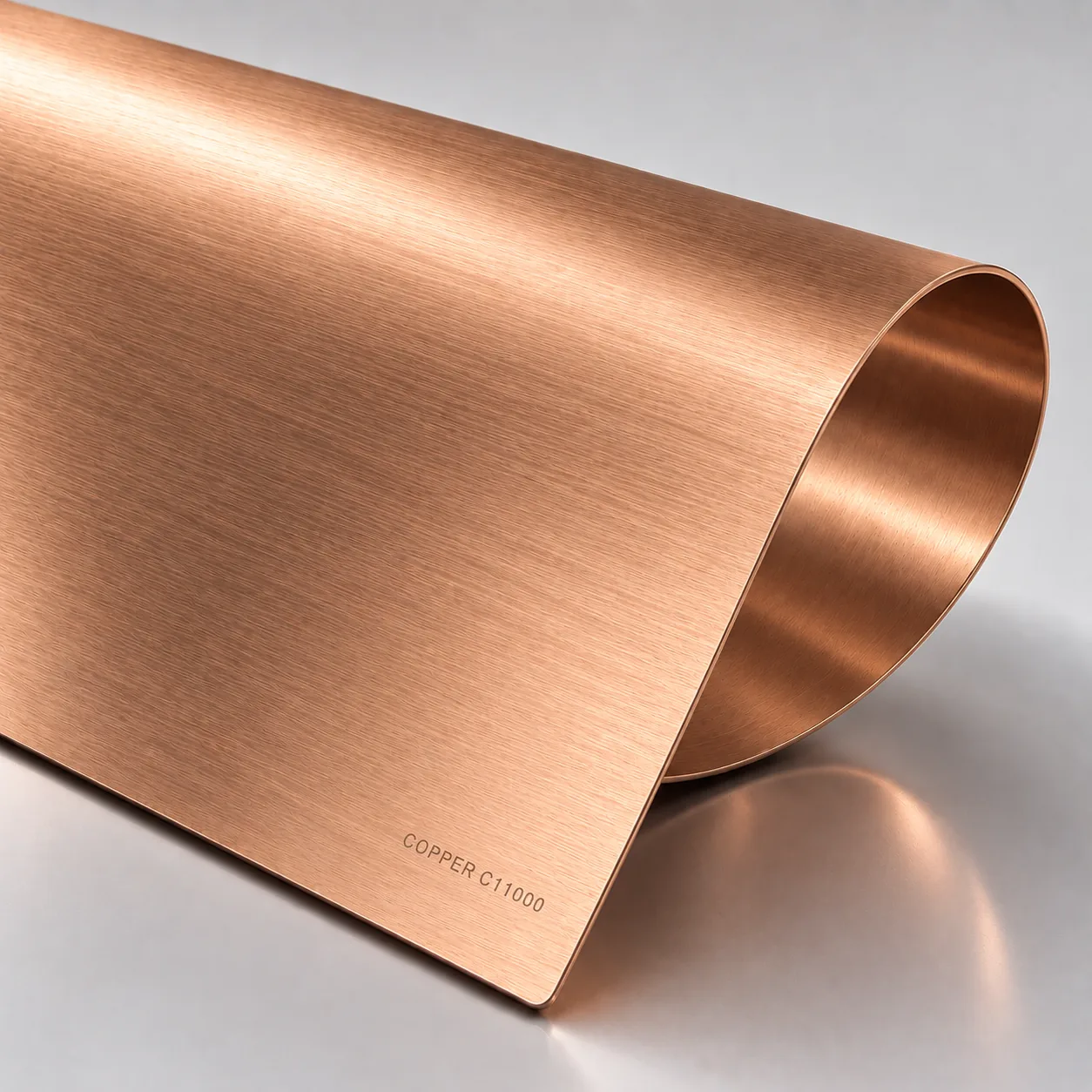
What C110 copper is
C110 is the UNS designation for electrolytic tough-pitch (ETP) copper: minimum 99.9% copper, the standard electrical grade worldwide. "IACS 100%" — the International Annealed Copper Standard — is not a property C110 approximately achieves; it is the reference C110 defines. Everything else is rated as a percentage of this alloy.
The metallurgy that matters for fabrication: copper work-hardens quickly. Where a bracket in aluminium might go through several forming operations before temper becomes a conversation, copper reaches its harder tempers (H00, H02, H04 on the sheet scale) after comparably light work. That is manageable — annealing between operations is standard practice — but it is the reason copper parts quote with their temper specified, not assumed.
Typical properties for engineering reference
Typical values below; copper's conductivity figures are the reference standards themselves.
| Property | Typical value |
|---|---|
| Purity | ≥99.9% Cu |
| Electrical conductivity | 100% IACS — the benchmark reference |
| Thermal conductivity | ~390 W/m·K — the highest we fabricate |
| Density | 8.94 g/cm³ |
| Tensile strength | ~200–250 MPa (soft temper), rising with cold work |
| Work hardening | Fast — temper specified per part; annealing between ops is standard |
| Corrosion behaviour | Good; develops protective patina outdoors |
How C110 behaves through fabrication
Laser cutting runs cleanly in the thin window copper is usually specified in, with the reflectivity consideration that fibre-laser settings for copper differ from steel — it is routine work on our line at busbar and shielding gauges, and the reason copper parts are quoted with thickness confirmed rather than assumed. Bending is straightforward in the soft tempers: copper bends to tight radii when it is fresh from anneal, and the work-hardening rule says form first, then handle.
Joining is where copper is genuinely distinctive. It solder brazes beautifully — the standard route for busbar joints. It TIG-welds with copper-specific technique. And it tig-welds to itself and to brass far more readily than it welds to steel, which is one more reason mixed-material assemblies get the joining conversation at DFM rather than at the welder.
- Laser cutting: thin-gauge window with copper-specific settings
- CNC bending: tight radii in soft temper; form before it work-hardens
- Solder brazing: the standard busbar joint route
- TIG welding: copper-specific technique, clean on like-for-like joints
Surface finishes that suit C110
Copper's finishes are about what happens over time. Left bare indoors, it darkens gracefully toward brown; outdoors it patinates toward green — sometimes the intent, often not. A clear protective coat holds the bright finish on decorative parts. Plating takes copper parts bright tin, nickel or silver where contact resistance or solderability is the duty. And bead blasting gives the uniform soft-matte look common on high-end audio and consumer electronics faces.
Anodising does not apply — that is an aluminium process, and the confusion is common enough to be worth stating. Where a drawing says "anodised copper", the real intent is usually clear-coat or plating, and the quotation resolves it before fabrication.
- Clear protective coat: holds the bright finish on decorative parts
- Tin / nickel / silver plating: for contact resistance and solderability
- Bead blasting: soft matte cosmetic finish
- Natural patina: sometimes the intent outdoors — specify it explicitly either way
Where copper earns its premium
Four duty families cover nearly all the C110 we fabricate. Busbars and electrical connections, where 100% IACS is the entire point. EMI/RFI shielding cans and gasketing frames, where conductivity closes the enclosure electrically. Thermal paths and heatsink spacers, where that ~390 W/m·K moves heat no alloy can. And decorative faces on premium hardware, where copper's look is the brand.
Everything else is a conversation about substitutes, because copper is the most expensive common sheet material by a wide margin and it is heavy. Brass carries the decorative look with better machinability and lower cost; aluminium carries the conductivity duty at a fraction of the weight and cost where the numbers allow. We will price the specified grade and suggest the alternative in the same quote — the comparison is part of DFM, not a upsell.
| Duty | C110 correct? | Alternative worth pricing |
|---|---|---|
| Busbar / current path | Yes — the reference conductor | Aluminium where weight rules and section can grow |
| EMI/RFI shielding | Yes | Tinned steel or aluminium cans for non-critical shielding |
| Thermal spreader | Yes | Aluminium where the budget rules and area can grow |
| Decorative face | Yes, with clear coat | Brass — similar look, better machinability, lower cost |
| General structural part | No | Almost anything — copper is the wrong tool here |
Sourcing and how to specify it
C110 sheet is sourced through our supply chain against temper and thickness — for formed parts, temper is the specification line that decides whether the bends survive, so it is quoted explicitly rather than assumed. Combine the callout with the finish intent ("C110 H00 1.0 mm, clear-coated") and any plating or conductivity documentation the project needs.
Where the duty is electrical, send the current and the joint type with the RFQ. Busbar work quotes differently — and correctly — when the joining route (solder braze vs mechanical) is known at DFM rather than discovered after the parts are cut.