
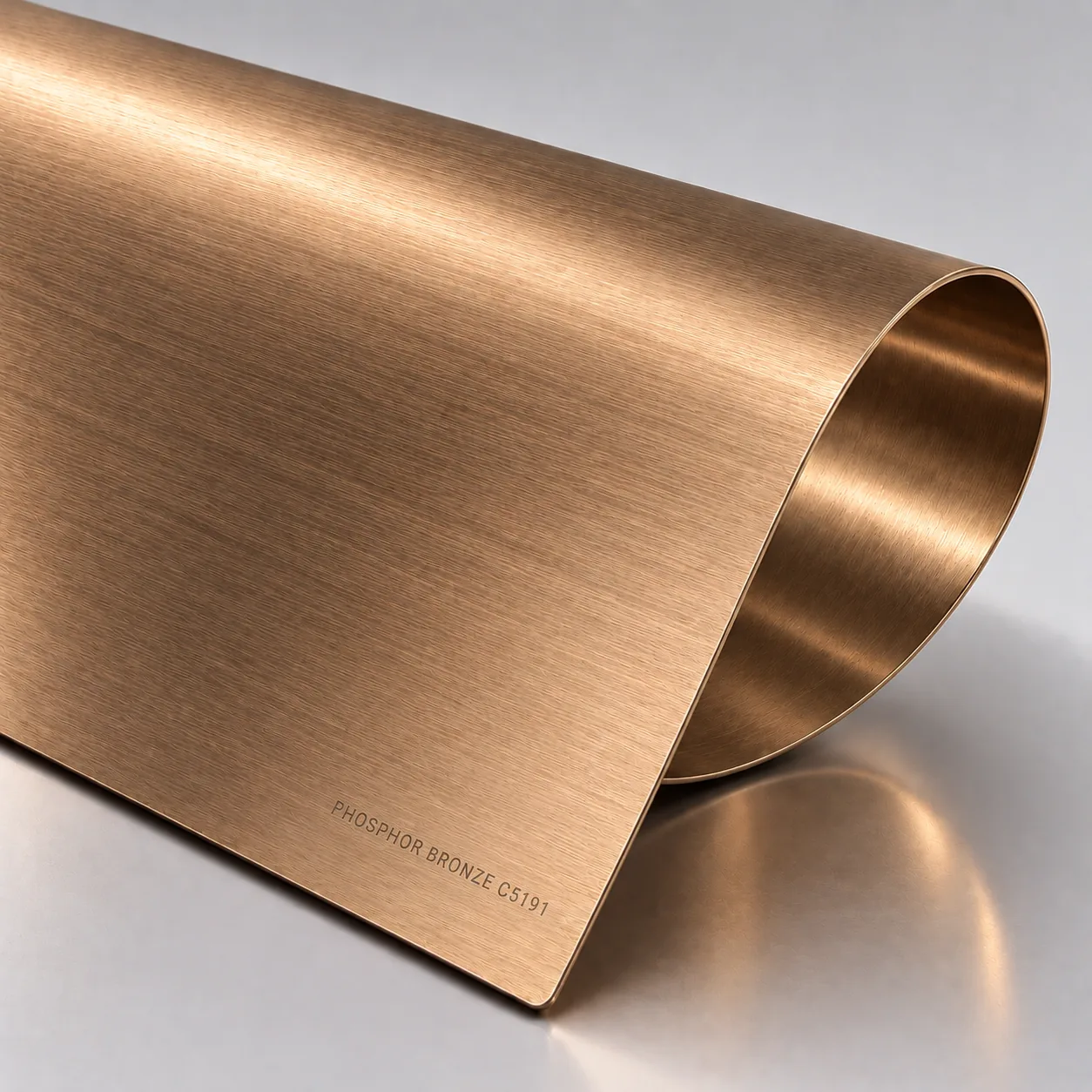
What the alloy is, and what each addition does
Phosphor bronze is copper alloyed with tin, plus a small deliberate residue of phosphorus. The tin is what gives the alloy its spring properties — it raises strength and, more importantly, fatigue resistance, so a contact can flex many millions of times without cracking. The phosphorus acts mainly as a deoxidiser during melting, which improves fluidity and consistency; it also contributes a modest amount of strength.
C5191 is the JIS designation with roughly 5.5–7% tin. C51000 is the UNS grade at 4.2–5.8% tin. As with the brasses, the two are related rather than interchangeable — C5191 carries slightly more tin, so slightly more strength and a slightly higher price. Both take the "phosphor bronze" name and both appear on this site because the shop buys to JIS while customers often specify UNS.
Properties at a glance
| Property | C5191 (CuSn6) | C51000 (CuSn5) | Note |
|---|---|---|---|
| Tin content | ≈5.5–7.0% | ≈4.2–5.8% | Tin drives strength and fatigue life |
| Conductivity | ≈12–15% IACS | ≈15% IACS | Well below brass; it is a spring material, not a conductor |
| Tensile (spring temper) | ≈600–750 MPa | ≈550–700 MPa | Far above annealed copper or brass |
| Elongation (spring temper) | ≈8–20% | ≈8–20% | Enough to form, not enough to deep draw |
| Fatigue resistance | Excellent | Excellent | The reason the grade exists |
| Typical supplied thickness | From ≈0.1 mm strip | From ≈0.1 mm strip | Stamped contacts, not formed panels |
| Cost | High | High | Tin content puts it above brass, below nothing much |
Why it is a strip material rather than a sheet material
Phosphor bronze on this site is nearly always thin strip — from around 0.1 mm upward — feeding a press. That is not a limitation of the alloy but of what it is used for: contacts, terminals, spring clips and connector bodies, all of which are stamped at volume from coil and formed in the die.
The practical consequence for a drawing is that the temper matters more than the thickness. Spring temper gives the strength and fatigue life but almost no formability; a part with a tight bend needs a harder-to-find compromise between the two. Where a contact has to be bent 90° after stamping, that decision has to be made at strip specification rather than at the press.
Forming and stamping behaviour
- Spring temper is deliberately low-elongation — bend radii are generous or the part is formed before the final temper.
- Bend relief matters more here than on sheet steel, because the fatigue life depends on there being no stress raiser at the bend root.
- Fine blanking or a well-maintained compound die holds the edge quality that a contact needs; a torn edge is a crack starter.
- Annealing between operations is possible but undoes the temper, so the sequence is normally arranged to avoid it.
- Tin and nickel plating after forming is the norm, with contact areas masked so the joint stays bare metal.
Where phosphor bronze is specified, and where it is not
It is specified wherever a part must function as a spring while also carrying a signal: switch contacts, relay springs, connector terminals, brush holders, and the fine stamped parts inside instrumentation. The combination of fatigue life, conductivity that is adequate for signals, and natural corrosion resistance is hard to replace.
It is not the answer for structural brackets, for anything carrying real current, or for parts that need deep forming. Beryllium copper does the same job with better conductivity and strength, at a much higher cost and with material-handling obligations; brass is cheaper but is not a spring material at the same level. Where the requirement is "flexes and comes back, many times", phosphor bronze is the conventional choice.