Table of Contents
Overview
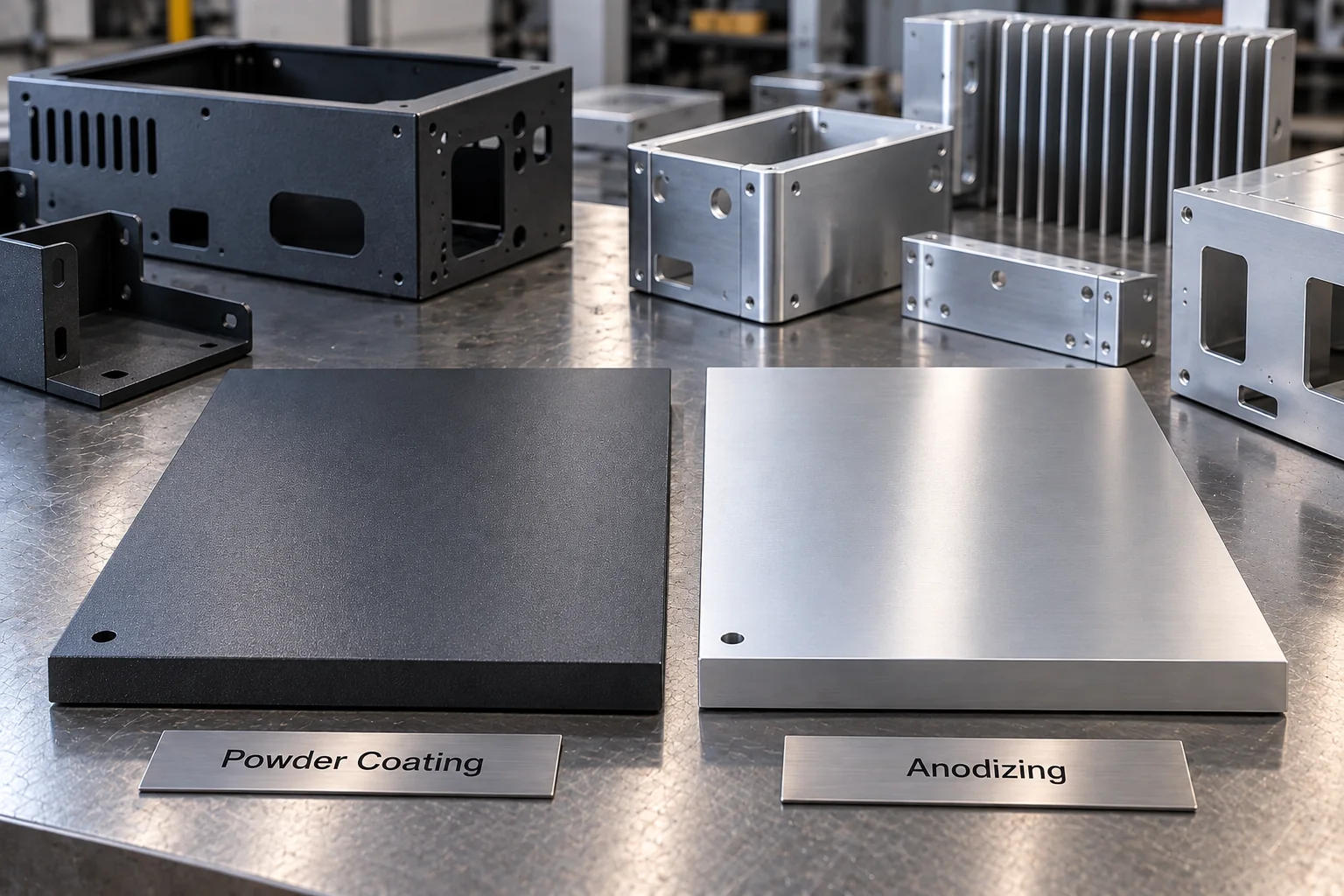
Quick answer: powder coating lays a 60–120 µm resin layer on top of the metal; anodizing converts the aluminium surface itself into a 5–50 µm oxide layer that cannot chip or peel. Powder works on steel, galvanized and aluminium; anodizing, aluminium only. Powder wins on colour and repair, anodizing on wear and UV stability.
How does powder coating work?
Charged resin powder is sprayed onto the part and cured at 180–200 °C, where it flows into a continuous 60–120 µm film. The part is coated in one pass, so edges and folds keep their coverage — a real advantage over liquid paint. Powder accepts any RAL or Pantone colour plus textures and metallics, and it bridges minor surface marks, which cuts prep work on non-cosmetic parts. Its weakness is impact: the layer is still a layer, and a sharp strike chips it and exposes the substrate.
Reference: the trade body for this finish is the Powder Coating Institute — its overview of film thickness, cure and performance is at Why Powder Coating?.
- Film thickness: 60–120 µm, measured against the drawing
- Any RAL or Pantone colour, plus fine, matte and metallic textures
- Works on steel, galvanized steel, aluminium and copper alloys
- Bridges minor surface marks — less prep on non-cosmetic parts
- Weakness: a sharp impact chips the layer and exposes the substrate
How does anodizing work?
Anodizing is an electrochemical process that converts the aluminium surface into aluminium oxide — the layer is the metal, so it cannot peel or chip. Type II builds 5–25 µm for decorative use and accepts dyes; Type III (hard anodizing) reaches 25–50 µm and resists abrasion. Two consequences surprise buyers: the part grows dimensionally by roughly half the layer thickness, which matters on tight fits and threads, and the surface stays electrically non-conductive unless areas are masked. Anodizing works on aluminium only.
- Type II: 5–25 µm, decorative, dyeable in greys, bronzes and black
- Type III hard anodize: 25–50 µm, abrasion-resistant
- Dimensional growth of about half the layer thickness — flag tight fits
- Non-conductive surface: grounding points and threads must be masked
- Aluminium only — it is chemically impossible on steel
How do powder coating and anodizing compare on cost?
Powder is priced per batch and per colour: one RAL across a batch is economical, two colours means two setup cycles. Anodizing is priced per rack area, so plain and clear finishes get cheaper fast at volume. On a typical enclosure, small-batch costs land within 10–20% of each other; above a few hundred parts, clear anodizing on aluminium usually wins. Hard anodizing (Type III) costs more than powder and is chosen for wear, not economy. Both carry a hidden cost: masking threads, grounding points and critical surfaces is labour.
Where does each finish fail first?
Powder fails by chipping on impact and by UV chalking — a standard polyester holds its colour outdoors for roughly 5–7 years before the surface dulls; polyurethane and fluoropolymer grades go well past that. If a chip exposes bare steel, corrosion starts under the coating and lifts it. Anodizing fails differently: it does not chip, and Type III shrugs off abrasion, but in chloride-rich environments (coastal, de-icing salt) anodized aluminium can pit if the sealing was poor. Its colour range is also narrower — greys, bronzes and black, with no exact RAL match.
How do you choose?
Five rules cover most decisions. Steel or galvanized part → powder coating; anodizing is chemically impossible on steel. Aluminium with tight dimensions, threads or grounding points → anodize and mask. Colour must match a brand RAL → powder. Abrasion, sliding contact or hard use → Type III hard anodize. Outdoor aluminium in a mild climate → either works; anodize for thinness, powder for colour. The two are not enemies either: anodize for protection, then powder the surfaces where colour and corrosion resistance must be guaranteed together — a common spec on outdoor aluminium enclosures.
| Decision factor | Powder coating | Anodizing |
|---|---|---|
| Substrates | Steel, galvanized, aluminium, copper | Aluminium only |
| Layer | 60–120 µm resin film on top | 5–50 µm oxide converted from the metal |
| Colour range | Any RAL/Pantone, textures, metallics | Greys, bronzes, black — no exact RAL |
| UV stability | Polyester 5–7 yrs; PU/fluoropolymer longer | Excellent |
| Wear / abrasion | Good; chips under sharp impact | Type III excellent; layer cannot chip |
| Tight fits & threads | No growth — coating adds 60–120 µm | Grows ~½ the layer; mask threads |
| Cost driver | Batch setup + number of colours | Rack area; cheap for plain finishes |
| Best for | Colour-matched enclosures, steel parts | Aluminium, wear parts, thin coatings |
FAQ
Written by

Industrial & Product Design Engineer
Julia takes a product from the first sketch to a sheet metal design that can actually be made. She sits between the customer’s concept and our press brakes — modelling enclosures and brackets in CAD, running early DFM passes, and choosing the material and finish that will still look right two years down the line.
View profileParts we make for this topic
Ready to Start Your Project?
Get DFM feedback and a quote within 24 hours. No minimum order quantity.