
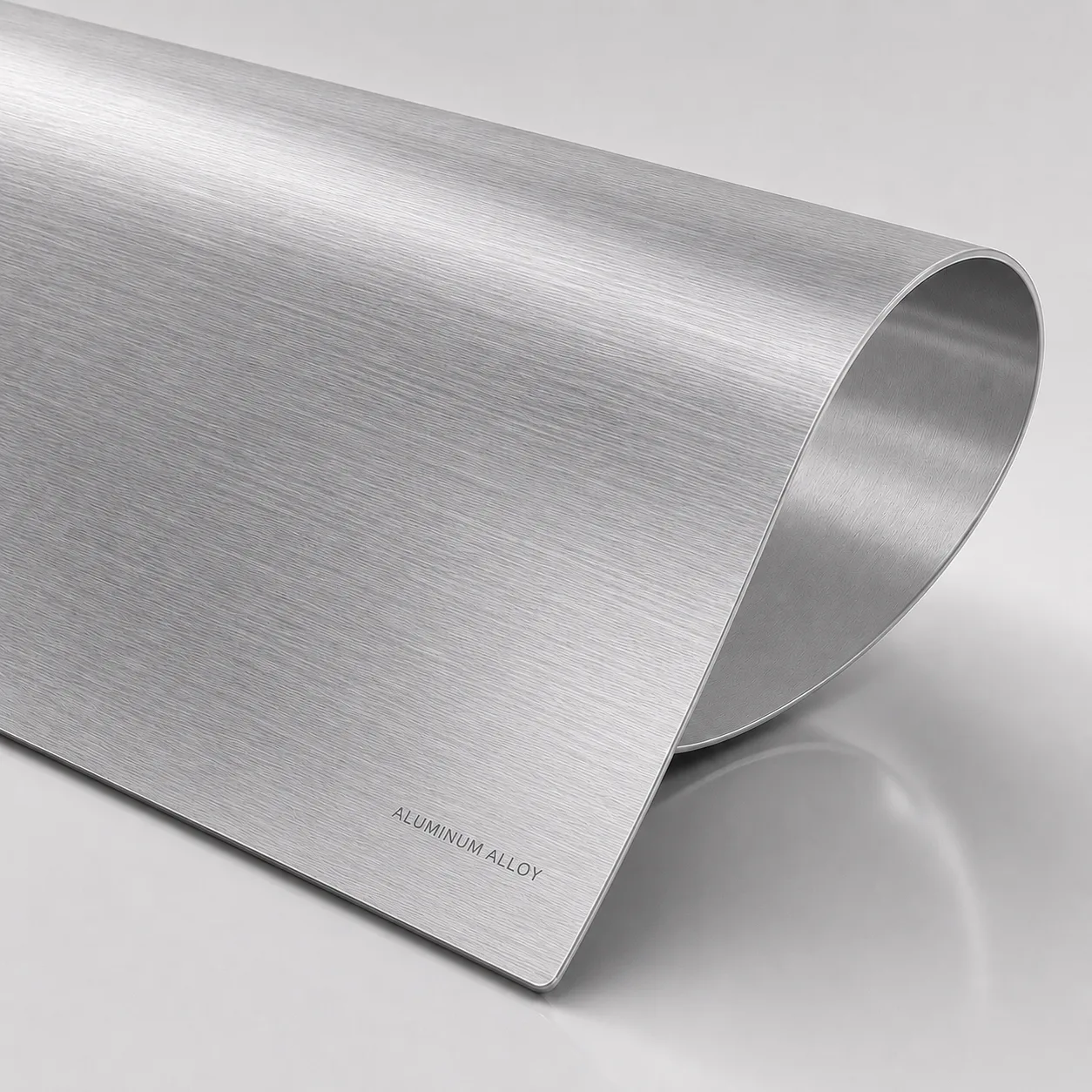
The four grades that cover most work
1100 is commercially pure aluminium: the best conductor, the softest, the most formable, and the easiest to anodise to a clean clear finish. It is chosen for busbars and shielding, for cosmetic panels, and for parts where forming is extreme and strength is irrelevant.
3003 adds manganese, which raises strength roughly 20% without losing the forming behaviour. It is the deep-draw grade — drawn covers, rounded housings, tight inside radii — and the sensible default when 1100 is too soft and 5052 is more than the part needs.
5052 adds magnesium, which is what lifts it above both: typically 30-40% more yield strength than 3003 at comparable tempers, with good atmospheric and marine corrosion resistance and excellent weldability. It is the workhorse for bent enclosures, brackets and chassis.
6061 is the exception in the family because it is heat treatable. In the T6 temper it is a structural and machinable alloy, but that same precipitation hardening limits elongation, so tight bends crack. It belongs on machined components and on formed parts whose radii are generous.
| Grade | Strengthening | Strength | Forming | Typical use |
|---|---|---|---|---|
| 1100 | Cold work only | Lowest | Best | Busbars, shielding, cosmetic panels |
| 3003 | Cold work only | Low | Excellent | Deep-drawn covers, tight radii |
| 5052 | Cold work only | Moderate | Very good | Enclosures, brackets, marine-duty parts |
| 6061-T6 | Heat treatment | Highest | Limited | Machined parts, structural brackets |
How to choose
Work from the forming operation backwards. If the part involves a deep draw or a bend tighter than about one material thickness, the answer is 3003 or 5052 rather than 6061. If the environment is coastal or chemical, 5052 leads because of its magnesium content. If the part is machined or carries a real structural load, 6061-T6 is the only grade in the family that qualifies.
Cost tracks the sequence as well: 1100 and 3003 are the economical choices, 5052 sits in the middle, and 6061-T6 carries a heat-treatment premium. Where two grades would both work, the cheaper one that still meets the forming and service requirements is the correct specification.
Fabrication and finishing notes
All four cut cleanly by fibre laser. Bending capacity depends on the alloy rather than the thickness alone — the same gauge bends further in 3003 than in 5052, and further in both than in 6061-T6. TIG welding is standard across the family, with surface oxide removed before welding and filler matched to the parent.
Anodising is available to all four, but alloying elements tint the anodic layer. 1100 and the 5xxx grades give the cleanest clear finish; 3003 reads slightly grey; 6061 is the least decorative. Where appearance matters, confirm the grade against a physical sample before committing the batch, and remember that powder coating is grade-independent by comparison.