
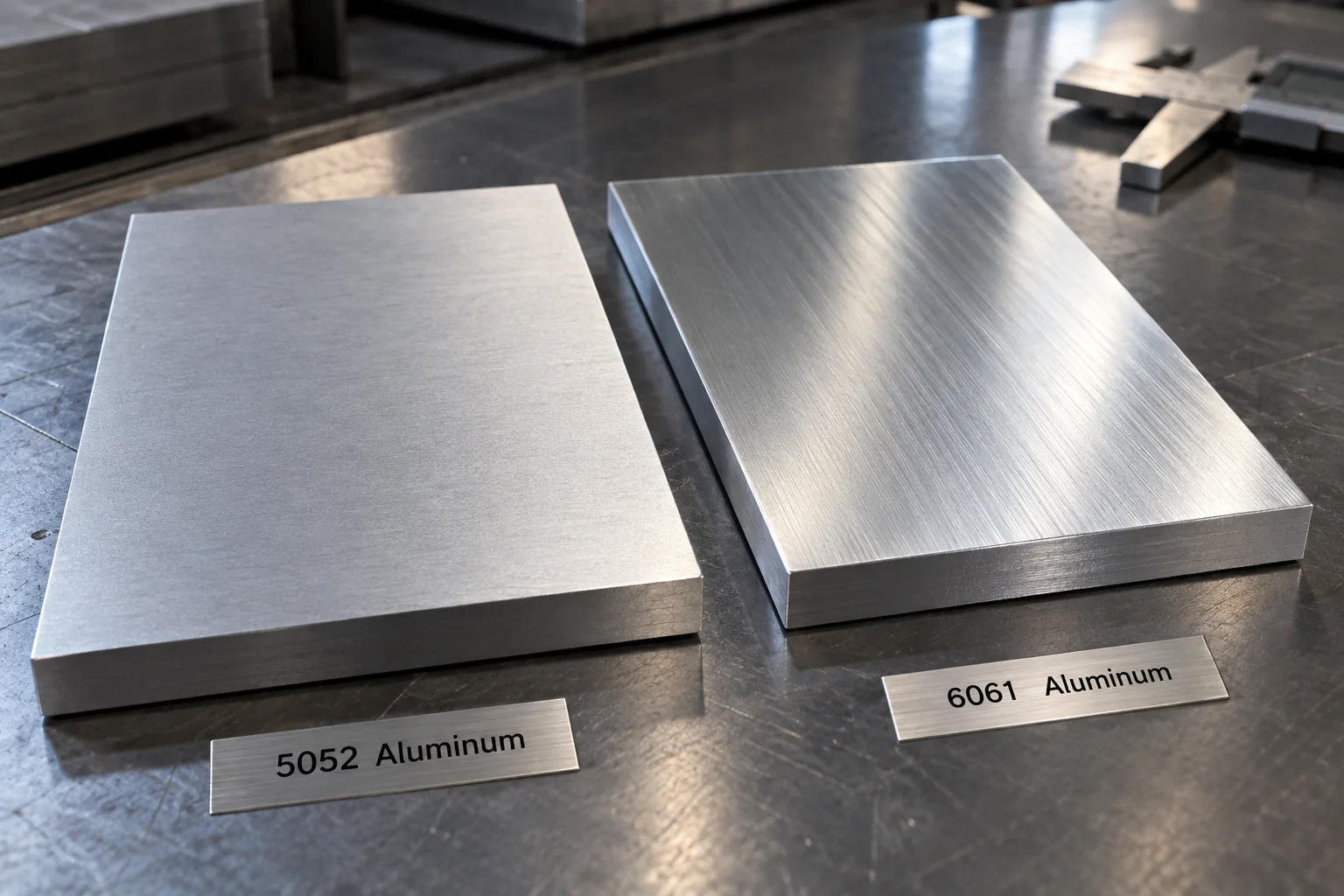
The one-line answer, and why it holds
5052-H32 is work-hardened aluminium–magnesium; 6061-T6 is heat-treated aluminium–magnesium–silicon. The heat treatment that gives 6061 its ~40% higher yield strength is the same treatment that leaves it little elongation before fracture — which is why tight bends in 6061 crack and the same bends in 5052 do not. Welding tells the same story from the other side: heat dissolves 6061's temper in the weld zone, while 5052 barely notices.
So the alloys are near-mirrors: 5052 trades peak strength for forming behaviour and weld stability; 6061 trades formability for strength and machinability. Most sheet metal parts want the first trade. A minority — structural brackets, frames, machined-and-formed hybrids — genuinely need the second.
Head-to-head on the properties that decide
| Criterion | 5052-H32 | 6061-T6 | Which wins |
|---|---|---|---|
| Yield strength | ~195 MPa | ~275 MPa | 6061 — when the load case needs it |
| Tight bends / hems | Routine, even zero-radius in thin gauges | Crack risk below ~1.5× thickness radii | 5052 — decisively |
| Welded strength retention | Good — HAZ largely unaffected | Poor — T6 temper lost locally | 5052 for welded assemblies |
| Machining after forming | Adequate | Excellent | 6061 for tapped/milled features |
| Anodised appearance | Even film, neutral tone | Consistent, slightly yellow tint | Both fine — sample-panel match in mixed assemblies |
| Corrosion, atmospheric | Excellent (marine-grade reputation) | Good | 5052, marginally |
| Relative cost | Lower | Modestly higher | 5052 — but cost rarely decides |
How the decision plays out in real RFQs
Enclosures, housings, panels and anything with a return flange: 5052, and the question ends. The parts bend, often weld, and their loads are modest — the extra yield of 6061 buys nothing that the duty would ever use, while its bend behaviour taxes every flange.
Structural brackets and frames: 6061 earns the quote, and the design conversation is about radii and weld locations. The brackets we see fail DFM in 6061 fail for the same two reasons — an inside radius copied from a 5052 drawing, and a weld placed on a load path that assumed full T6 strength through the joint.
Machined-and-formed hybrids (milled pockets, tapped bores, then light forming): 6061, because machining is where it dominates. The forming step is designed around its limits — generous radii, bends across the grain — and the result is a part neither alloy could be alone.
The transitions, where the choice is genuinely close
Flat brackets with one shallow 90° bend sit in the overlap: either alloy fabricates fine, and the load case or the tapped holes tip the decision. Welded boxes that must also carry structural loads are the other overlap — 5052 forms and welds better, 6061 carries loads better, and the honest answer comes from knowing which requirement is actually non-negotiable.
When we review such a part, the question we ask is not "which alloy is better" but "what does this part refuse to forgive". A crack at a bend is unforgiving; a few percent of deflection usually is not. Naming the unforgiving requirement picks the alloy.
What to send with the RFQ
Send the model, the load cases if structural, the bend schedule if you have one, and either the alloy with the note "or propose" or simply "material open". An engineer reviews bends, welds and machining against the alloys' behaviours and returns a recommendation with the quotation — including the radius changes that would make a 6061 part safe, or the 5052 substitution that would make a welded part stronger where it matters.