
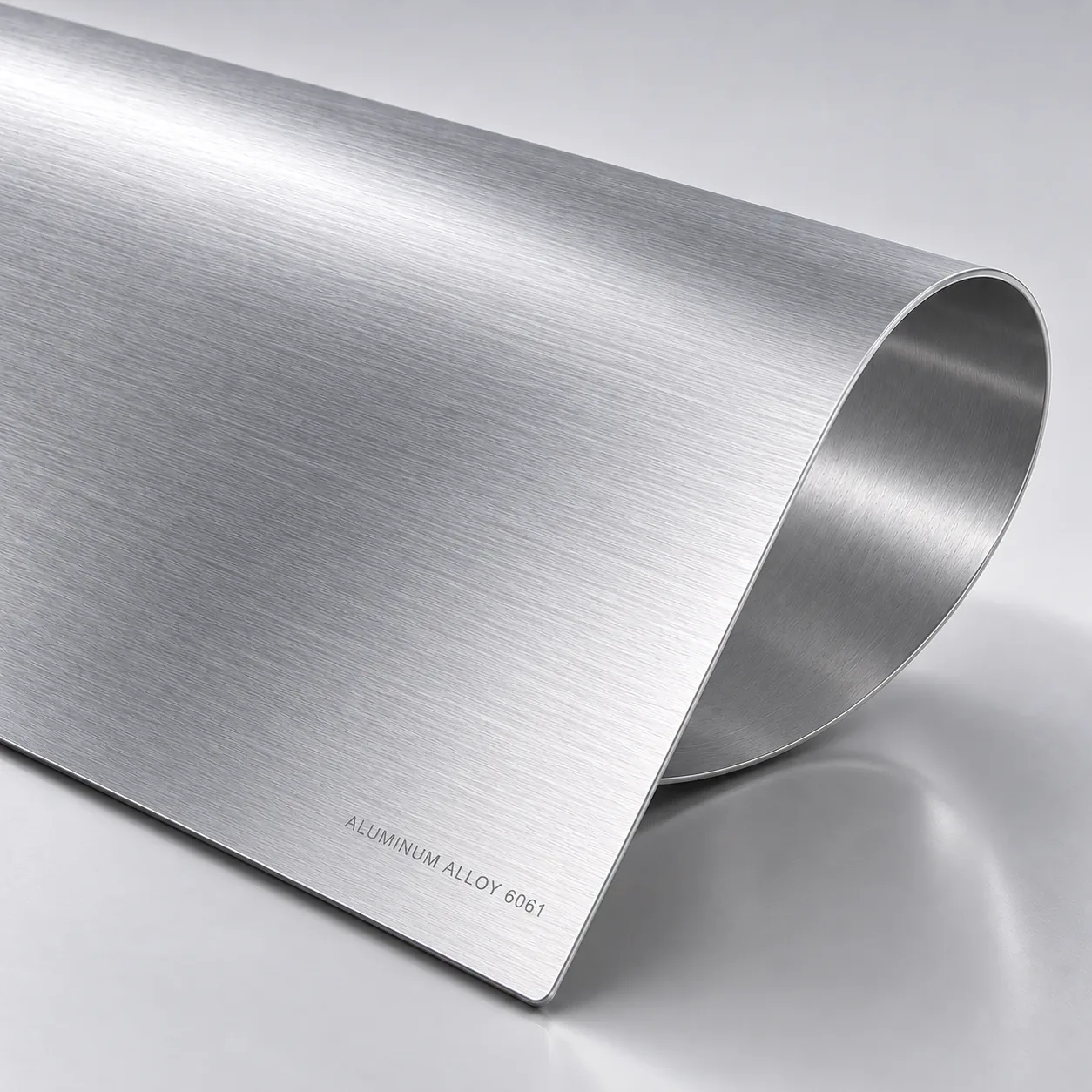
What 6061 aluminium is
6061 is an aluminium–magnesium–silicon alloy, and unlike 5052 it is heat-treatable. Supplied in the T6 temper — solution-treated and artificially aged — it delivers a yield strength around 275 MPa, roughly 40% above 5052-H32, which is why it dominates structural brackets, frames and any part where stiffness per gram is the brief.
The heat treatment is also the source of its two sheet-metal limitations. First, the hardened temper has limited elongation before fracture, so tight bends crack. Second, welding dissolves the temper locally: a TIG weld in 6061 loses a large share of its strength in the heat-affected zone, and the part only recovers it if it is re-heat-treated — which sheet metal parts practically never are.
Typical properties for engineering reference
Typical values for the T6 temper are tabulated below for selection purposes. Confirm project-critical properties against the material certificate — temper, thickness and specification all move these numbers.
| Property | Typical value (T6 temper) |
|---|---|
| Density | 2.70 g/cm³ |
| Tensile strength | ~310 MPa |
| Yield strength | ~275 MPa |
| Elongation | ~10–12% |
| Machinability | Good — the standard choice for machined-and-formed parts |
| Weldability | Welds readily, but HAZ loses most of the T6 strength |
| Bending behaviour | Limited — generous radii required; tight bends crack |
Bending 6061 without cracking it
The rule that keeps 6061 bends alive: open the inside radius. Where 5052 accepts an inside radius of one thickness or less, 6061-T6 in sheet gauges wants roughly 1.5 to 2 times the material thickness, and bends made along the rolling direction want more than bends across it. A 90° flange in 2 mm 6061 at a 1 mm inside radius is a coin-flip; at 3 mm it is routine.
If the drawing genuinely needs a sharp bend in 6061, the alternatives are worth a conversation before the press brake answers the question for us: a T4-temper sheet bent and then aged, a thicker section with fewer bends, or moving that feature to 5052. Our bending DFM notes cover the radius rules in detail.
How 6061 behaves through fabrication
Laser cutting is unproblematic — 6061 cuts in the same window as 5052, up to around 5 mm on our laser line, and the higher hardness actually gives a slightly crisper edge. Machining after cutting is where 6061 outshines every other sheet alloy: tapped holes, milled pockets and precision bores are the reason machined-and-formed hybrid parts specify it.
Welding works mechanically — TIG and MIG both run well — but design for the weakened joint: put welds where the load path allows the HAZ to be non-critical, or accept the local strength loss explicitly. For assemblies where a welded 6xxx joint must carry full strength, 5052 is usually the better answer, and we will say so at DFM review.
- Laser cutting: clean window up to ~5 mm, crisp edge
- CNC bending: needs 1.5–2× thickness inside radii; no zero-radius hems
- Machining: the strong suit — tapped holes, bores, pockets
- Welding: fine mechanically, weak mechanically in the HAZ — design around it
Surface finishes that suit 6061
6061 anodises reliably and is the standard choice where anodising follows machining, because the heat-treatable metallurgy gives a consistent, hard clear or black film. Type II decorative anodising is the everyday pairing for brackets and frames; Type III hard anodising suits wear surfaces. Powder coating is equally at home on structural parts that skip cosmetic duties.
One alloy-specific note: anodised 6061 shows the alloy's characteristic slightly yellowish tint compared with 5052, and colour matching across the two alloys in one assembly needs a sample panel agreed up front rather than an assumption.
- Anodising Type II: standard for visible structural parts
- Anodising Type III: hard anodising for wear surfaces
- Powder coating: durable colour on non-cosmetic frames
Where 6061 beats 5052 — and where it does not
The table is the decision. When a part mixes machined features with light bends, or the load case rewards the higher yield, 6061 is correct. When the part is a formed enclosure or carries tight-return flanges, 5052 avoids the crack risk entirely at a small strength cost most sheet metal parts never notice.
| Criterion | 6061-T6 | 5052-H32 |
|---|---|---|
| Yield strength | ~275 MPa — the reason it is chosen | ~195 MPa |
| Tight bends | Crack risk — needs generous radii | Best-in-class formability |
| Welded strength retention | Poor in the HAZ | Good |
| Machining | Excellent | Adequate |
| Anodised appearance | Consistent, slightly yellow tint | Even film, neutral tone |
| Sweet spot | Brackets, frames, machined-and-formed parts | Enclosures, panels, housings, anything with bends |
Sourcing and how to specify it
6061 sheet is sourced through our supply chain in the T6 temper against your drawing; if the design can accept T4 for forming, say so at quotation and we will price both routes. On the drawing: "Al 6061-T6", thickness, and — the one that saves parts — the inside bend radii stated explicitly rather than left to the brake operator's discretion.
Send the model with load cases if the part is structural. The difference between "works" and "works for five years" in 6061 is usually a radius, a grain direction or a weld location, and all three are cheapest to fix before the first sheet is cut.