
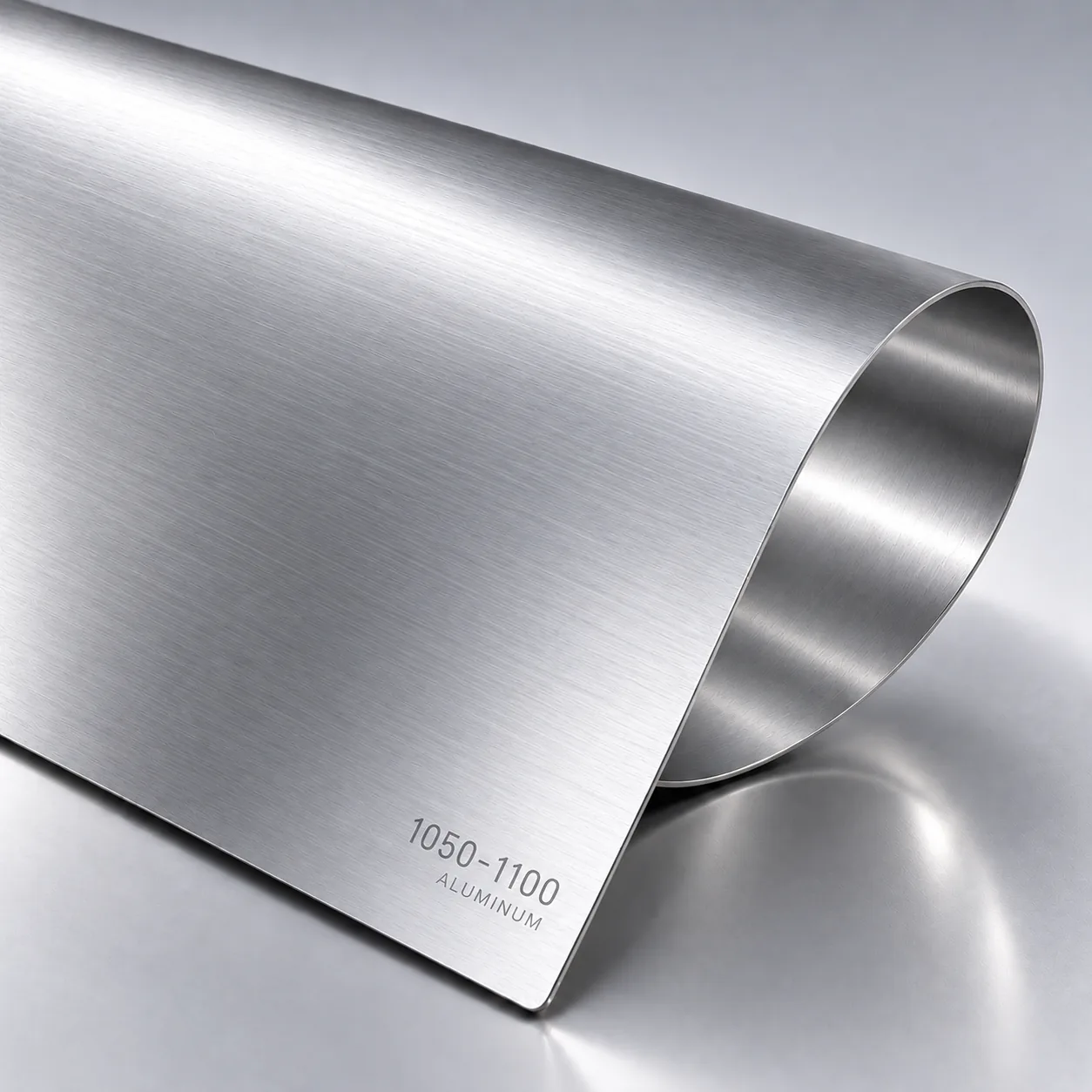
What 1050 and 1100 are
Both are commercially pure aluminium, differing only in how much impurity is tolerated. 1050 requires 99.50% minimum aluminium; 1100 requires 99.00% and permits slightly more iron and silicon. In the annealed O temper both are very soft and very ductile — the most formable sheet we handle.
The distinction between them rarely changes a decision. 1100 is the traditional US designation and is slightly the cheaper of the two in some markets; 1050 is the more common European specification. If a drawing names one and the other is available sooner, they are interchangeable for most fabrication purposes, and we will say so at quotation rather than let the part wait.
Typical properties for engineering reference
The figures below are for O (annealed) temper, which is the condition these grades are usually specified in for formed parts. This matters more here than on any other grade: 1xxx aluminium is also stocked in H14 and H24 tempers, where tensile strength roughly doubles and elongation falls sharply. If your part is stiff rather than formed, the temper may be the real specification.
| Property | Typical value (O temper) |
|---|---|
| Density | 2.71 g/cm³ |
| Tensile strength | 60–110 MPa |
| Yield strength | 15–40 MPa |
| Elongation | 25–35% |
| Purity | Al ≥99.50% (1050) / ≥99.00% (1100) |
| Electrical conductivity | ≈61% IACS (1050) / ≈59% IACS (1100) |
| Corrosion resistance | Excellent — atmospheric, fresh water, food contact |
| Weldability | Excellent |
| Thickness range we fabricate | 0.5 mm – 3.0 mm |
Where these grades are the right answer
Conductivity and thermal transfer are the reasons to specify 1xxx. Busbars, terminal links, heat spreaders and shielding parts use it because the electrical and thermal performance of pure aluminium beats any alloy — adding magnesium or manganese for strength always costs conductivity.
The other use is cosmetic. Because the metal is uniform and takes anodising and polishing very evenly, 1050 and 1100 are common for reflectors, nameplates, trim and decorative panels. The failure mode is mechanical: a 1xxx part is not a structural part. If the panel will be walked on, sat on, or asked to hold a fixing under load, 3003 or 5052 is the correct specification and we will flag the substitution at DFM review.
- Right: busbars, terminal links, heat spreaders, shielding
- Right: reflectors, nameplates, anodised cosmetic panels
- Wrong: any load-bearing bracket, chassis member or structural panel
- Wrong: parts that need to hold threads or take repeated fastener torque without reinforcement
How these grades behave through fabrication
Forming is the easy part — O-temper 1xxx aluminium bends, rolls and draws more readily than anything else in the catalogue, and tight radii that would crack 5052 are unremarkable here. The complication is handling: the same softness that makes it form well makes it mark. Surface protection film is worth specifying for cosmetic parts, and the flat pattern should assume generous tooling contact rather than slide-fit tooling.
Welding is straightforward and usually done TIG for appearance or a clean fillet. Where the part needs strength as well as conductivity, the answer is generally to keep the 1xxx section for the conductive path and use a 5xxx or 6xxx grade where the load sits, rather than trying to make one grade do both.