
Materials

3003 Aluminum Sheet Metal: Deep Forming Grade

There is a gap in the aluminium range between commercially pure sheet and the structural alloys, and 3003 fills it. It is the alloy that tolerates forming operations others refuse, which is why it turns up in drawn enclosures, formed housings and parts with tight radii rather than in anything carrying a structural load.

Reviewed by Tom, Senior Process Engineer·Dongguan source factory · 11+ years in precision sheet metal
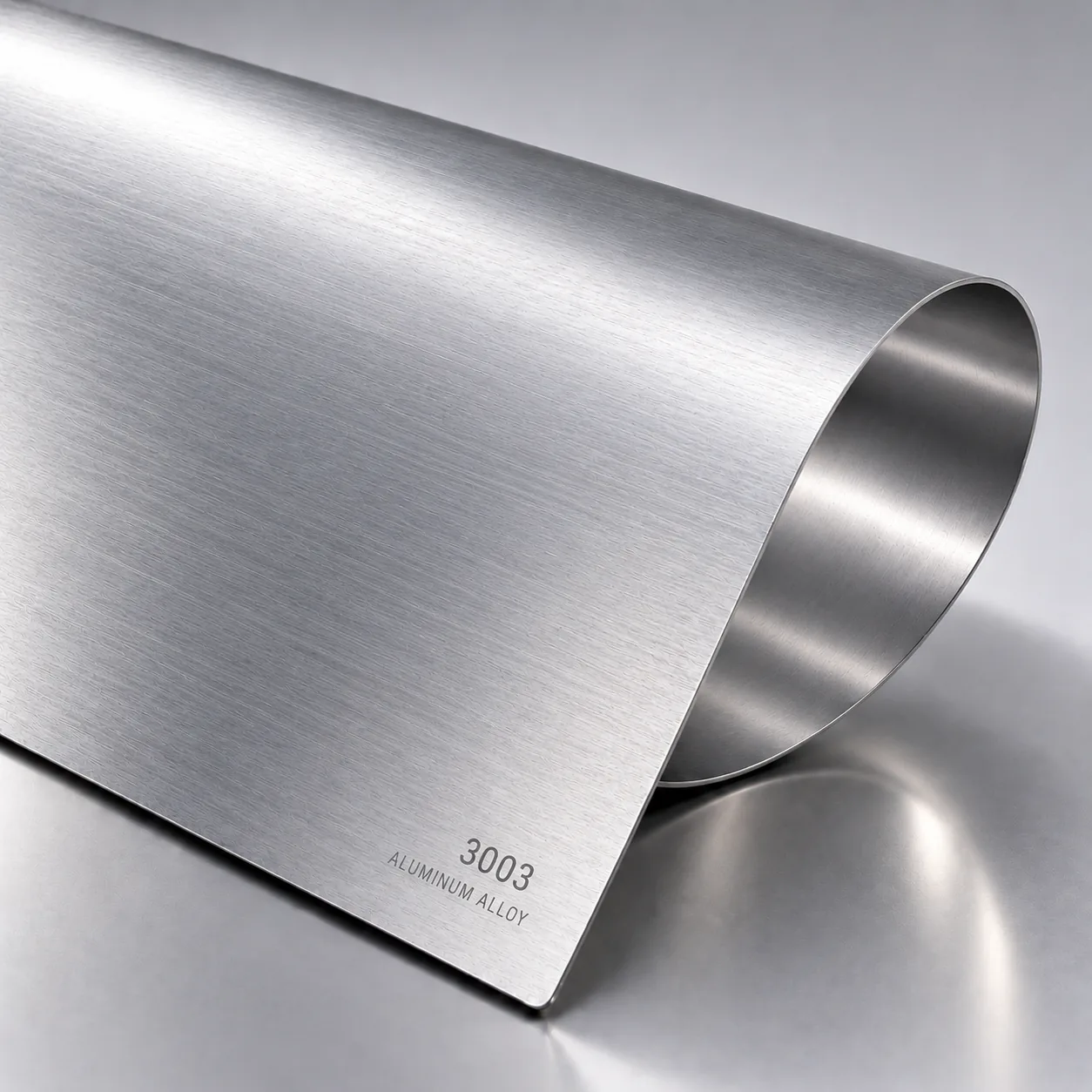
aluminum 3003 sheet sample — 3003 aluminum sheet metal
Short answer

3003 is an aluminium-manganese alloy: roughly 20% stronger than 1100 commercially pure aluminium with essentially the same formability. It cannot be strengthened by heat treatment, only by cold work, and it is the standard answer for deep-drawn and severely formed parts where 5052 would crack and 6061 would not bend at all.

AL3003-H14

Mechanical Properties

Open in the data sheet
Density
2.73
Tensile Strength
150 MPa
Yield Strength
125 MPa
Elongation
10%
Weldability
Good
Corrosion Resistance
Excellent
Thickness Range
0.3mm – 5.0mm
Chemical composition
Mn: 1.0% – 1.5%, Cu: 0.05% – 0.20%, Fe: ≤0.70%, Si: ≤0.60%, Zn: ≤0.10%, Al: balance
Equivalent Grades
CN
3003 / 3A21
US
ASTM B209 AA3003-H14
JP
JIS H4000 A3003P
EU
EN AW-3003

What 3003 is

3003 is aluminium with manganese as the main addition, typically 1.0-1.5%, plus a small copper content. The manganese lifts strength above the 1xxx pure grades without the magnesium that gives 5052 its higher strength and slightly lower ductility. Like the 3xxx and 5xxx families, it is non-heat-treatable: strength comes from cold work, so the temper designation is the lever rather than a quench.

In sheet metal work it appears where a part must be formed deeply — a drawn cover, a rounded housing, a bracket with a tight inside radius — or where a low-cost alloy is wanted and the mechanical demand is modest.

Typical properties for engineering reference

Typical values for sheet in common tempers. Actual values vary by temper and by mill.

PropertyTypical value
Alloy content~1.0-1.5% Mn, small Cu addition
Tensile strength (O / H14)~110-145 MPa / ~145-185 MPa
Yield strength (O / H14)~40-50 MPa / ~125-150 MPa
Elongation (O)~25-30% — excellent for deep forming
Density2.73 g/cm3
Heat treatableNo — cold work only
WeldabilityGood, all common processes
Corrosion resistanceGood in atmosphere; not for marine service without a finish
3003 aluminium sheet — typical values

Where it fits, and where it does not

3003 sits below 5052 in strength and below 6061 in everything that follows from heat treatment. Against 1100 it is the better default: similar forming behaviour, more strength, comparable cost. The honest summary is that 3003 is chosen for the forming operation first and the mechanical duty second.

It is the wrong choice where a part must carry load, where the environment is aggressive, or where an anodised structural finish is wanted. For a bent enclosure seeing coastal air, 5052 is the more durable answer. Where the part is a machined structural component, 6061-T6 is the only one of the three that qualifies.

Fabrication notes

3003 forms beautifully: tight inside radii that would tear 6061-T6 are routine, and deep draws that would need an intermediate anneal in 5052 are done in one operation. Laser cutting is straightforward and the soft cut edges deburr easily.

Welding is standard, with the usual aluminium caveats — surface oxide removed before welding and filler matched to the parent. Where the part will be finished, anodising responds normally, although the manganese content gives a slightly greyer tone than pure aluminium, which matters on decorative work matched to a sample.

Frequently asked questions

Is 3003 stronger than 5052?

No. 5052 is meaningfully stronger across comparable tempers — typically 30-40% higher yield — because its magnesium addition hardens more effectively than the manganese in 3003. 3003 is the better former and the cheaper of the two; 5052 performs better in service.

Can 3003 be heat treated?

No. It is a non-heat-treatable alloy, alongside 5052 and the 1xxx grades. Strength is controlled by cold work, which is why the temper designation — H14, H22, H24 — is the variable to specify. Annealing softens it back toward the O temper, sometimes used deliberately between deep forming steps.

Why does 3003 bend better than 6061?

Because of how each alloy gains strength. 6061-T6 is precipitation hardened, which leaves limited elongation before fracture, so a tight bend cracks on the outside. 3003 is work hardened, its ductility is intact, and the same geometry forms without complaint.

Is 3003 suitable for outdoor use?

For sheltered outdoor duty, yes. Aluminium develops its own protective oxide and manganese does not compromise that. For coastal, marine or chemically exposed service the magnesium-bearing 5052 is the safer choice, and either alloy benefits from powder coating or anodising where appearance and durability are wanted.

How does 3003 take anodising?

Normally and predictably, with one colour caveat: alloying elements tint the anodic layer, and 3003 reads slightly greyer than 1100 or the 5xxx grades. On clear anodised decorative parts that difference is visible next to a pure-aluminium sample. On dyed or powder-coated work it is irrelevant.

Send the drawing, get a real answer

An engineer reviews your model for manufacturability and returns a costed quotation — with the DFM observations that would change the price.