
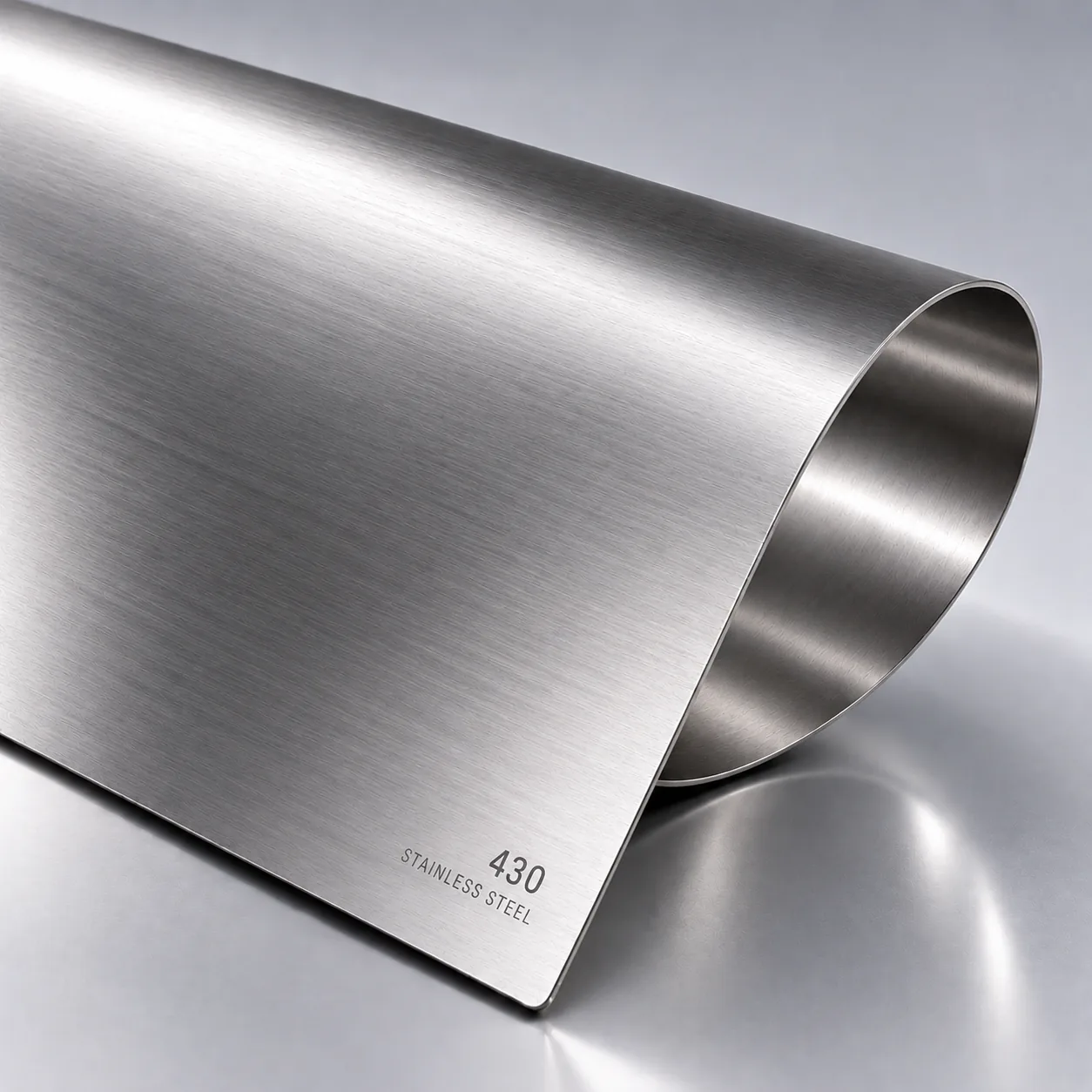
What 430 stainless steel is
430 is a ferritic chromium stainless steel: 16–18% chromium, carbon capped at 0.12%, and nickel held to 0.75% or below. That last figure is the whole story of the grade. 304 carries roughly 8% nickel, and nickel is the expensive element — so 430 substitutes a fully ferritic microstructure for the austenitic one nickel would have stabilised, and the price difference follows.
A ferritic structure behaves differently in three ways that are visible on the shop floor. It is magnetic, so a magnet sticks to a flat 430 sheet — unlike annealed 304. It cannot be hardened by heat treatment at all, only by cold work. And it grows grains in the heat-affected zone when welded, which is why the welding note further down matters more here than it does on 304.
Typical properties for engineering reference
Values below are typical for annealed sheet to ASTM A240. Confirm project-critical properties against the mill certificate: strength rises with cold work, and limits vary slightly between the ASTM, EN, JIS and GB editions of the specification.
| Property | Typical value (annealed sheet) |
|---|---|
| Density | 7.70 g/cm³ |
| Tensile strength | 450–600 MPa |
| Yield strength | ≥205 MPa |
| Elongation | ≥22% |
| Chromium / nickel | 16.00–18.00% Cr, ≤0.75% Ni |
| Corrosion resistance | Good in atmosphere, fresh water, food and dilute acids — poor in chlorides |
| Weldability | Fair — control heat input; ferritic grain growth in the HAZ |
| Magnetism | Ferromagnetic (a magnet sticks, annealed or formed) |
Where 430 is the right answer — and where it is not
The grade earns its place indoors and on appearance parts. Appliance panels, refrigerator and dishwasher liners, range hoods, elevator interiors, architectural trim and automotive decorative parts are all classic 430 work — surfaces that must look right, resist household atmosphere and take a brushed or polished finish, at a cost 304 cannot match.
The failure mode is chlorides, and it is not gradual. Without molybdenum, 430 pits and stains in coastal air, swimming-pool atmosphere, road salt and chloride-bearing process chemicals. Stainless steel does not rust like carbon steel; it stains from a pit, and on a visible panel that stain is the whole cost of having chosen wrong. If the part will ever see salt, specify 304 at minimum and prefer 316 near the coast.
- Right: indoor appliance panels, liners, trim, decorative and architectural interior work
- Right: heat-exchanger and radiant-tube parts, where its thermal conductivity beats austenitic grades
- Wrong: coastal or marine exposure, swimming-pool atmosphere, road-salt splash
- Wrong: anything that must be welded heavily and then loaded in fatigue — grain growth costs toughness
- Wrong: parts needing deep drawing beyond moderate severity — 304 draws further
How 430 behaves through fabrication
Laser cutting behaves much like 304 and gives a clean edge. Bending is where 430 differs: it work-hardens at a similar rate but has less elongation to spend, so tight-radius bends on thin sheet crack earlier than the same bend in 304. Set the inside radius from the material thickness and check it against our minimum bend radius data before the flat pattern is released, not after the first part fails.
Welding is possible with standard fusion processes, but 430 is the grade where heat input has to be planned. Ferritic stainless grows grains in the heat-affected zone and suffers 475 °C embrittlement if it sits too long in that range, so the discipline is low heat, fast travel, and no unnecessary passes. Where a part must be welded and then trusted, 439 — the titanium-stabilised ferritic grade — is the better specification, and we will say so at quotation rather than quote 430 and hope.
- Laser cutting: clean edge, comparable to 304
- CNC bending: work-hardens fast — respect the minimum inside radius on thin gauge
- Welding: control heat input; consider 439 for welded fatigue-loaded parts
- Finishing: polishes and brushes well; verify the finish supplier for cosmetic classes