
Minimum Flange Length: Why Short Flanges Cost More
Short flanges are the most common hidden cost in a folded part, and they are invisible in a 3D model. Everything looks fine right up to the point where the blank will not sit in the die.
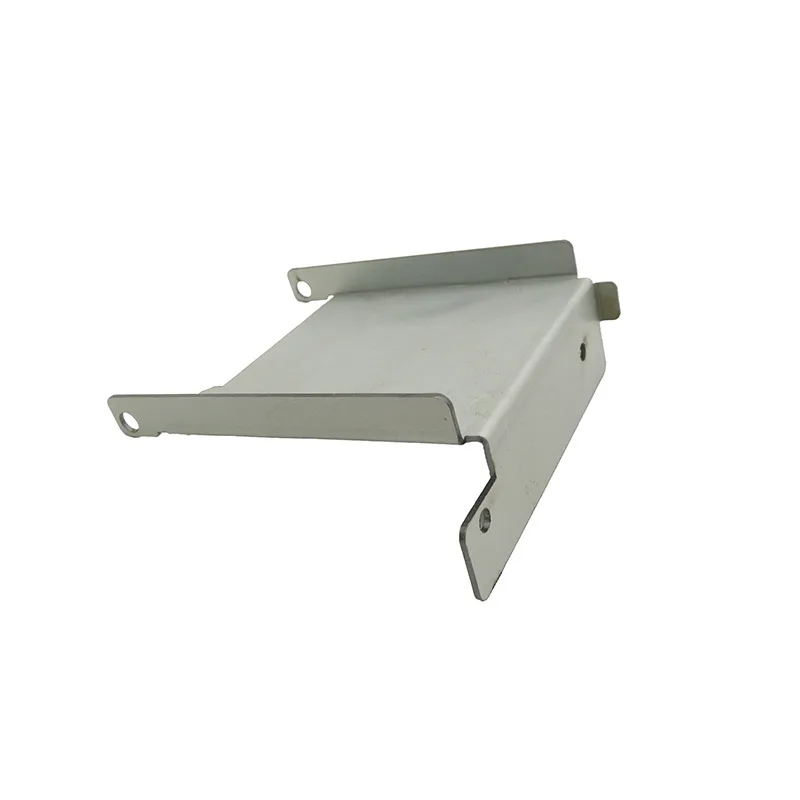
The shortest flange you can form is set by the V-die opening, because the part has to sit on both shoulders of the die during the stroke. As a working rule it is several times the material thickness — and a flange below it forces a tooling change, a different bend direction, or a redesign.
Why the die decides it
Air bending rests the blank on the two shoulders of a V-die while the punch pushes the material down between them. For that to work, there has to be enough flange on each side of the bend line to sit on the shoulder and stay put. Too little and the part tips into the die, the angle comes out wrong, or the flange slips off the shoulder altogether.
The die opening scales with material thickness: thicker material needs a wider V to bend at a sensible tonnage. That means the minimum flange grows with thickness, both because the shoulder is further from the centreline and because the material is less forgiving.
What the drawing usually asks for instead
A designer adds a 5 mm return flange to stiffen an edge or to give a screw somewhere to bite, in 2 mm steel. It looks trivial. In practice that flange may be at or below the limit for the die the part needs, and the options are all worse than changing the design.
| Option | Cost | When it is the right answer |
|---|---|---|
| Change to a smaller die opening | A tooling change and a setup, plus higher tonnage | Occasionally, if the bend is the only problem on the part |
| Reverse the bend direction | Geometry change, may collide with earlier flanges | When the sequence allows it |
| Form it in a second setup with different tooling | Extra handling and a second operation on every part | Rarely — it usually means the design should change |
| Replace the flange with a hem or a rib | No extra cost, changes the appearance | Most of the time |
| Make the flange longer | No cost, and it stiffens more | Whenever the function allows it |
| Use a welded or riveted stiffener | Extra part and an extra operation | Large panels where a return flange is impractical |
What happens when a flange is short
The companion rule: bend relief
A flange that runs to the edge of the part behaves differently from one that stops short. Where a bend line runs all the way off the edge of the blank, or where two bends meet at a corner, the material has to be given somewhere to go. That is what a bend relief is: a notch or a slot at the end of the bend line.
Without it, the corner tears or deforms as the material is drawn into the bend, and the tear is usually on the outside of the part. With it, the bend is clean and the corner holds its shape. Reliefs are one of the cheapest features on a drawing and one of the most commonly missing.
- Where two flanges meet at a corner, decide how the corner closes — overlap, butt or mitre — before the blank is drawn.
- A relief at the end of a bend line is cheaper than a re-cut part.
- Keep in mind that reliefs create a stress concentration if the corner is load-bearing.
- Where a flange carries a fastener, check the flange length against the washer and the tool clearance too, not just the die.
Frequently asked questions
What is a practical minimum flange length?
It follows the V-die opening, which follows the material thickness, so the honest answer is "several times the thickness, and we will confirm it against the tooling for your part". For a given part the check takes a few minutes at DFM stage; finding it out after cutting costs the whole blank.
Can you bend a flange shorter than the minimum?
Not reliably with the same tooling. The part will not sit on the die shoulders, so the angle and the flange position both suffer. Where a drawing genuinely requires it, there are usually better answers — a hem, a rib, or a longer flange — and we would raise them rather than quietly absorb the problem.
Do I need a bend relief?
Wherever a bend line runs to the edge of the blank, or two bends meet at a corner that has to stay intact. Without a relief the material tears as it is drawn into the bend. It is a small notch and it prevents a whole class of rejects.
How does material thickness change things?
It changes everything on this page. Thicker material needs a wider V-die and more force, which raises the minimum flange, the minimum bend radius and the minimum hole-to-bend distance at the same time. That is why adding thickness to solve a stiffness problem tends to cost more than adding a formed feature.
What about a hem instead of a flange?
A hem folds the material back on itself rather than leaving a flange. It stiffens an edge, removes a sharp edge and adds almost no depth — which is why it is so often the right answer where a short return flange was specified. It needs a slightly longer blank to form, which the flat pattern accounts for.
Send the drawing, get a real answer
An engineer reviews your model for manufacturability and returns a costed quotation — with the DFM observations that would change the price.