
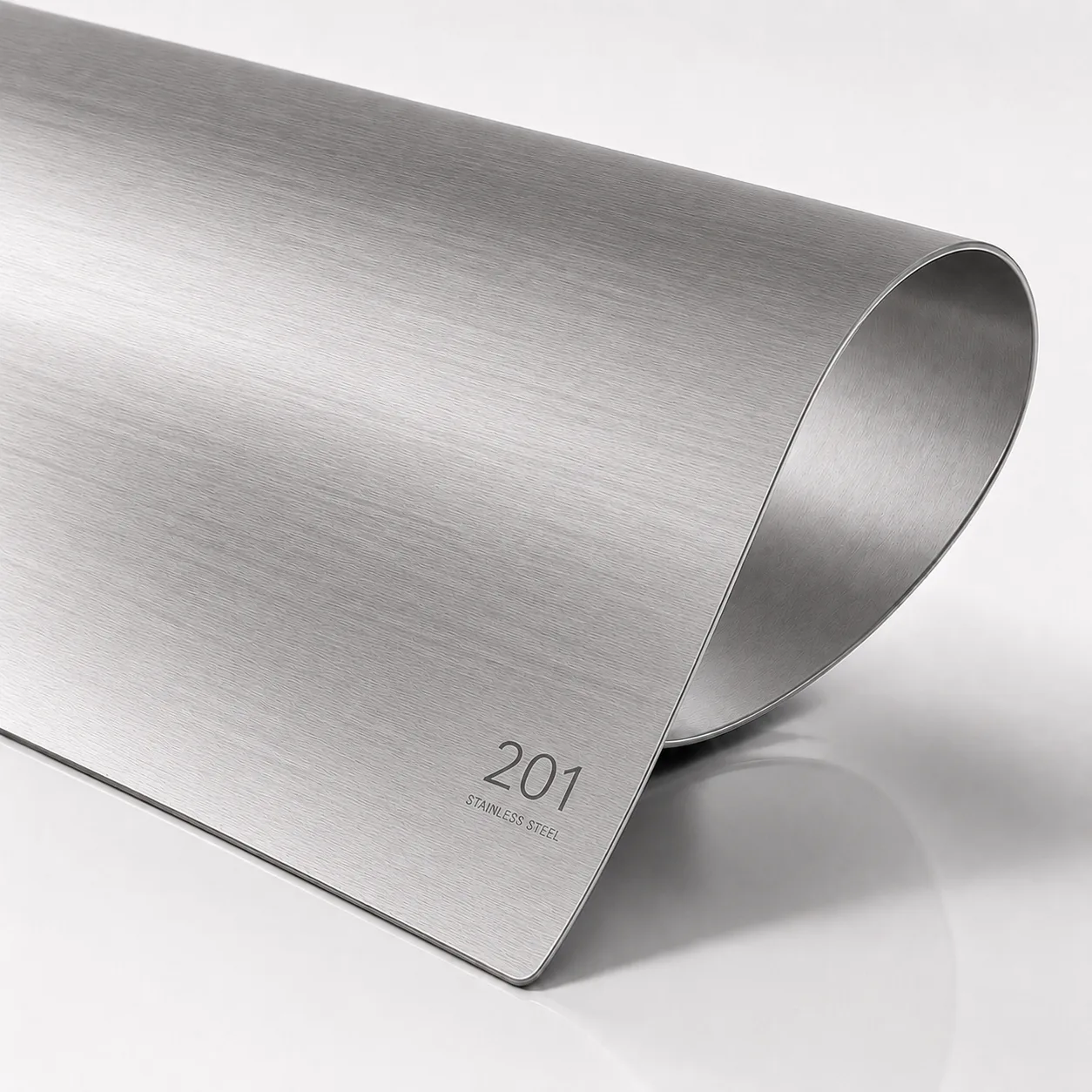
What 201 stainless steel is
201 is an austenitic stainless steel in the 200 series: chromium near 16–17% with manganese and nitrogen replacing roughly half the nickel that 304 carries (SUS201 on Asian drawings). The substitution keeps the austenitic structure — non-magnetic, formable, familiar to look at — while reducing raw-material cost.
The trade is corrosion reserve. Chromium is slightly lower, nickel is meaningfully lower, and the passive film that 304 maintains comfortably in damp or polluted air has less margin in 201. In a dry indoor environment the difference may never surface; in a humid plant, a coastal install or anywhere condensation cycles, 201 shows surface rust staining years before 304 would.
Typical properties for engineering reference
Typical annealed-sheet values below. Note the yield strength runs higher than 304 — 201 is actually stiffer in the early part of its curve, with correspondingly less ductility in the deep-forming window.
| Property | Typical value (annealed sheet) |
|---|---|
| Density | ~7.8 g/cm³ |
| Tensile strength | ≥515 MPa |
| Yield strength | ≥275 MPa — higher than 304 |
| Elongation | ≥40%, with less deep-draw margin than 304 |
| Corrosion resistance | Adequate dry indoor; visibly weaker than 304 in damp/ polluted service |
| Weldability | Works, but more operator-sensitive than 304 |
| Magnetism | Non-magnetic annealed; work-hardens similarly |
Fabrication behaviour: close to 304, with two cautions
Laser cutting, bending and general forming run essentially like 304 — the same thin-gauge window on the laser, the same work-hardening behaviour on the press brakes. The first caution is deep drawing: 201's reduced nickel gives less ductility in aggressive draw ratios, so deep-drawn parts are quoted with the grade question opened rather than assumed.
The second caution is welding and post-weld appearance. 201 welds, but the weld zone and heat tint need more attention to finish cleanly, and on a part that will not be passivated the seam area is where corrosion staining shows first. For indoor decorative parts that are brushed after welding, this is a non-issue; for functional parts it is a reason to reconsider the grade.
- Laser cutting: standard thin-gauge window, same as 304
- CNC bending: comparable; slightly stiffer feel on the brake
- Deep drawing: reduced margin — review draw ratio before committing
- Welding: functional but more finish-sensitive than 304
Where 201 is the right answer
201 earns its place in three situations, and they are common enough that we quote it weekly. Dry indoor decorative panels and trims where the stainless look matters and the environment is controlled. Cost-sensitive interior hardware at volume, where the price gap across thousands of parts is real money. And replacement or non-critical parts for indoor equipment where the original 304 was itself conservatively specified.
The wrong answers are equally specific: anything outdoors, anything washed, anything near the coast, anything carrying food or medical duties, and any part whose failure mode is visible rust staining on a customer floor. The saving over 304 is modest per part; the stain is permanent.
| Application | 201 acceptable? | Note |
|---|---|---|
| Dry indoor decorative panel | Yes | The natural home of the grade |
| Interior hardware at volume | Yes | Price gap scales with quantity |
| Outdoor enclosure | No | Staining and pitting risk |
| Washdown / wet environment | No | Specify 304 or 316 |
| Food or medical contact | No | 304 is the floor for those duties |
| Coastal installation | No | Chlorides defeat the thin reserve |
Surface finishes that suit 201
Brushed finishing is the everyday pairing — indoor decorative panels are the grade's core duty, and the brushed look is the point. Bead blasting works for a matte appearance. Passivation is still worthwhile on welded indoor parts, and powder coating behaves as on 304 where colour is required. What 201 does not get is the outdoor finish stack: no coating turns 201 into a 304-class outdoor material, and we will not pretend otherwise on a quote.
- Brushed finish: the standard indoor decorative pairing
- Bead blasting: matte indoor appearance
- Powder coating: for colour on indoor parts
Sourcing and how to specify it honestly
201 sheet is sourced through our supply chain like any other grade; the specification question is never availability, it is fitness. If your drawing says 304 and the duty is dry indoor, ask us whether 201 is worth a review — the answer saves real money at volume when it is honest. If the drawing says 201 and the duty is wet, we will push back before fabrication rather than after the first warranty photo.
That is the whole value of specifying material by duty rather than by habit: the grade is a cost decision and an engineering decision at the same time, and the RFQ is where both belong.