
Reading a brass designation
Brass grades are named by their copper content. In the Chinese standard GB/T 5231 the designation is literal — H62 is a brass with a nominal 62% copper, H65 has 65%, H70 has 70%. Western systems use four- or five-digit UNS numbers instead, so C26000 is a 70/30 brass and does not map one-to-one onto the H series, though the families correspond.
Two other elements appear in this family and change its behaviour. A small lead addition improves machinability at the cost of weldability and of restrictions in some markets. Arsenic is added in some grades specifically to suppress dezincification — the selective leaching of zinc that attacks brasses in aggressive water and saline conditions.
The two grades that matter most in sheet metal
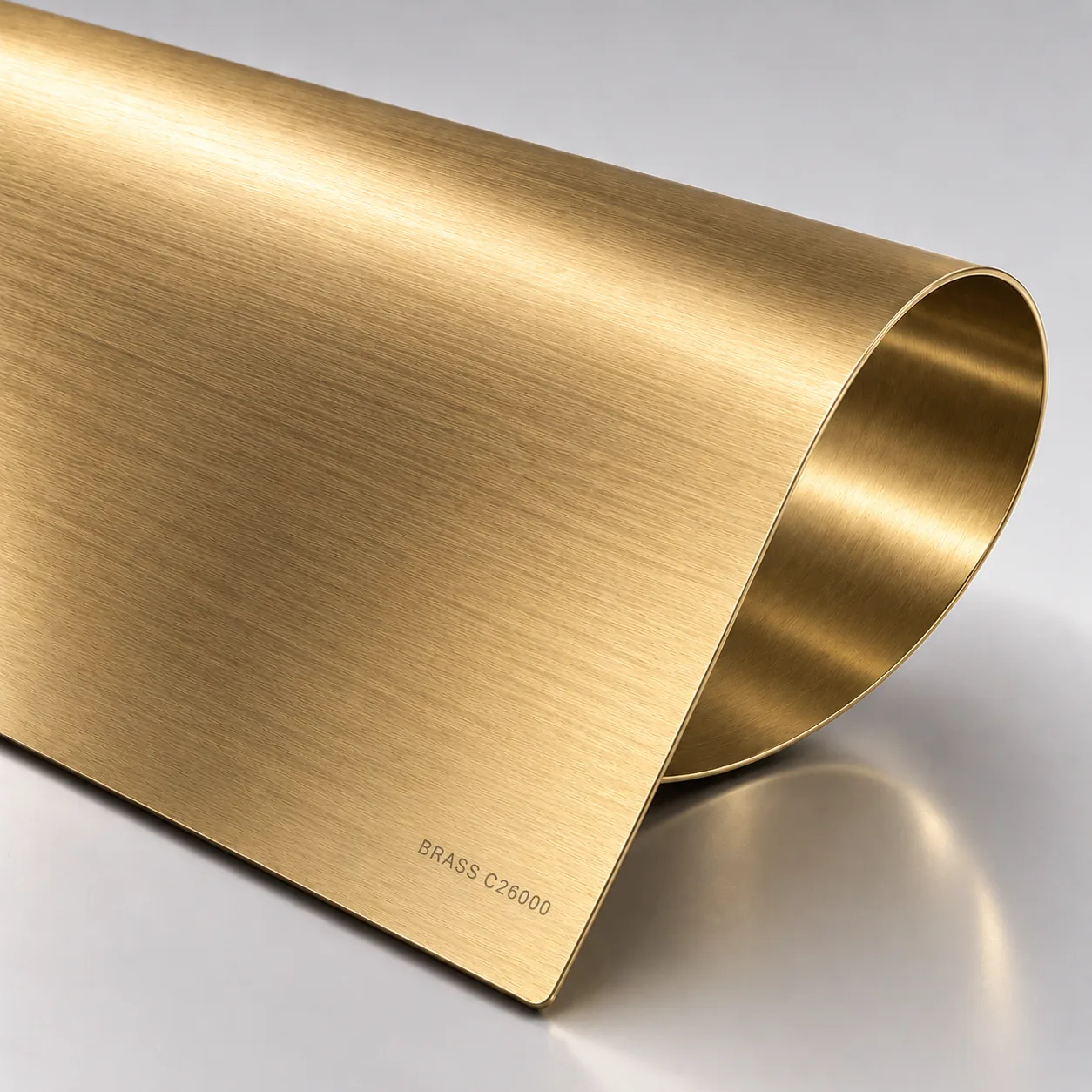
C26000 cartridge brass, at 70% copper, is prized for deep drawing: it will form a cup or a drawn shell in a single operation that would need an intermediate anneal in a leaner brass. That ductility is why it turns up in drawn enclosures, cosmetic shells and formed decorative parts.
H62, at roughly 62% copper, gives up some of that ductility in exchange for higher tensile strength and hardness, better machinability and a lower copper cost. It is the grade for terminals, connectors, fittings and hardware — parts that are bent and blanked rather than deeply drawn, and that need to hold their shape in service.
| Grade | Copper | Ductility | Strength | Typical use |
|---|---|---|---|---|
| C26000 (70/30) | ~70% | Excellent — deep drawing | Moderate | Drawn shells, cosmetic parts |
| H65 / H70 | ~65-70% | Very good | Moderate | General formed parts, hardware |
| H62 (62/38) | ~62% | Moderate | Higher | Terminals, connectors, fittings |
Fabrication, joining and tarnish
Both grades blank and bend on standard equipment, and both work-harden, so a deep or multi-stage form may need an intermediate anneal. Laser cutting is straightforward; the cut edge takes a finish in the same way as the surface.
Joining is where brass differs from steel. Soft soldering and brazing are the standard routes and both work well on electrical parts. Fusion welding is a poor fit because zinc volatilises at welding temperature, causing porosity and fume — so a design that avoids welded brass joints is usually the better engineering answer.
Finally, tarnish. Brass darkens in handling and in atmosphere, and the effect is stronger as zinc content rises. Where the appearance matters, specify a clear lacquer, a plated finish such as nickel, or a powder coating — and fix the sequence, because a coating applied before soldering will not survive the soldering.