
Sheet Metal Bend Radius: What the Process Holds
Bend radius is the design dimension that decides whether a part forms cleanly or cracks on the first stroke. It is not an arbitrary call-out — it is a function of the material and temper, the grain direction and the thickness — which is why the same radius that works in cold-rolled steel will fail in a hard aluminium temper.
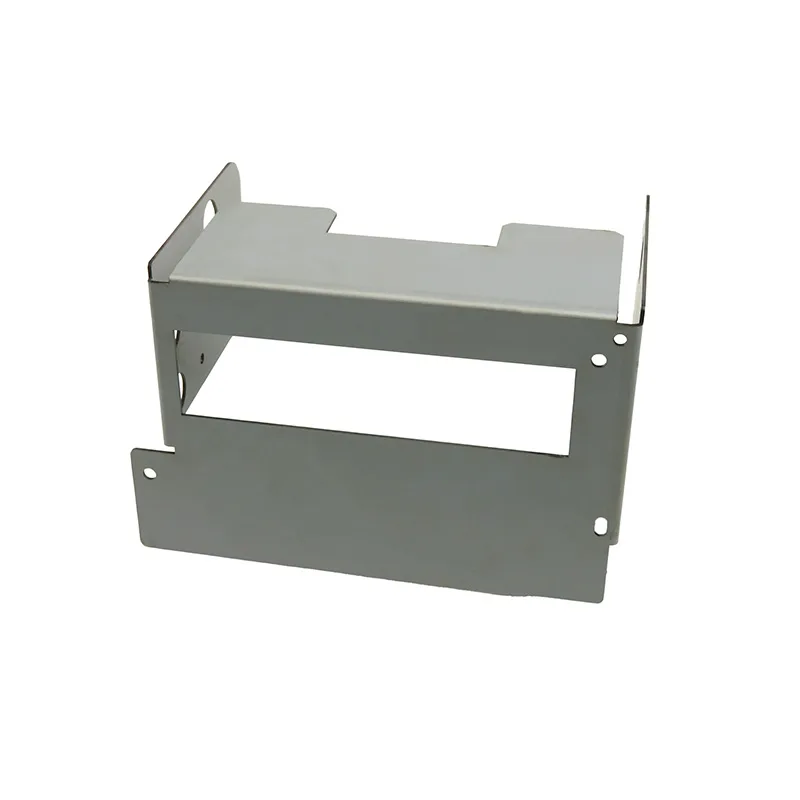
The minimum bend radius is set by the material's elongation at the outside surface: the outer fibre must stretch without cracking. As a working rule the inside radius is at least the material thickness for mild steel, but soft aluminium allows less and 6061-T6 considerably more.
01What actually limits the radius
When sheet is bent, the outside of the bend stretches and the inside compresses. Failure starts on the outside, as a tensile crack, when the strain exceeds what the material can take. The strain is governed by the ratio of the radius to the thickness, so a given radius becomes progressively more severe as the material gets thicker.
That is the origin of the familiar shorthand that the minimum inside radius equals the thickness for mild steel. It is a useful default and a poor universal rule, because it says nothing about the elongation figure, the temper or the direction of the bend relative to the rolling direction.
02Working minimums by material
| Material | Typical minimum inside radius | Notes |
|---|---|---|
| Mild steel / cold-rolled (SPCC) | 1 × t | The usual default; annealed stock tolerates less |
| Galvanised steel (SGCC, SECC) | 1 × t | Zinc can crack or flake at the outside of a tight bend |
| Stainless 304 | 1 × t to 1.5 × t | High elongation but strong work-hardening; may need a larger radius on a second bend |
| Stainless 316 | 1 × t to 1.5 × t | As 304, with slightly more springback |
| Aluminium 5052-H32 | 1 × t | Good formability for an aluminium; the practical choice for bent panels |
| Aluminium 6061-T6 | 2 × t to 4 × t | Hard temper; cracking is common below 2 × t, especially across the grain |
| Copper / brass | 0.5 × t to 1 × t | Soft and highly formable; the constraint is usually tooling, not cracking |
Typical minimum inside bend radius as a multiple of thickness (air bending, room temperature)
03Inside radius, outside radius and what the drawing should say
Bend radius is ambiguous unless it is qualified. The inside radius is set by the punch or the die opening and is the dimension the tooling determines. The outside radius is the inside radius plus the thickness. Because the neutral axis sits between them, the flat pattern length depends on which one the model was built from.
State the inside radius, and state it per feature rather than as a blanket note. A drawing that says "minimum bend radius 1 × t" alongside a geometry whose tightest bend is 0.4 × t will be caught at DFM review, but it is faster to specify the geometry you want and let the shop confirm the tooling can produce it.
04Where cracking actually starts
- Bending across the rolling direction rather than along it — the material has less ductility across the grain.A bend line that passes through a sheared or laser-cut edge with a burr, because the burr acts as a stress raiser.A bend whose radius falls below the material minimum, especially on hard-temper aluminium.
- A bend placed too close to a hole, so the hole deforms and the material around it tears.A bend run on tooling narrower than the recommended die opening, which sharpens the effective strain.A second bend immediately adjacent to the first, where the work-hardened zone is bent again.
05The tooling side of the same question
Even where the material would allow a tighter radius, the tooling may not. Air bending sets the inside radius from the die opening, and standard press-brake tooling covers a finite set of punch profiles. A call-out tighter than the available punch means either a special tool or a different process.
This is why a shop will sometimes ask you to widen a radius that the material could technically take. The constraint is not the metal; it is whether a punch exists to form it at that width without marking the part. If you want to know what your part will cost before committing, the bend radius is one of the inputs the cost model uses.
Frequently asked questions
What is the minimum bend radius for sheet metal?
A common working default is one times the material thickness for mild steel. It is not universal: soft aluminium and copper allow less, while 6061-T6 and other hard tempers need two to four times the thickness. The governing property is the material's elongation.
Why does the radius need to increase with thickness?
Because the strain at the outside surface grows as the radius-to-thickness ratio falls. A 1 mm radius on 1 mm sheet is a 1:1 ratio; the same radius on 3 mm sheet is 1:3 and will crack. The radius has to scale with thickness to keep the strain constant.
Is it the inside or outside radius that matters?
The inside radius, because that is what the punch and die determine and what the bend calculation is written around. The outside radius is simply the inside radius plus the material thickness. Specify the inside radius on the drawing to avoid ambiguity.
Can I bend 6061-T6 aluminium?
Yes, but not tightly. It is a hard temper with limited elongation, and 2 × t to 4 × t inside radius is the practical window — more when bending across the grain. Where a tight radius is essential, 5052 is usually the better alloy for a formed part.
How does bend radius affect cost?
Indirectly, through the bending time and the tooling it requires. A radius that needs a special punch or an extra operation costs more than one a standard punch produces, and a radius so tight that parts crack costs far more, because cracking is discovered as scrap.
Send the drawing, get a real answer
An engineer reviews your model for manufacturability and returns a costed quotation — with the DFM observations that would change the price.