
Materials

65Mn Spring Steel: Properties & Heat Treatment

65Mn is the grade where the fabrication sequence matters more than the material. It arrives soft so it can be formed, and only becomes a spring after heat treatment — so the drawing has to specify both states, and the shop has to know which one it is holding. It is also the grade where we most often talk an engineer out of welding.

Reviewed by Tom, Senior Process Engineer·Dongguan source factory · 11+ years in precision sheet metal
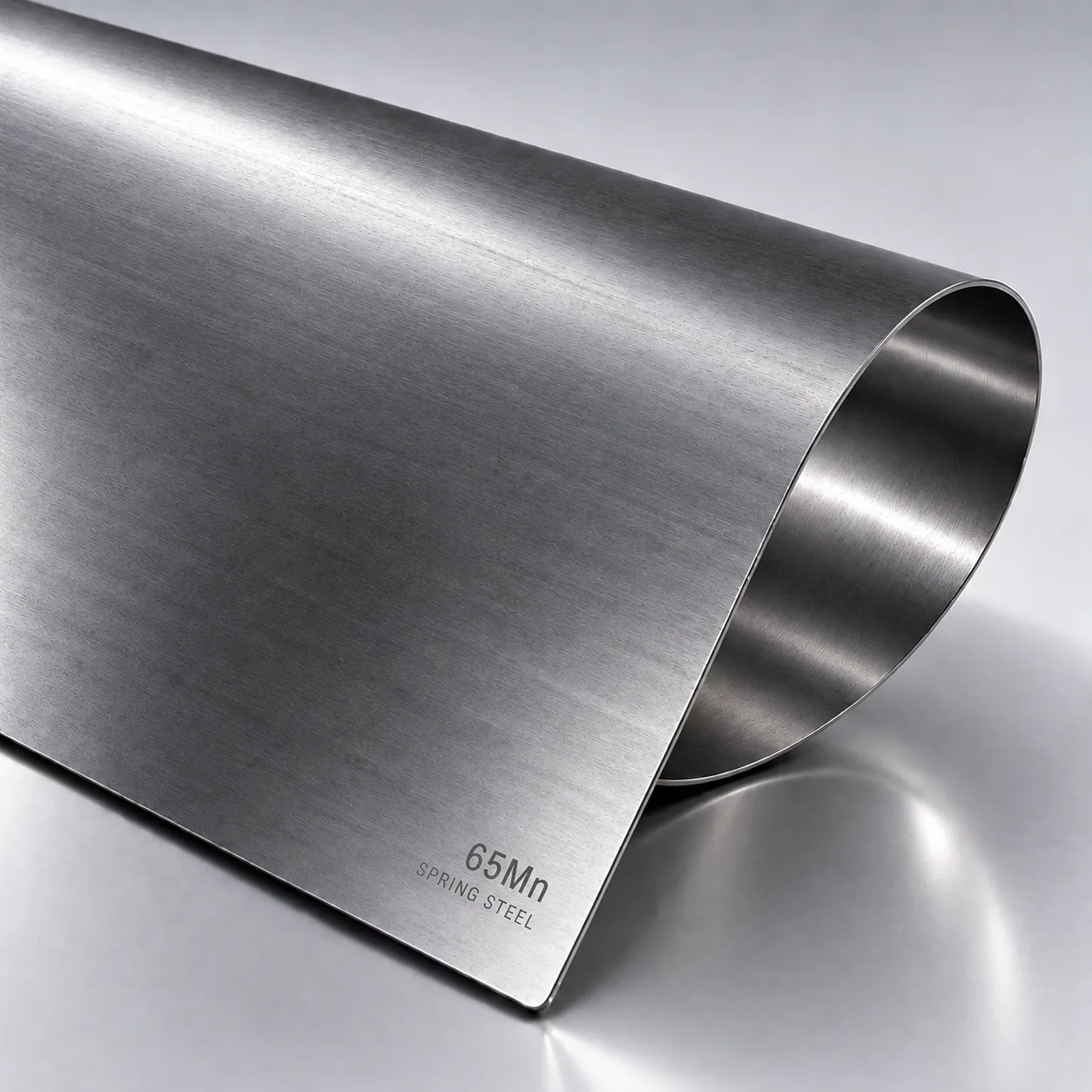
spring steel 65mn sheet sample — 65Mn spring steel
Short answer

65Mn is a Chinese-standard manganese spring steel to GB/T 1222, supplied annealed and then hardened and tempered after forming. In the annealed state it machines and forms at roughly 735 MPa tensile; after quench and temper it reaches 980 MPa and above, which is why it is specified for clips, retaining rings and flat springs rather than for folded sheet parts.

65Mn

Mechanical Properties

Open in the data sheet
Density
7.85
Tensile Strength
735 MPa (annealed)
Yield Strength
430 MPa (annealed)
Elongation
14–21%
Weldability
Poor (cracks without preheat)
Corrosion Resistance
Poor (requires coating)
Thickness Range
0.3mm – 2.0mm
Chemical composition
C: 0.62% – 0.70%, Si: 0.17% – 0.37%, Mn: 0.90% – 1.20%, P: ≤0.035%, S: ≤0.035%, Cr: ≤0.25%, Ni: ≤0.25%, Cu: ≤0.25%, Fe: balance
Equivalent Grades
CN
GB/T 1222 65Mn
US
AISI 1065 (similar)
JP
—
EU
—

What 65Mn is

65Mn is a high-carbon manganese spring steel: 0.62–0.70% carbon with 0.90–1.20% manganese. The manganese raises hardenability enough that a 12 mm section through-hardens in oil, and it produces a steel with a better combination of strength, elasticity and wear resistance than plain high-carbon steel of the same carbon level, at meaningfully lower cost than a chrome-vanadium spring grade.

It is a GB/T 1222 grade, which means it is common in Chinese-sourced parts and less familiar elsewhere — there is no direct ASTM equivalent, though 1065 is the nearest US comparison and is not interchangeable in a hardening specification. If a drawing originating outside China names 65Mn, the design intent is usually a hardened flat spring or clip, and the closest local grade should be confirmed rather than assumed.

Typical properties for engineering reference

This is the one grade on the site where a single column of numbers would be actively misleading, so the table gives both states. The as-supplied figures are what a formed part is worked in; the hardened figures are what the finished spring delivers. Confirm the heat-treatment specification against the drawing, not against this table.

PropertyAs supplied (annealed / hot-rolled)After quench and temper
Density7.85 g/cm³7.85 g/cm³
Tensile strength≈735 MPa≥980 MPa
Yield strength≈430 MPa≥784 MPa
Elongation14–21%≥8%
Hardness≤302 HB (hot-rolled)38–60 HRC
Carbon / manganeseC 0.62–0.70%, Mn 0.90–1.20%unchanged
WeldabilityPoor — hard, brittle HAZ without preheatNot welded after hardening
65Mn spring steel (GB/T 1222) — typical values by condition

Working with 65Mn

The sequence is fixed: form in the annealed state, then harden and temper. Quench is typically oil at around 830 °C, followed by tempering near 540 °C — water quenching is avoided because it cracks, and the grade is sensitive to overheating, which coarsens the grain and leaves the part brittle rather than springy. That heat treatment is a specialist process; we send it to a partner hardening shop with the specification, not to a general finisher.

Welding is the step to design out. 65Mn welds poorly in any condition: the heat-affected zone hardens and cracks without preheat and interpass control, and welding a part that has already been hardened destroys the temper locally. Where a spring steel part needs to be joined, the usual answer is a mechanical joint, a rivet, or a redesign that puts the spring element in a separate piece.

  • Form annealed, then harden and temper — the order is not optional
  • Design out welding; use mechanical joints instead
  • Bare 65Mn rusts — plan for plating, coating or an oiled finish
  • Specify the final hardness or tempering temperature, not just the grade

Frequently asked questions

Is 65Mn the same as 1065 steel?

No, though they are close relatives. Both are high-carbon spring steels, but 65Mn is a GB/T 1222 grade with a defined manganese range for hardenability, and 1065 is an AISI carbon steel without that specification. They are not interchangeable in a hardening specification — if a drawing calls for 65Mn, confirm whether an equivalent grade is acceptable rather than substituting silently.

Can 65Mn be welded?

It can be welded, but it should not be part of a design if it can be avoided. The heat-affected zone hardens and becomes crack-prone without preheat and interpass temperature control, and welding a hardened part destroys the temper locally. For spring elements that must be attached, use a rivet or mechanical joint, or split the part so the spring is separate.

What hardness does 65Mn reach?

After quench and temper it is typically 38–60 HRC depending on the tempering temperature — higher tempering gives lower hardness and more toughness. The as-supplied hot-rolled condition is around 302 HB maximum. The usable spring properties come from the heat treatment, so the tempering temperature belongs on the drawing.

Does 65Mn need a coating?

Yes. It is a plain carbon spring steel with no alloying for corrosion resistance, so bare 65Mn rusts readily. Plating, phosphate-and-oil, or a coating is normal. Coating is carried out by our long-standing partner finishers to our specification, and inspected before dispatch.

Does WERIX hold 65Mn in stock?

WERIX does not mill metal. Common grades and thicknesses are held in stock for same-week cutting; anything outside that is sourced to order and confirmed at quotation, together with the mill certificate for the lot being used.

Send the drawing, get a real answer

An engineer reviews your model for manufacturability and returns a costed quotation — with the DFM observations that would change the price.