
Trimming & Edge Cropping
Trimming removes the material a forming operation leaves behind — the flange on a drawn part, the skeleton after a stamping pass, or the excess on a blank — so the part reaches its final outline. In die work it is a station in the sequence; on a formed or drawn part it is usually a second operation. The edge it leaves is square, and is deburred as a following step.
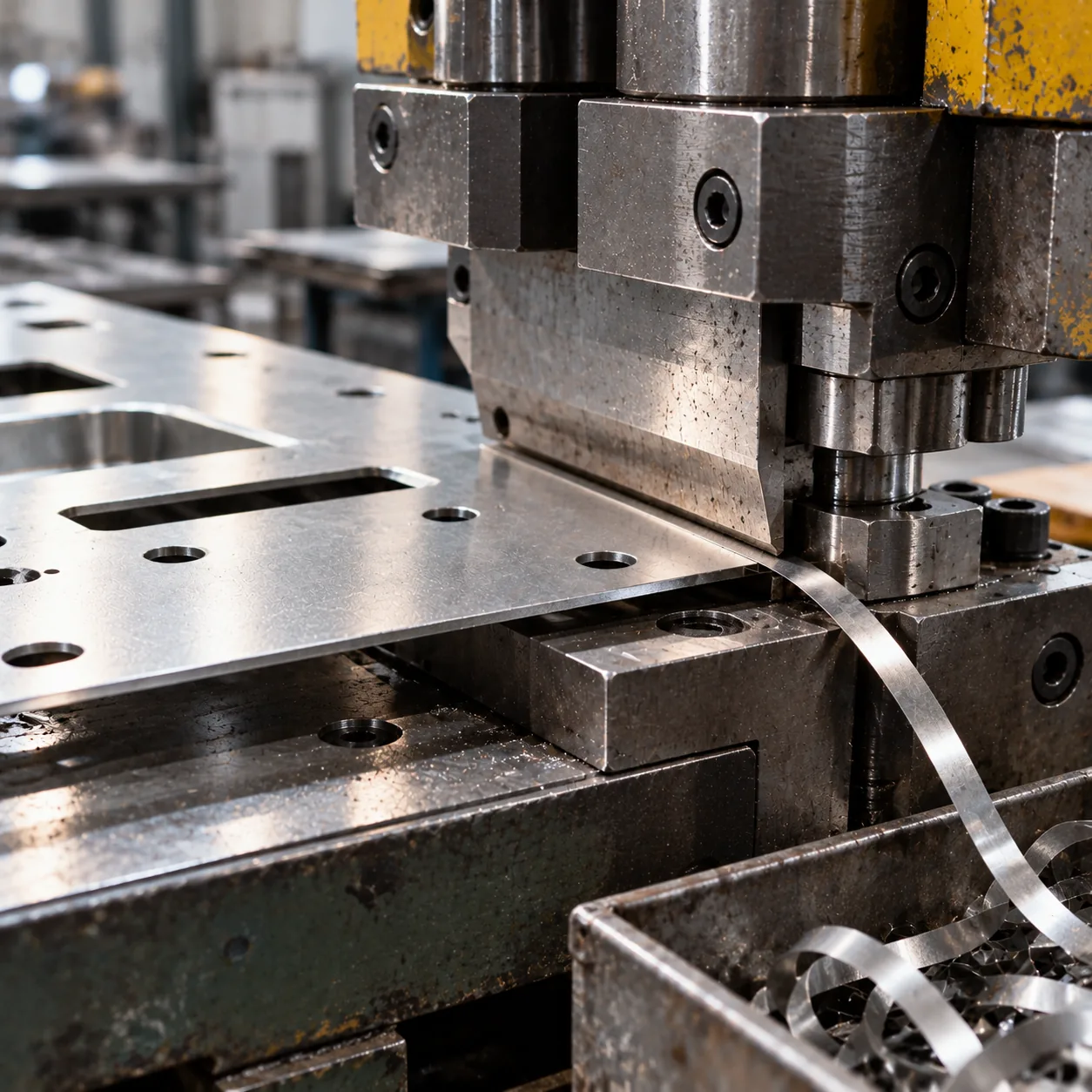
Trimming removes the material a forming operation leaves behind, so the part reaches its final outline. That means the flange on a drawn part, the skeleton left after a stamping pass, or the surplus on a blank. In progressive die work it is a station inside the sequence; on a drawn or formed part it is usually a separate second operation. The edge it leaves is square and is deburred as a following step.
Where does trimming sit in a die sequence?
In a progressive die, trimming is one of the stations that shapes the outline as the strip advances, working alongside piercing and forming. In transfer and deep-drawing work the part leaves the form with a flange the drawing process needed but the finished part does not, and trimming removes it. Order matters: trimming after forming lets the material flow freely during the draw, where trimming first would restrict it.
Trim die or laser?
A trim die costs money up front and then produces edges in a fraction of a second each, so it belongs on production volumes and on parts whose shape is settled. Laser trimming needs no tooling at all and is the sensible route for prototypes, for low volumes, and for designs still moving, where a die would be scrapped after the first revision. The break-even sits in the low thousands of parts for most geometries.
How does trimming differ from blanking?
Blanking cuts the entire outline of the part from the sheet in one operation, producing the part and leaving the skeleton as scrap. Trimming removes material from a part that already exists in roughly its final form, correcting the outline after forming or drawing. A part needing both is blanked slightly oversize on purpose, formed, then trimmed to the final dimension, which keeps the forming operation free of the precision the outline requires.
What edge quality does trimming leave?
A trim die leaves a square, sheared edge with the usual shear zone and a burr on the exit side, and that burr is removed in the deburring step rather than left on the part. Laser trimming leaves a cut edge with a small heat-affected zone and light dross on thicker material. Where the drawing calls for a radius or a specific edge condition, that is produced as a separate finishing step and verified against the drawing.
Trimming: tooling choice and the edge it produces
| Situation | Method | Edge and economics |
|---|---|---|
| Prototype or low volume | Laser trimming | No tooling cost; heat-affected zone, light dross |
| Production, shape settled | Trim die | Square sheared edge; break-even in the low thousands |
| Inside a progressive die | Trim station in sequence | No extra handling between operations |
| Drawn part with a flange | Second-operation trim | Flange removed after the draw completes |
| Every trimmed part | Deburr as the next step | Sheared burr removed before finishing |
Common questions about Trimming & Edge Cropping
What is the difference between trimming and blanking?
Blanking produces the part outline from flat sheet in one cut; trimming corrects the outline of a part that already exists in near-final form, usually after forming or drawing. Blanking creates the part, trimming finishes its edge. Where both are needed, the blank is deliberately cut oversize so the forming operation is not constrained by the final outline tolerance.
When is a trim die worth the tooling cost?
Around the low thousands of parts for most geometries. Below that, laser trimming does the job with no tooling investment and allows the design to keep changing. Above it, the per-part time of a die falls far below cutting each part individually, and the edge quality is more consistent from part to part.
Can laser cutting replace a trim die?
For prototypes, low volumes and evolving designs, yes, and it is usually the better choice there because there is no tooling to write off when the drawing changes. At production volume the comparison turns on cycle time: a trim die produces an edge in a fraction of a second, where laser cutting each part takes seconds and adds a heat-affected zone along the edge.
Does trimming affect the drawing operation?
The sequence does. Trimming before forming would restrict how the material flows into the draw, which risks tearing and limits the depth achievable. Trimming after forming lets the material move freely and then corrects the outline, which is why a drawn part is normally formed with a flange and trimmed afterwards.
Materials we run this process on
Related capabilities and next steps
Specifications
Capabilities
Sheet metal engineering guides
 Sheet Metal Fabrication vs CNC Machining: How to Choose the Right ProcessSheet metal fabrication and CNC machining serve different geometries, volumes, and budgets. This data-backed comparison covers cost, tolerance, materials, and lead time.Read More
 DFM for Sheet Metal: Essential Design Rules That Save Cost and Prevent Production FailuresDesign-for-manufacturing rules for sheet metal — minimum hole sizes, bend radii, edge distances, tab-and-slot design, and common mistakes that cause scrap.Read More
Ready to get started?
Upload your design for a quote with DFM analysis — our engineers respond within 24 hours.