
Die Maintenance & Repair
Our in-house toolroom services every die we build on a stroke-count schedule — inspection, regrind, bushing replacement and re-trial — so wear is corrected before it reaches the part. Worn sections are machined as replacement inserts rather than scrapping the whole die, and dies built by other shops are taken over and restored.
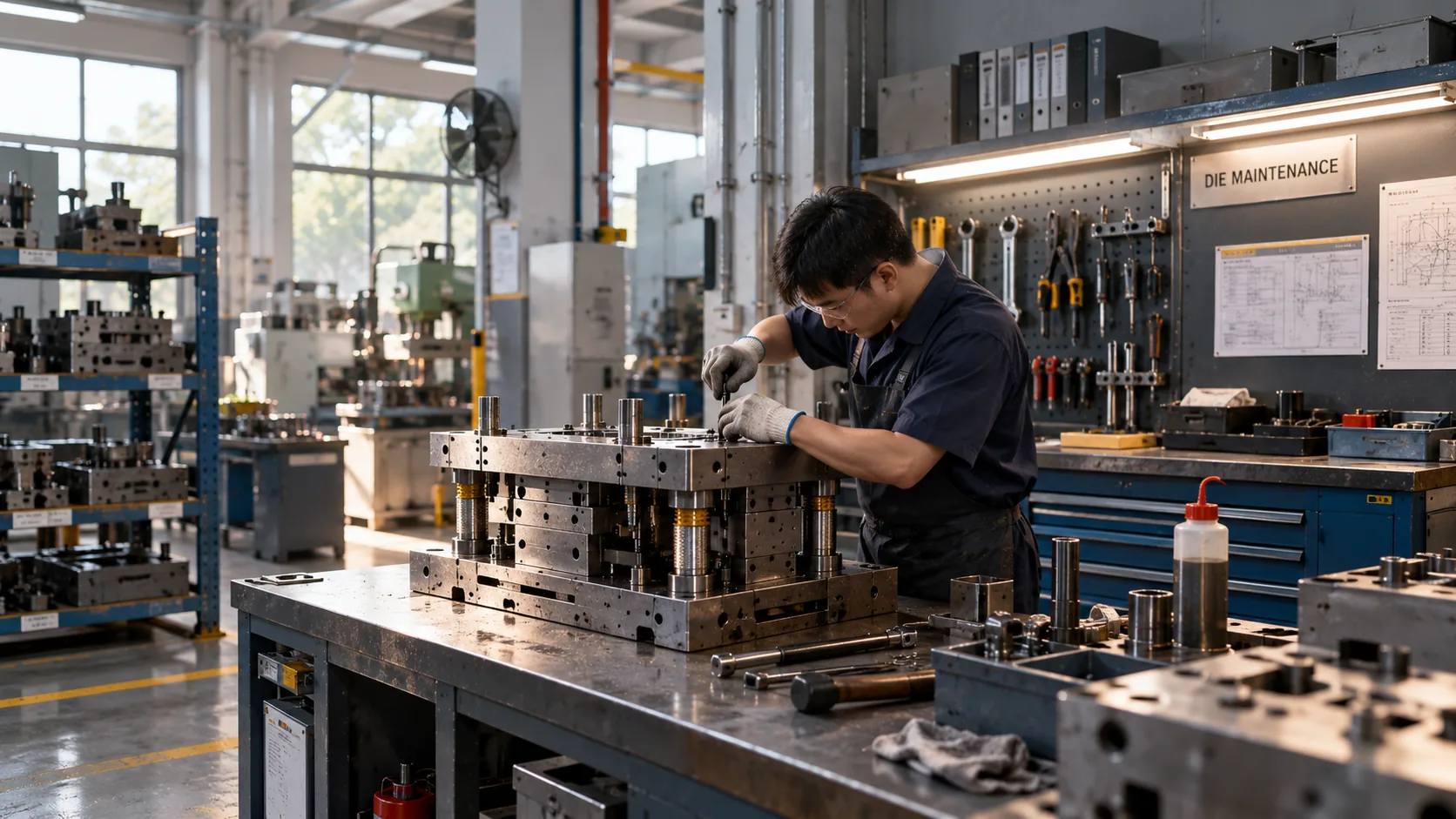
Die maintenance is the scheduled inspection, sharpening, repair and re-trial that keeps a stamping die producing in-tolerance parts for its full life. Our in-house toolroom services every die we build on a stroke-count schedule, correcting wear before it reaches the part — which is what lets a progressive die hold ±0.01 mm across runs of up to one million strokes.
How often should a stamping die be serviced?
We schedule maintenance on stroke count rather than calendar time, because wear tracks the number of hits, not the weeks elapsed. A progressive die in mild steel is inspected at roughly every 100,000 strokes, with full disassembly, guide-bushing replacement and punch regrind at the intervals the die's run history dictates. Dies running abrasive or high-strength material are serviced more often.
What does a die maintenance visit include?
Every visit opens the die, clears slug and galling, checks guide bushings and heels, measures critical punch and die dimensions against the first-article record, and regrinds or replaces worn cutters. We log the stroke count, the parts replaced and the measured wear so the next interval is set from data rather than guesswork.
Can a worn die be restored without losing accuracy?
Yes, provided wear is caught early. Punches and dies are reground to restore cutting edges, pilots and forming radii, and the die is re-trialled with first-off measurement before production resumes. Where a section has worn beyond regrind we machine a replacement insert rather than scrapping the whole die — which is exactly why keeping the toolroom under the same roof as production matters.
Die maintenance: intervals and what each visit checks
| Trigger | Action | Why it matters |
|---|---|---|
| Every ~100,000 strokes | Inspect, clean, measure critical dimensions | Catches wear before it reaches the part |
| Every ~500,000 strokes | Full strip, bushing + heel check, regrind | Restores cutting edges and guidance |
| Worn section detected | Machine a replacement insert | Avoids scrapping the whole die |
| Material change (abrasive / HSLA) | Shorten the interval | Those materials wear tooling faster |
| First-off after service | Full dimensional re-trial | Confirms accuracy before production |
Common questions about Die Maintenance & Repair
Do you maintain dies built by other tool shops?
Yes. We routinely take over maintenance, repair and modification of dies we did not build, provided we can assess condition and obtain or reverse-engineer the drawings. Send the die or its prints and we will quote the restoration and set a maintenance schedule from its actual wear history.
What happens if a die wears past tolerance between services?
That is why we inspect on stroke count and keep a measured wear record — the interval is shortened the moment trend data shows drift. Parts are checked at first-off and at a defined sample rate during the run, so a worn cutter is caught at inspection, not at the customer's assembly line.
Is die maintenance included in the part price?
Tooling maintenance is a separate line from part production, because the cost belongs to the die's life, not to any single order. You own the die, so you own its upkeep; we store, service and document it for the life of the programme and quote maintenance transparently when it falls due.
Related capabilities and next steps
Specifications
Capabilities
Ready to get started?
Upload your design for a quote with DFM analysis — our engineers respond within 24 hours.