
Tapping & Threaded Holes
Tapping puts an internal thread directly into a sheet metal part, so a screw fastens to it without a separate nut. Form tapping cold-forms the thread in a pre-drilled hole and leaves it stronger than a cut thread, because the metal is displaced rather than removed. Where the sheet is too thin to hold a reliable thread, a rivet nut or a self-clinching nut is inserted instead.
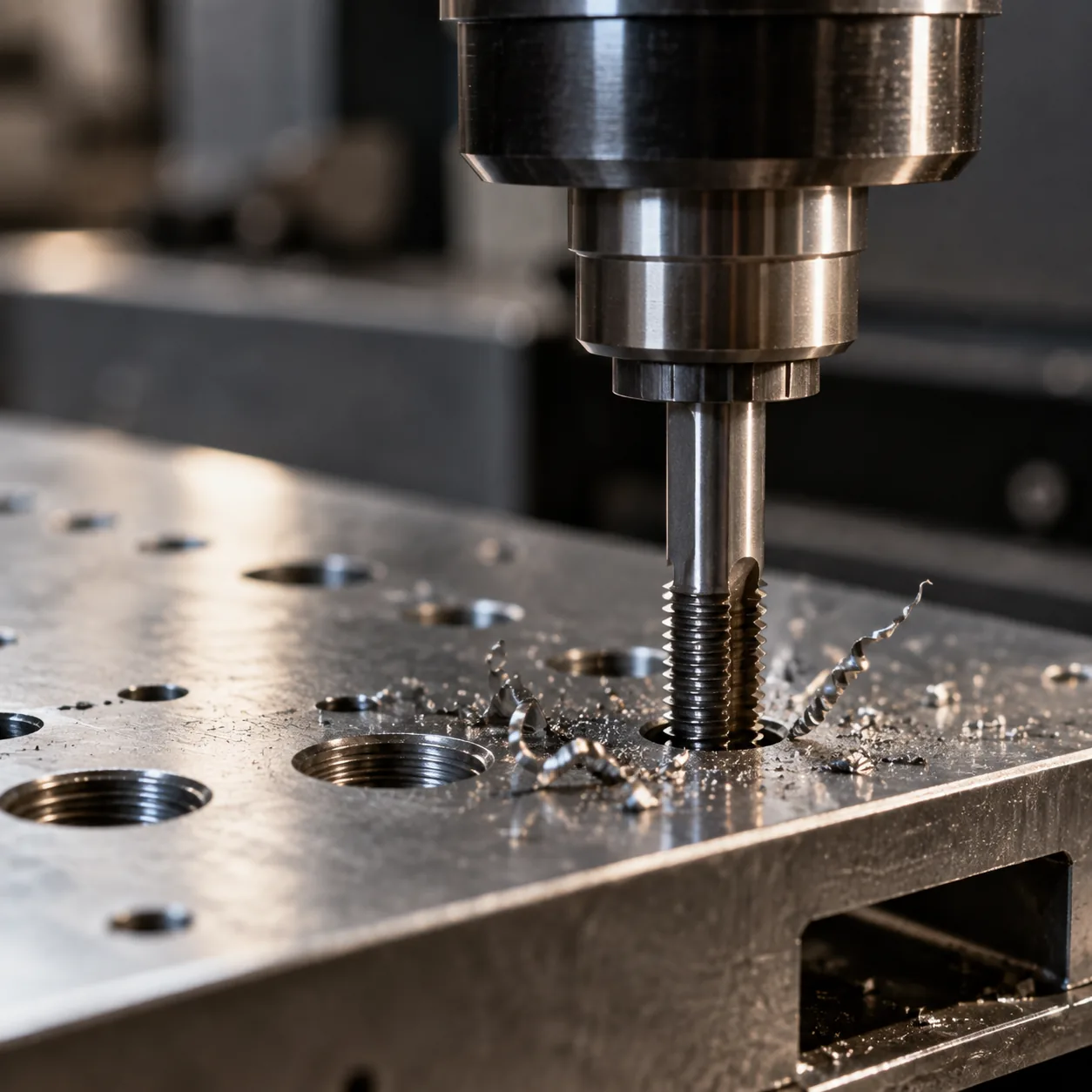
Tapping puts a thread directly into the sheet metal so a screw attaches to the part without a loose nut behind it. Form tapping displaces the metal rather than cutting it away, which leaves a stronger thread than a cut tap in the same hole. Where the sheet is too thin to hold a reliable thread at all, a rivet nut or self-clinching nut is inserted instead. The choice between tapping and inserting is decided by thickness, not by preference.
When is form tapping the right choice?
Form tapping needs enough material around the hole for the thread to form without the sheet deforming, and in practice that means roughly one millimetre of steel or more. Aluminium needs more thickness than steel for the same thread, because it is softer and the thread strips more easily. Where the thickness is there, the formed thread is the better one: the metal is cold-worked as it flows into the thread form, which leaves it measurably stronger and produces no chips to clear.
When is a rivet nut the better answer?
Below the thickness a thread can survive, and anywhere the joint has to come apart repeatedly, a rivet nut or self-clinching nut is the correct specification. The fastener carries the load instead of the sheet, the sheet can be thin, and the result is still a threaded attachment point installed in one press operation. Blind-side access is not required, which matters on a closed enclosure where the back face cannot be reached.
How is thread quality verified?
Thread depth and form are checked with go and no-go gauges, so a thread that is too shallow or damaged is caught here rather than on the customer assembly line. Where a threaded joint carries load, we also run push-out and torque tests on the first article and repeat them whenever the tooling or the material changes.
Does tapping have to happen before finishing?
Yes. Tapping after coating would damage the coating around the hole and expose bare metal, which is exactly where corrosion starts. On parts that will be anodised or plated the thread also grows slightly with the coating thickness, so thread size is specified against the finished dimension rather than the bare one.
Tapping and threaded inserts: design rules
| Rule | Guideline | Failure mode if ignored |
|---|---|---|
| Minimum thickness for form tapping | ≥ 1.0 mm in steel; more in aluminium | Thread strips under load |
| Hole diameter for form tapping | Per the tap maker chart, not a drill chart | Torn or oversized thread |
| Hole-to-edge distance | ≥ 2 × thread diameter | Edge bulge, thread distorts |
| Thread engagement | ≥ 1.5 × thread diameter in steel | Screw bottoms out or strips |
| Sheet below the limit | Rivet nut or self-clinching nut | No reliable thread at any torque |
Common questions about Tapping & Threaded Holes
What is the difference between form tapping and cut tapping?
Cut tapping removes metal to create the thread; form tapping displaces it. The formed thread is stronger because the material around it is cold-worked in the process, and there are no chips to clear from blind holes. The trade-off is that form tapping needs a larger pilot hole and more material thickness, since it relies on the metal flowing rather than being cut away.
Can a hole be tapped after powder coating?
It should not be. Tapping through a cured coating damages the coating around the hole and exposes bare metal, creating a corrosion path exactly where moisture collects. The standard sequence is tapping, then deburring, then finishing. Where a thread is needed in a coated assembly, a masked area or a rivet nut installed before coating is the cleaner answer.
How thin can sheet metal be tapped?
Around one millimetre is the practical floor for form tapping in steel, and aluminium needs more because it strips more easily. Below that the sheet cannot support the thread, and the correct specification is a rivet nut, a self-clinching nut or a welded nut. Push-out testing confirms which of those is right for the load on the joint.
Do tapped holes need deburring?
Yes. Tapping raises a burr at the thread entry, and on a part that will be coated that burr also prevents the coating from covering the hole edge evenly. Threads are deburred and cleared before finishing, which is why deburring is specified as the step immediately after tapping rather than as a separate operation ordered later.
Materials we run this process on
Related capabilities and next steps
Specifications
Capabilities
Sheet metal engineering guides
 DFM for Sheet Metal: Essential Design Rules That Save Cost and Prevent Production FailuresDesign-for-manufacturing rules for sheet metal — minimum hole sizes, bend radii, edge distances, tab-and-slot design, and common mistakes that cause scrap.Read More
 8 Proven Ways to Cut Sheet Metal Costs Without Sacrificing QualityFrom bend radius optimization to material nesting — eight actionable design and sourcing strategies that reduce cost while maintaining part performance.Read More
Ready to get started?
Upload your design for a quote with DFM analysis — our engineers respond within 24 hours.