Table of Contents
Overview
Laser cutting and CNC turret punching are the two workhorse processes in flat sheet-metal fabrication. Both create internal and external profiles by removing material, yet they differ fundamentally in mechanism, cost structure, and ideal application range. Selecting the wrong process can double per-part cost or add weeks to lead time — making this one of the earliest and most consequential decisions in any sheet-metal project.
How Laser Cutting Works
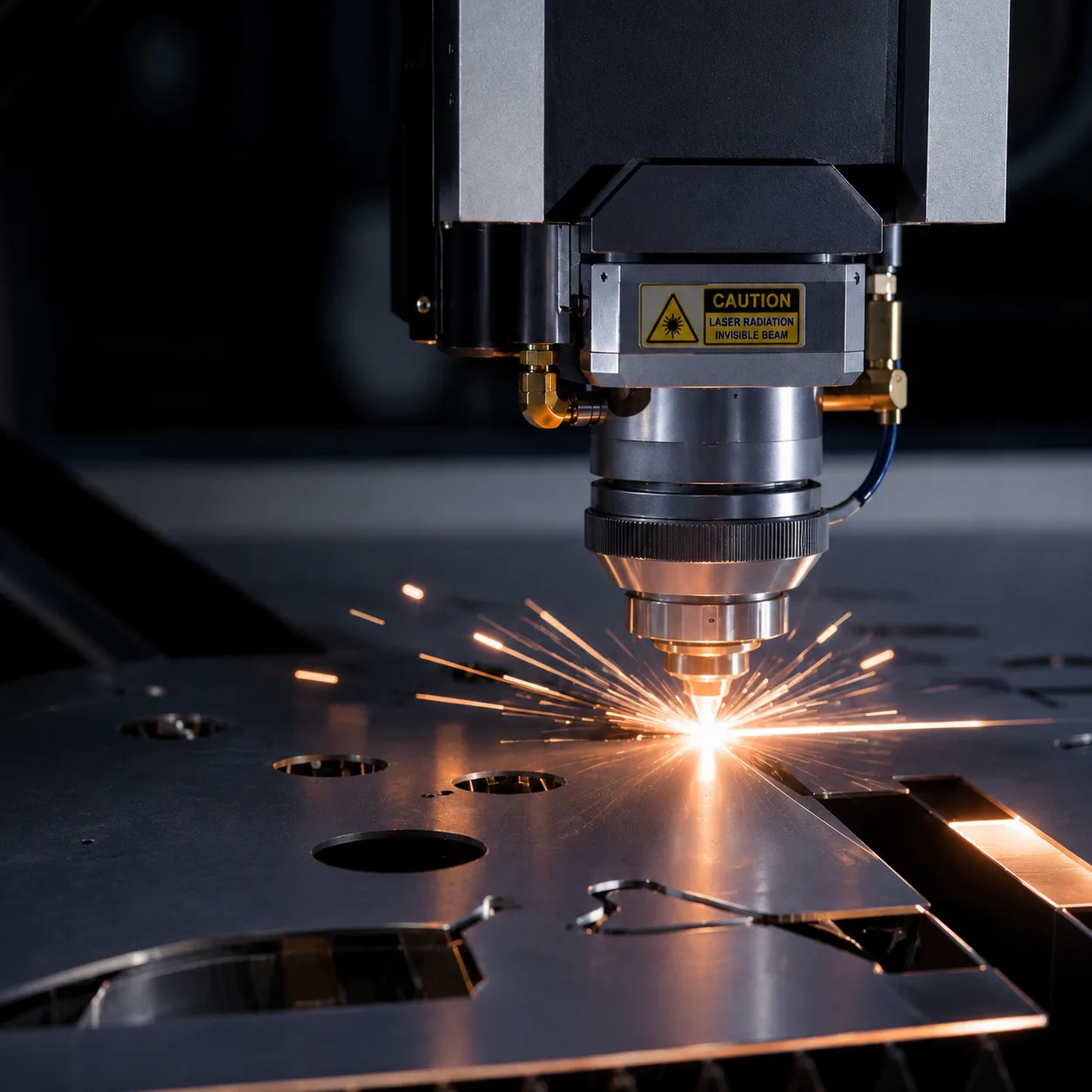
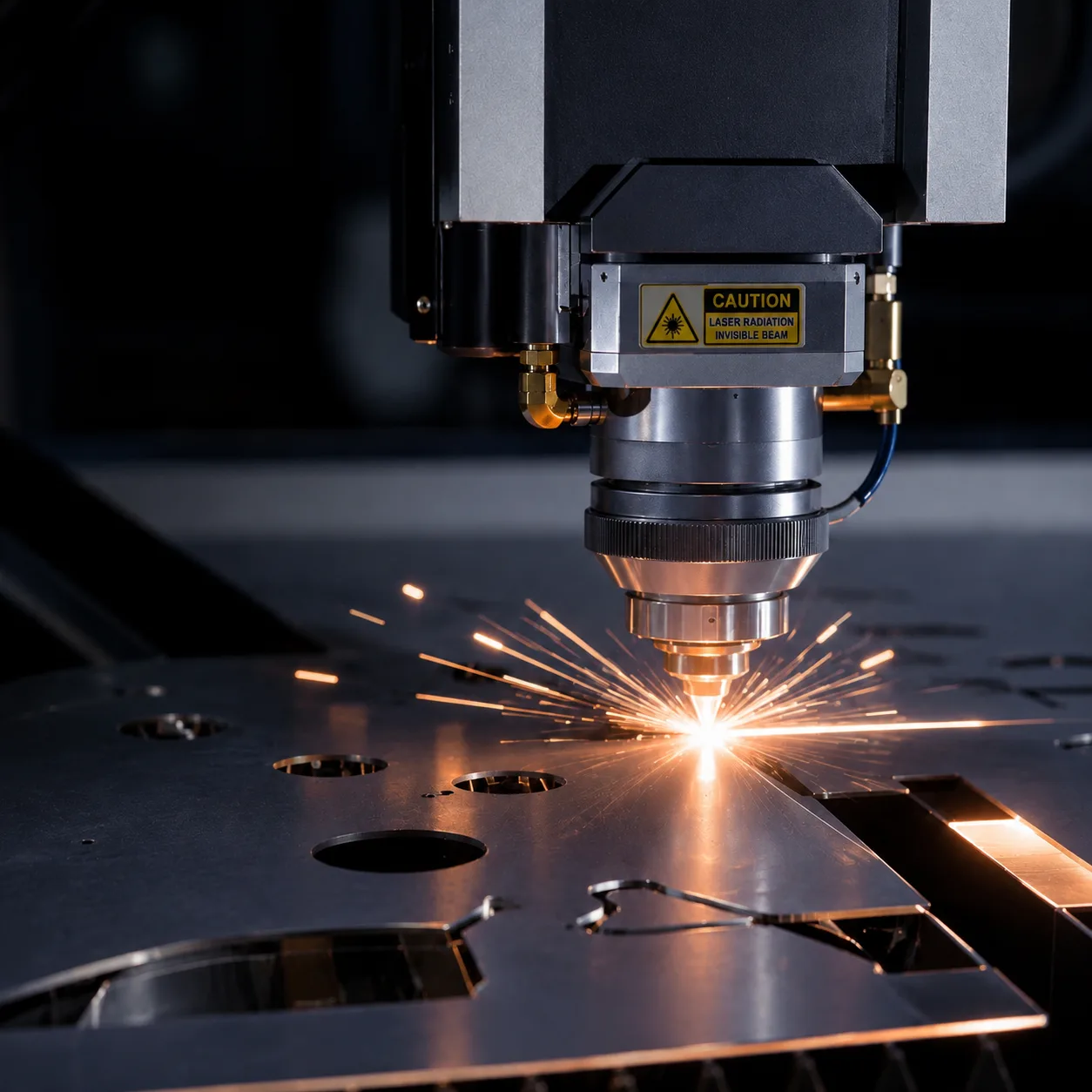
A focused fiber or CO₂ laser beam melts and vaporizes material along a programmed path. A coaxial assist gas (nitrogen, oxygen, or air) ejects the molten kerf. Because no physical tool contacts the workpiece, laser cutting excels at intricate contours, tight radii, and fine details that would be impossible with mechanical methods.
- No tooling cost — programs are generated directly from DXF/DWG files
- Kerf width: 0.1–0.3 mm, enabling very tight tolerances (±0.05 mm achievable)
- Material thickness range: 0.3–5.0 mm (typical for production fiber lasers up to 6 kW); industry range extends to 25 mm+ with higher-power sources
- Cuts virtually any 2D profile without geometric constraints
How CNC Punching Works
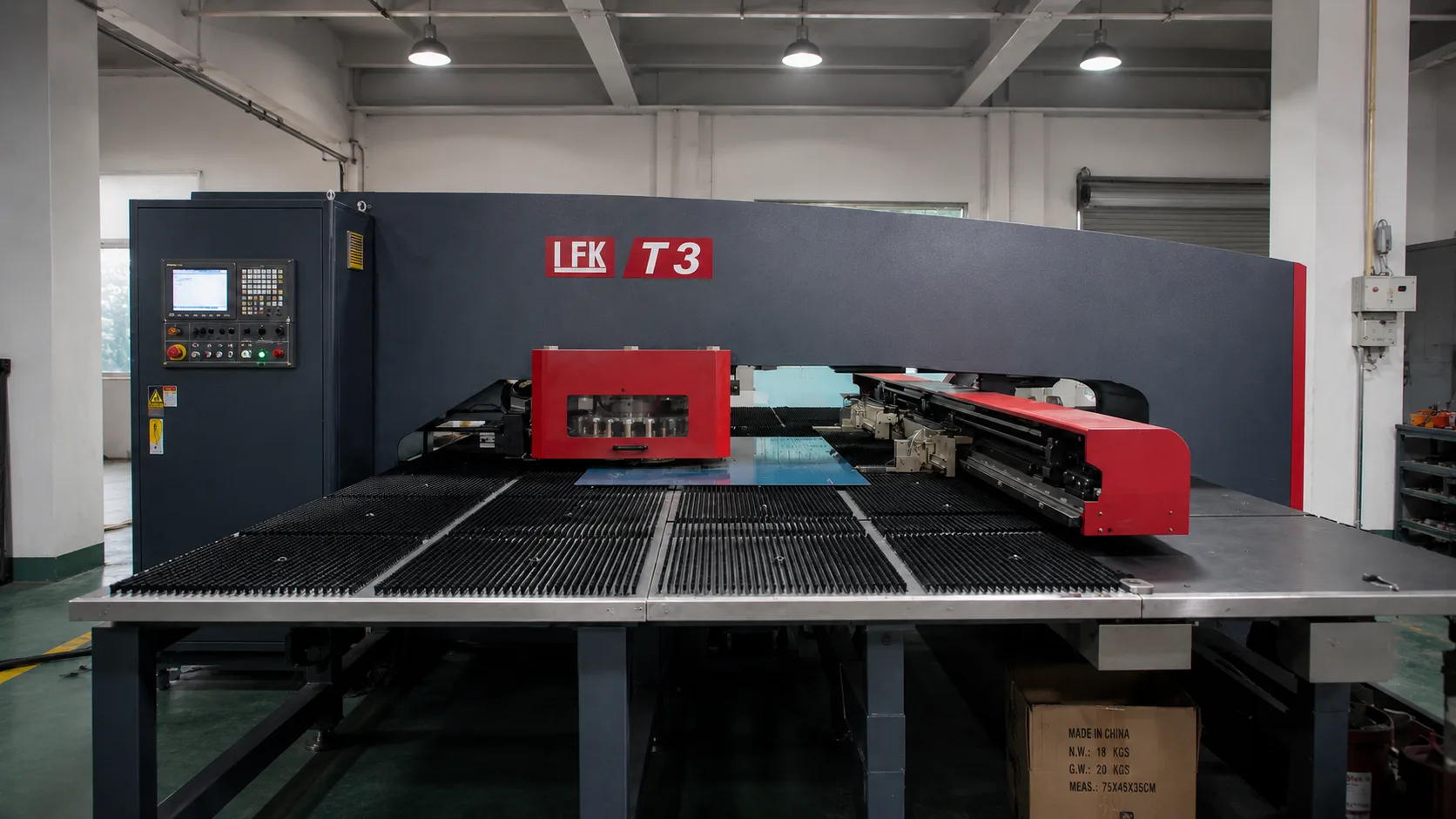
A CNC turret punch press strikes the sheet with hardened tooling mounted on a rotating turret. Each punch creates a specific shape — round holes, louvers, embossments, countersinks — by shearing or forming the metal. For larger contours, the machine nibbles along the profile with a punch-and-die pair, stepping small increments per stroke.
- Tooling cost per shape: $200–$10,000, amortized over high volumes
- Cycle time for simple hole patterns: 10× faster than laser on thin gauge material
- Can form features: louvers, countersinks, embossments, extruded holes, 3D forms
- Best suited for 0.5 mm to 3.2 mm mild steel, aluminum, and stainless
Key Differences
The choice between laser and punching comes down to geometry complexity, production volume, material thickness, and required features. Below is a side-by-side comparison.
Comparison Table
| Parameter | Laser Cutting | CNC Punching |
|---|---|---|
| Tooling Cost | None (program only) | $200–$10,000 per tool |
| Minimum Feature Size | 0.1 mm kerf width | 3.0 mm (punch diameter) |
| Thickness Range | 0.3–5.0 mm (typical 6 kW); up to 25 mm+ with higher-power sources | 0.5–3.2 mm (optimal) |
| Forming Capabilities | None — flat cut only | Louvers, emboss, countersinks |
| Best Volume | 1–500 parts | 500–50,000+ parts |
| Geometric Complexity | Unlimited contours | Limited to tool shapes + nibbling |
| Edge Quality | Smooth, minimal burr | Clean shear, may need deburring |
| Nesting Efficiency | High (no tool constraints) | Lower (tool clearances required) |
| Setup Time | ~5 min (load DXF) | 15–30 min (tool change + program) |
| Typical Cost per Part | Higher at volume | Lower at volume (>500 pcs) |
When to Choose Laser Cutting
Laser cutting is the clear winner when your design features intricate geometry, tight tolerances, or very thin or thick material that falls outside the turret punch range.
- Complex outlines with small internal radii (< 1 mm)
- Prototype or low-volume runs (1–500 parts)
- Material thickness above 3.2 mm or below 0.5 mm
- Parts requiring no formed features — purely flat profiles
- Quick-turnaround projects where setup time matters
When to Choose CNC Punching
CNC punching dominates when the part includes formed features, high hole density, or production volumes that justify tooling investment.
- Parts requiring louvers, extruded holes, or embossments
- High hole-density panels (hundreds of perforations)
- Production runs exceeding 500 identical parts
- Thin-gauge material (0.5–3.2 mm) with simple profiles
- Applications where part cost per unit is the primary driver
FAQ
Written by
Tom
Senior Process Engineer
Experienced manufacturing engineer specializing in sheet metal fabrication, CNC machining, and surface finishing. Writes practical guides to help engineers make informed sourcing decisions.
Ready to Start Your Project?
Get DFM feedback and a quote within 24 hours. No minimum order quantity.