
Sheet Metal Stamping Design: Rules for Pressed Parts
Everything about a stamping is decided before a press runs. That makes stamped-part design a different discipline from sheet metal design generally: the strip layout is the design, and the drawing is a description of what comes off the end of it.
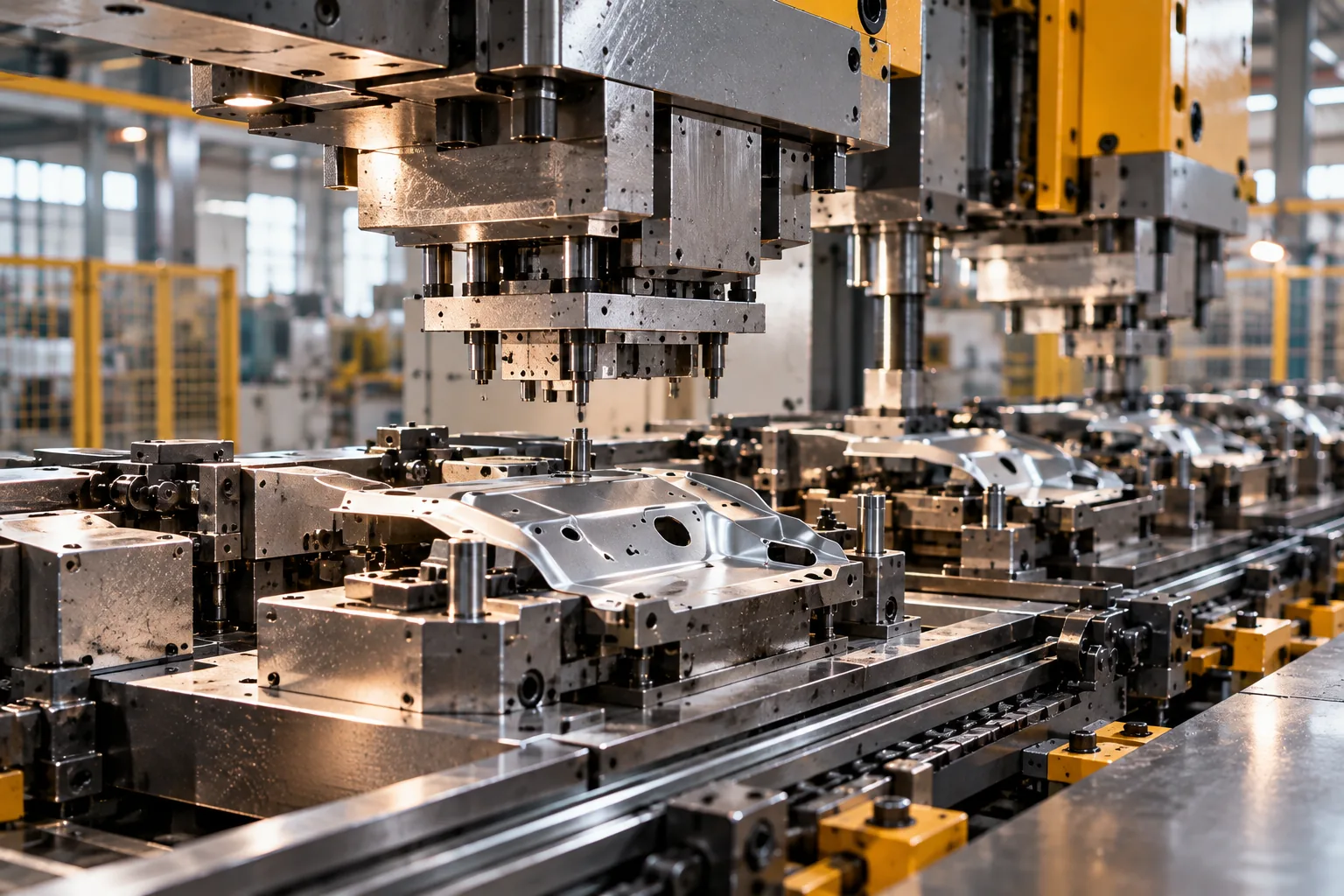
Stamped-part design is strip design. Material width and progression pitch, bridge and pilot strategy, minimum pierce size and bend relief are all fixed when the die is cut, so they have to be right on the drawing. A feature added later costs a die modification.
The strip is the design
A progressive die consumes coil at a fixed width and a fixed pitch. The part has to be carried through the stations by bridges of material, located by pilot holes that engage before the forming stations, and released only at the final trimming station. Every one of those is a geometry decision that also has a material cost.
Strip width and pitch together set how much material each part consumes, regardless of the part area. A layout that wastes 20 mm across the strip wastes it on every stroke for the life of the die, so the strip layout review is the single most valuable engineering checkpoint in a stamping programme.
Rules that come out of that
| Feature | Rule | Why |
|---|---|---|
| Minimum pierced hole | Generally at least ~0.8 × thickness, and not below the tooling limit | Small punches break or bend without a guided arrangement |
| Hole-to-edge distance | At least 1 × thickness, more near a bend | Less, and the punch tears or the edge deforms |
| Bend relief | Notch or slot at the end of a bend line | Without it the material tears as it is drawn into the bend |
| Corner radius on the trim | Not less than the material thickness | Sharp corners wear the die and shorten its life |
| Burr direction | Decide and state it | The burr is on the die side; it affects fit and safety |
| Formed features near the trim edge | Keep clear of the trim station | Trimming after forming disturbs the form |
| Features that can wait | Move to a later station | Cheaper to add to a station than to rebuild an earlier one |
Design rules for pressed parts
Where a stamped part still needs secondary operations
Not everything belongs in the die. Tapping, countersinking, insert pressing and anything requiring a third axis are usually secondary operations, because building them into a die costs far more than doing them afterwards for the volume involved. Deciding which features go in the die and which come after is a cost exercise, not a purity one.
Tumbling and deburring are the other common follow-on steps. A stamped edge is a sheared edge, and its condition depends on punch-die clearance: too much clearance gives a ragged edge with a heavy burr, too little accelerates wear. Where the edge is functional — a sliding fit, a sealing face, a thread — the edge condition belongs on the drawing.
What to send with a stamped part for quotation
- The part drawing, plus the annual volume and the expected programme life — both drive the tooling decision.
- Whether the burr side matters, and which way it should face in the assembly.
- The edge condition where it is functional, rather than a general deburr note.
- Any feature that must be a formed-in feature rather than a secondary operation.
- The inspection requirement: a first article is normal, an ongoing dimensional report is priced separately.
Frequently asked questions
What is the minimum hole you can punch?
It depends on material and thickness, and the practical floor is usually around 0.8 times the thickness before the punch becomes fragile. Below that, the hole is better drilled or the design changed — putting a fragile punch in a high-volume die is a maintenance problem you will keep paying for.
Do I need bend relief on a stamped part?
On any bend that runs to the edge of the material, yes. Without a notch or slot the material tears as it is drawn into the bend. The relief is cheap to design in as part of the blank and expensive to add to a die afterwards.
When does a part move from laser cutting to stamping?
At the volume where the per-part saving repays the tooling. That is a calculation, not a rule of thumb — a part with many holes and formed features saves far more per piece than a plain flat plate, so it pays back sooner. Give us the drawing and an annual volume and we will run it.
Can you add a feature to a die after it is built?
Often, yes — an extra station, an adjusted form, a revised trim. What is generally not economic is a change that moves the strip layout, because that is built into the die blocks and the feed. This is why the layout gets a formal sign-off before the die is cut.
How is the edge condition controlled on a stamped part?
By punch-die clearance, which is set when the die is made and maintained through its life. Where the edge is functional — a sealing face, a thread, a sliding fit — specify the finished edge rather than assuming a sheared edge will do.
Send the drawing, get a real answer
An engineer reviews your model for manufacturability and returns a costed quotation — with the DFM observations that would change the price.