
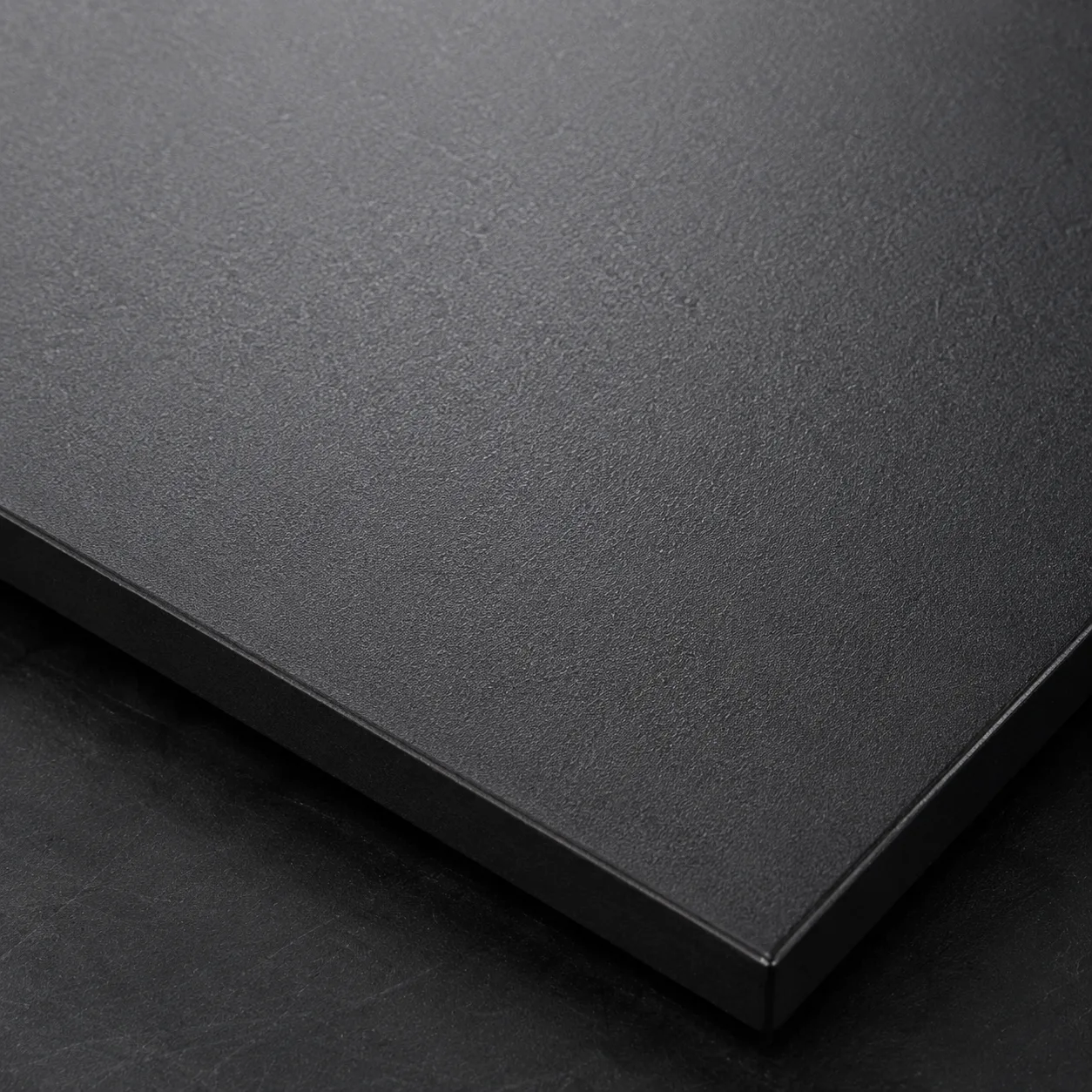
What bead blasting is
Bead blasting bombards a part with clean spherical media — usually glass or ceramic bead — under pressure, producing a uniform matte surface with no directional grain. The round media peens rather than cuts, which is what keeps stainless from being contaminated and gouged. Because the process is mechanical, it adds no film: the part is the same thickness before and after, and the corrosion performance is still the base metal's.
That makes blasting a surface preparation as much as a finish. It is used on its own where a uniform matte is the intent, and as the prep under a powder coat or a plating, where a consistent microtexture is what lets the coating bond. The specification is the media and, where roughness matters, the Ra value.
- Round bead media peens the surface; it does not cut it like angular sand
- Uniform matte with no directional grain — unlike brushed
- Adds no film and no protection: the rating is the base metal's
- Used as appearance finish or as prep under powder coat and plating
- Specify the media (bead / ceramic) and an Ra value if roughness matters
Bead versus sand, and why the media is specified
The reason the media appears on the drawing is that bead and sand are not interchangeable. Glass bead is round, produces a finer and denser matte, and leaves no embedded residue — which matters on stainless, where angular sand can embed in the surface and seed corrosion. Ceramic bead gives a finer, more controlled finish and is used where a precise cosmetic result matters. Sand is cheaper and more aggressive, and on stainless it carries the contamination risk.
The practical instruction is therefore to name the media, not the effect. "Blasted" is an incomplete specification, because the same word covers an angular cut surface and a fine peened one. Where the finish is cosmetic, the media and, if it matters, the Ra value go on the drawing; where it is prep under a coating, the media is chosen for adhesion and the coating does the protecting.
| Media | Effect | Typical use |
|---|---|---|
| Glass bead | Fine, dense matte; peens; no embedded residue | Stainless and aluminium cosmetic finish |
| Ceramic bead | Finer, more controlled texture | Precise cosmetic and uniform-matte work |
| Sand (angular) | More aggressive, cuts; can embed residue | Prep on carbon steel; risk on stainless |
| Other (specified) | Depends on media and pressure | State the media and Ra if roughness matters |
Bead blasting as preparation, not protection
Used on its own, bead blasting changes how the surface looks and how light reads off it, and nothing else. The corrosion performance of a blasted stainless part is the grade's, exactly as it is for a brushed one. Where the environment is aggressive, the protection is a passivation step for stainless or the correct alloy — specified separately from the texture.
Used as prep, it earns its place differently: a consistent peened microtexture is what gives a powder coat or a plating its adhesion, particularly on aluminium where the conversion chemistry does the bonding and the texture does the keying. Where a part will be coated after blasting, the two specifications are one decision, and the media is chosen to suit the coating rather than for its own sake.
- As a finish: appearance only — no protection, the base metal still decides
- As prep: gives the coating a consistent keying surface
- Stainless: bead avoids the contamination risk of angular sand
- Specify media and, where roughness matters, the Ra value
How WERIX specifies and executes it
Bead blasting is coordinated as part of the finishing sequence under our specification and inspection — either as the final texture or as the prep before a coating, in which case the two are specified together. ISO 9001 is the only management-system certification held; a blasted texture has no certification and no class, so the page does not imply one.
The specification work is small but it is the whole point: name the media, and where the finish is cosmetic and roughness is judged, name the Ra. "Blasted" on its own is the instruction that comes back as a dispute, because it describes an effect rather than a process.