
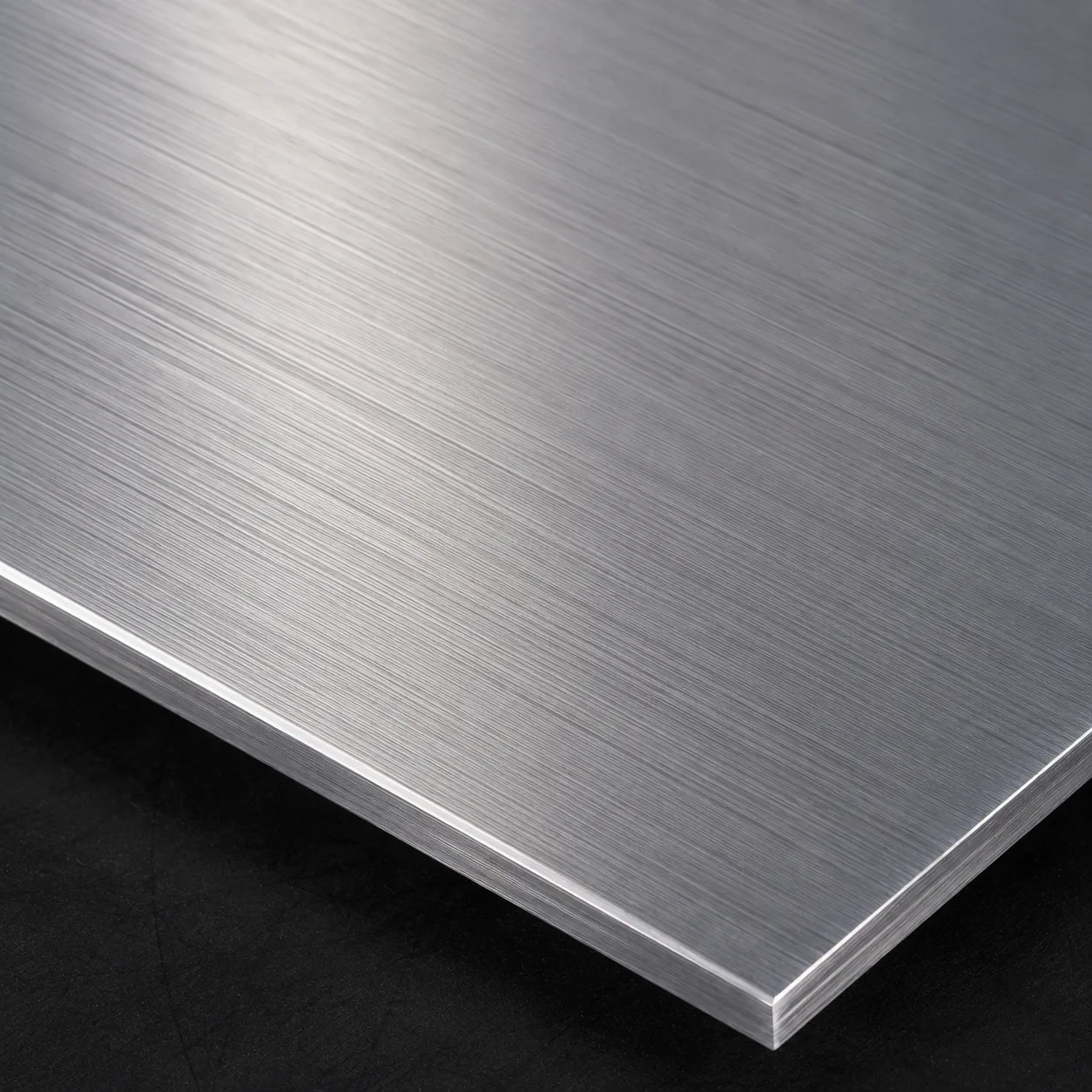
What each finish actually is
Brushing abrades the surface along one direction with progressively finer abrasive, producing parallel grain — the No. 4 finish familiar from kitchen and elevator stainless, or the finer hairline variant. The grain is the aesthetic and the discipline: every brushed face states its direction, and faces whose grains meet at a corner or cross at a seam read as mismatched.
Bead blasting fires fine glass media at the surface, peening it into a uniform, non-directional matte. There is no grain to align — every face of every part reads identically from any angle — which is why consumer electronics aluminium is so often blasted before clear anodising. The texture also does practical work: it hides handling marks and fingerprints far better than a brushed face, which shows contact.
Side by side
| Criterion | Brushed (No. 4 / hairline) | Bead blasted |
|---|---|---|
| Appearance | Directional grain, classic metallic sheen | Uniform non-directional matte |
| Grain discipline | Direction must be specified per face | None — orientation-free |
| Fingerprints & marks | Shows contact, shows wear-in | Hides both well |
| Scratch behaviour | Light scratches can be re-grained out | Local damage breaks the texture — hard to blend |
| Pre-anodising pairing | Possible — grain shows through clear anodise | The standard route to matte anodised aluminium |
| Typical duty | Appliance & elevator panels, visible stainless faces | Electronics housings, equipment faces, uniform builds |
The specification details that decide the outcome
- Grain direction per face, on the drawing — horizontal and vertical brushed faces read completely differently on one cabinet
- No. 4 versus hairline — similar names, different texture; settle it with a reference sample
- Blast media and pre-finish sequence — blasting before anodising is the standard matte-aluminium route; blasting after bending differs from blasting flat sheet
- Cosmetic-face protection through fabrication — brushed faces scratch, so protection through laser, bending and welding is planned, not hoped for
- Welded assemblies: whether welds are blended and re-finished to match the surrounding texture, and which faces that applies to
How this lands on our materials
On stainless — 304 above all — brushed is the signature finish: the appliance look, the elevator look, the food-equipment look. Bead blasting stainless gives a softer, more uniform matte that suits equipment housings and medical-adjacent hardware; both pair with passivation where corrosion performance is part of the brief.
On aluminium — 5052 and 6061 — bead blasting is the dominant route, almost always followed by clear anodising to lock the matte texture in. Brushed aluminium exists and pairs with anodising, but the brushed look on aluminium reads industrial rather than consumer, and the choice is usually a brand decision rather than a fabrication one. Both alloys' finish behaviour is on their grade pages.