What powder coating is
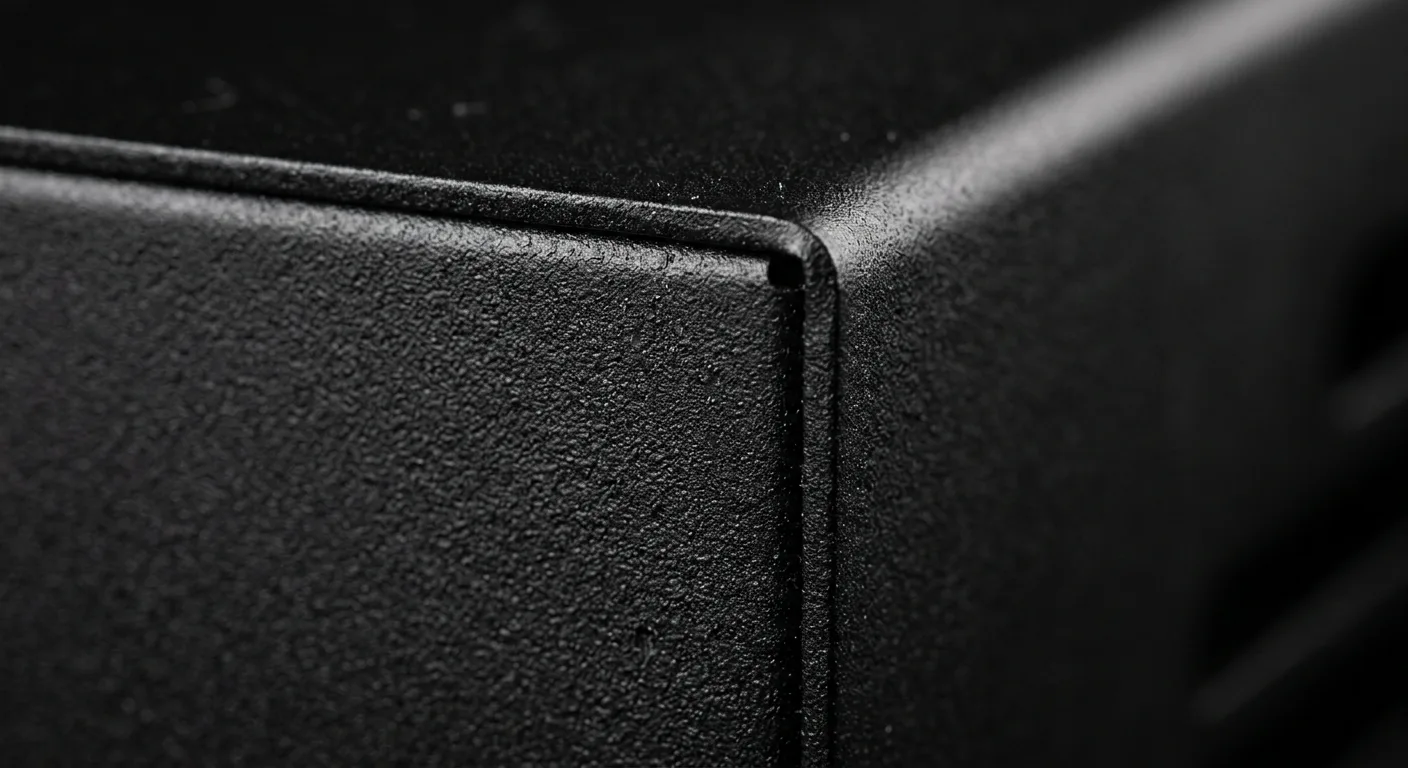
Powder coating applies a dry polymer powder electrostatically rather than a liquid coating: the part is grounded, the powder is sprayed and held by charge, then fused and cured in an oven so the particles flow into a continuous film and cross-link. Because the coating is a cured polymer rather than a dried solvent film, it does not re-dissolve once cured, and the layer thickness is controlled by application time rather than by wiping.
That process is why the film thickness on the spec is a range and not a number. Typical application is 60–120 µm per applied face. A film in that range is a genuine dimensional change — the reason every functional feature on a powder-coated part has to be masked or accounted for — and it is also the reason powder coat is a barrier and wear finish rather than a decorative one.
- Application: electrostatic spray of dry powder, then oven cure
- Typical film: 60–120 µm per applied face, measured per batch
- Colour: referenced to RAL or Pantone so the match is verifiable
- Substrates: steel, stainless, aluminium, copper and brass — each needs its own pretreatment
Substrate suitability and the pretreatment it implies
Pretreatment is the step that decides whether the coating adheres, and it is chosen by base metal rather than by the coating. Bare cold-rolled steel, galvanised steel, stainless, aluminium and copper do not share a conversion chemistry, and a coating applied over the wrong one blisters or peels — usually after the part has already shipped.
This is also the honest limit of powder coating as corrosion protection. On stainless and on copper alloys it is specified for colour and for a cleanable surface, not to protect the metal: the corrosion performance of the part is still the base metal's. Where corrosion resistance is the requirement, the answer is a plating specification or a passivation step, not a thicker coat.
| Substrate | Pretreatment | Notes |
|---|---|---|
| Cold-rolled steel (SPCC) | Degrease + phosphate conversion | The straightforward case; cut edges unprotected |
| Galvanised / zinc-coated (SGCC, SECC) | Degrease + zinc-matched conversion | Different chemistry from bare steel; skipping it causes blistering |
| Stainless 304 / 316 | Degrease + adhesion promoter | Coated for colour, not for corrosion protection |
| Aluminium 5052 / 6061 | Degrease + chromate conversion | Conversion layer required before powder for adhesion |
| Copper / brass | Degrease + adhesion promoter | Usually coated for appearance; plating is often the better route |
What powder coating does to your drawing
Three things belong on the drawing, and their absence is what generates rework. First, the colour as a named reference — a RAL or Pantone code, not "grey" or "similar to sample". Second, the finish type, because gloss, satin, matt and textured are different films with different appearances from the same powder. Third, the masking instruction, which is the one most often left out.
A 60–120 µm film is thick enough to change a fit, close a bore or cover a thread. Masking is not a finishing preference; it is a dimensional instruction. Features that need to stay bare — tapped holes, bearing bores, gasket faces, earth points, contact surfaces — are masked, and the drawing says which. Where a feature can tolerate the film instead, that is a legitimate alternative, but it should be a decision on the drawing rather than a discovery on the shop floor.
- Colour to a RAL or Pantone reference, with the finish type — gloss, satin, matt or textured
- Film thickness range where the environment or a customer specification demands one
- Mask threads, bores, earth points and any contact or bearing surface
- State whether cosmetic faces need peel-coat film through fabrication
Powder coating against the other finishes
The comparison that decides most specifications is powder coat versus anodize, and it is decided by the base metal rather than by preference. Anodizing is an integral oxide on aluminium only; powder coat is a deposited film that applies to steel and stainless too. If the drawing says aluminium and the finish must be integral, anodizing is the answer. If it says steel, powder coat is one of very few colour options.
Against plating, the choice is barrier thickness against function. Plating gives sacrificial protection, conductivity, solderability and true contact wear resistance; powder coat gives colour, a thicker barrier and a more repairable surface. Parts that carry current or make electrical contact are plated, not coated, and the contact surfaces are masked either way.
| Criterion | Powder coating | Anodizing | Electroplating |
|---|---|---|---|
| Base metals | Steel, stainless, aluminium, copper, brass | Aluminium only | Steel, copper, brass |
| Film thickness | 60–120 µm | 5–25 µm (II) / 25–50 µm+ (III) | Per ASTM B633 class (declared) |
| Adds thickness | Yes — mask or allow for it | Yes — roughly half per side | Yes — declare the class |
| Corrosion role | Barrier on steel; none on stainless | Integral to the aluminium | Sacrificial on steel |
| Colour | RAL / Pantone, any tone | Clear or dyed, integral | Deposit metal, not a colour coat |
How WERIX specifies and executes it
Powder coating is partner-executed. We select the coating system against the specification, state the film thickness and the colour reference, and inspect the result before delivery — which is the arrangement that lets a spec sheet carry a reference value rather than a certificate. ISO 9001 is the only management-system certification we hold; it is not a coating certification, and the coating product carries its own conformity.
The engineering value we add is upstream of the spray gun: substrate selection, whether the part can tolerate a 60–120 µm film on its functional features, what gets masked, and whether the colour reference will still be recognisable after cure. A powder specification that omits those three is a specification that comes back.