What a source factory means, and what it does not
A source factory owns its equipment, employs its operators and quotes from its own floor. A trading company sources from factories and adds margin, which is a legitimate model but a different one: it has no floor to walk, no capacity it controls and no inspection it performs itself.
The distinction matters most when something goes wrong. With a source factory, a concession, a rework or a schedule change is negotiated with the people who make the part. With an intermediary, it is negotiated through a layer that has to relay the conversation — and that layer has a commercial interest in the outcome.
Why the Dongguan cluster matters to a buyer
| Input | Effect of local availability |
|---|---|
| Tooling and die steel | Die inserts and die maintenance without a shipping cycle |
| Special punch and die profiles | Non-standard tooling sourced in days rather than weeks |
| Surface treatment | Plating, anodizing and coating coordinated as a routine step, not a project |
| Fasteners and inserts | PEM hardware and standard fasteners available at short notice |
| Steel and aluminium stock | Grade and gauge availability across multiple service centres |
| Crating and freight | Export crating and port access within the same metropolitan area |
What we run in-house
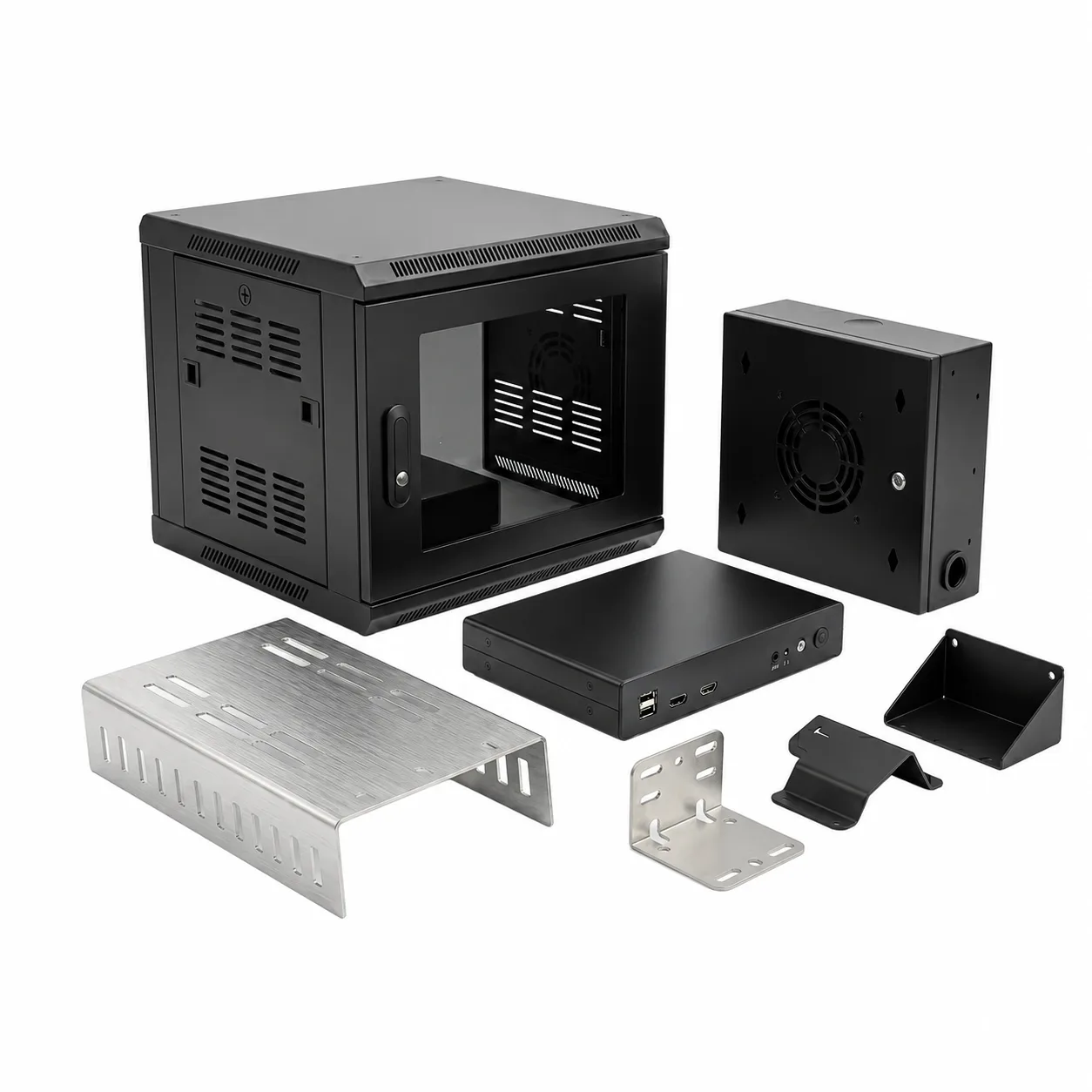
Fiber laser cutting, CNC turret punching, shearing, press-brake forming, TIG/MIG/spot/laser welding, riveting, embossing, deep drawing, and progressive, transfer and compound die stamping. The stamping dies are designed, built, tried out and maintained in our own die workshop rather than bought in, which is what makes the prototype-to-production path a single route rather than a handover between two companies.
Surface finishing — powder coating, anodizing, plating — is coordinated with specialist partners rather than run under our roof, because those processes need their own certification structure and effluent handling. We control the specification, the inspection and the delivery, and we say which operations are partner-executed rather than implying everything happens on one floor.
Quality and documentation
The quality management system is certified to ISO 9001. That is the only management-system certification we hold, and we state that plainly rather than implying a broader portfolio: we do not hold IATF 16949 for automotive or ISO 13485 for medical devices, and where a programme requires a certified system we do not have, that requirement has to be met by a supplier who holds it.
What we do provide is the objective evidence a programme generates: first-article dimensional reports against the ballooned drawing, in-process checks, material certificates from the mill, coating and weld records, and a documented inspection plan with defined sampling. Programs for offshore sourcing usually fail on documentation rather than on the parts, so the documentation is treated as part of the product.
How to qualify a factory before you commit
- Ask for a live video walk-through of the floor during working hours, not a photo set.
- Ask which operations are in-house and which are subcontracted, process by process.
- Ask for the equipment list with capacities, and compare it against what your part actually needs.
- Ask for a first-article report from an existing programme, with the customer name removed if necessary.
- Ask what the corrective-action path looks like when a first article fails.
- Ask about tooling ownership and transfer terms in writing before the die is cut.
- Send a test part that is genuinely representative, not the simplest one in the catalogue.
Logistics from Guangdong
Export shipments typically move through Yantian or Shekou in Shenzhen, or via Hong Kong, which puts them on the main transpacific and Asia-Europe lanes. Ocean freight is the default for production volumes, air freight is reserved for urgent prototypes and small high-value shipments, and the Incoterm decides where our responsibility ends.
The practical scheduling point is that the finish is usually the last operation and the one most exposed to batch minimums. Planning a shipment around a coating run rather than against it is the difference between a clean schedule and a week of expediting.