Sheet Metal Fabrication Quote: What to Send
A quotation is only as good as the information behind it. Every field you leave blank is a field we have to fill with an assumption, and an assumption is the most common reason a price moves between the quote and the invoice. Sending five things properly removes almost all of that risk.
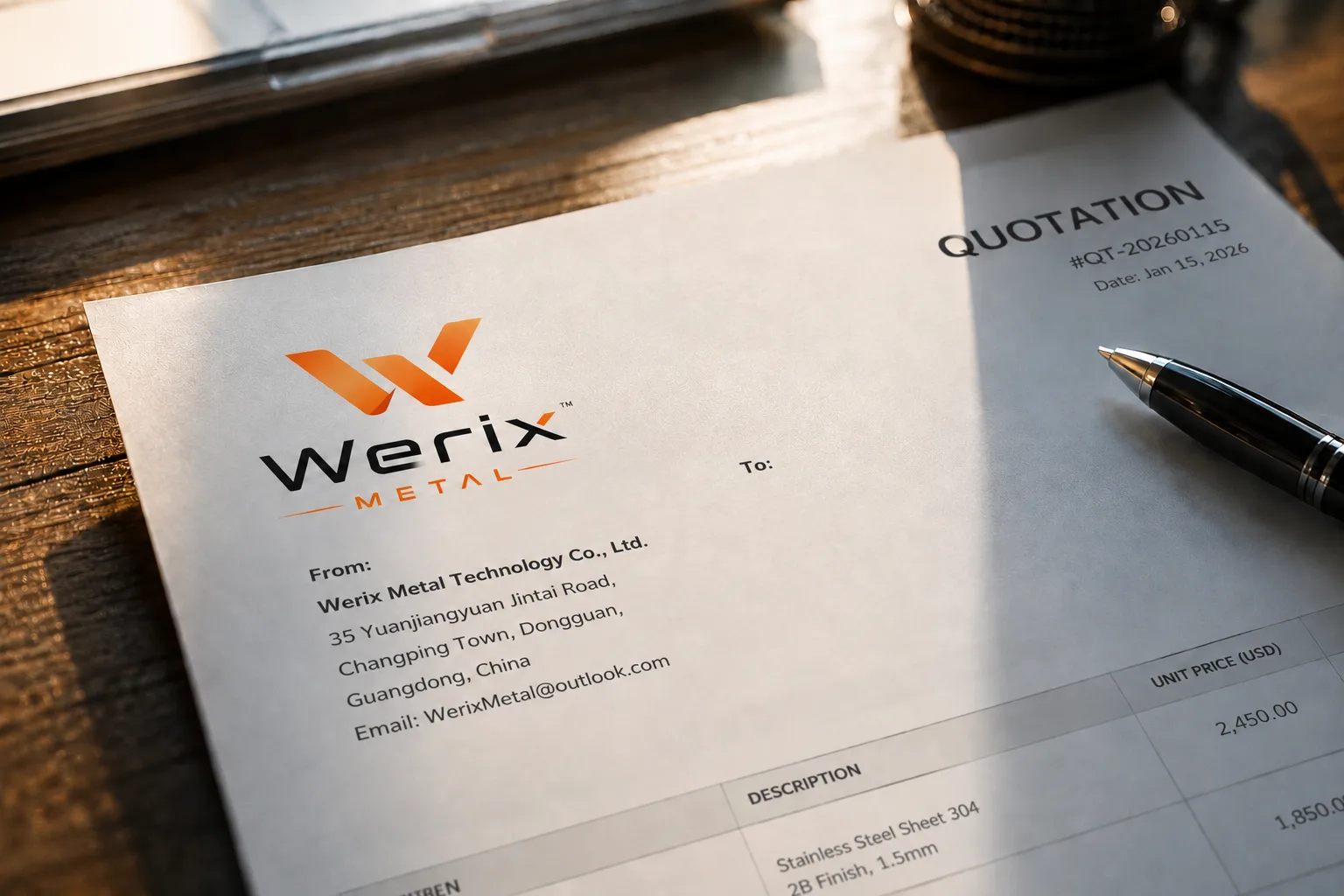
To get an accurate sheet metal quote, send the 3D model or a dimensioned 2D drawing, the material and thickness, the quantity and expected repeat rate, the finish and colour, and any inspection or documentation requirement. Anything missing becomes an assumption in the price.
8 rows of reference data below — the summary above is the short answer, the tables are what you quote from.
What to send, and why each item changes the price
| Send this | Why it changes the number |
|---|---|
| 3D model or dimensioned 2D drawing | Bend count, hole count and feature access set the process route |
| Material and thickness | Decides cutting speed, forming force, mass and which grade is viable |
| Quantity, and whether it repeats | Fixes whether fixed cost is amortised or carried once |
| Finish and colour reference | A standard RAL and a matched bespoke colour have different minimums |
| Tolerance standard or the critical features | Tells us where to spend inspection time and where not to |
| Inspection and documentation level | A first article report and material certificates are work, not paperwork |
| Environment and duty | Outdoor, washdown and corrosive service push material, finish and sealing choices |
| Delivery destination and Incoterm | Turns a factory-gate number into a landed one |
The input list behind every quotation
Formats we can work from
A STEP or IGES model is the most complete input because the solid carries the bend geometry rather than describing it in annotations. Native CAD files are welcome if that is easier. A dimensioned PDF drawing is perfectly workable, and for a bracket with six bends it is often faster to read than a model.
DXF is enough for a flat laser-cut part with no forming, which makes it the right format for a plate or a shroud. What is not enough is a screenshot, a sketch, or a verbal description — those produce a price we cannot stand behind, and we would rather ask a question than issue a guess.
The DFM pass that comes back with the quote
Every enquiry is reviewed by a production engineer before it is priced, not after. That review looks for the issues that cost money in production: an internal corner sharper than the tool can cut, a hole narrower than the material is thick, a flange too short for the die opening, a bend sequence that needs the operator to hold a large panel while reaching for the back gauge.
Where the review finds something, we say so on the quotation and quote the corrected geometry alongside the original so you can see what the change is worth. This is not a value-added extra; it is cheaper for us to flag a sharp radius at quotation than to scrap a batch at forming.
What comes back
- A costed quotation with the one-off element and the unit price separated.Quantity breaks where the volume justifies them.DFM observations, and a requote for the corrected geometry where a change is worth making.
- The material and thickness assumed, and the tolerance standard applied.The finishing specification, including colour reference and film or coating thickness.Lead time, validity window and the assumed Incoterm.
What actually delays a quote
The delays are almost never the engineering. They are an unspecified material, a quantity given as a range with no repeat indication, a colour referenced by name rather than to a RAL or Pantone standard, or a drawing whose revision does not match the model attached to the same email.
The single most useful extra field is the expected annual or lifetime volume. It does not change the price of the first order much, but it tells us whether to quote the laser route, the tooling route, or both — and quoting both is where the real saving usually sits.
What we will not do
- Quote from a description without geometry and a quantity — the answer would be fiction dressed as a price.Publish a "typical" rate per part, because the number depends entirely on the part.
- Hide one-off tooling inside a per-piece rate to make the unit price look competitive.
Frequently asked questions
What is the minimum I need to send for a quote?
A drawing or model, the quantity, and the material if you have a preference. From that we can price the geometry and recommend a grade. Finishing, tolerance and inspection detail refine the number but are not required to start the conversation.
How fast is a quotation returned?
Normally within one working day for sheet metal, and often faster for a simple flat part. Stamped parts with new tooling take longer, because the die has to be estimated rather than read off a programme.
Do I need to specify the material myself?
No, but it helps if you know the environment. Temperature range, indoor or outdoor exposure, corrosive contact and any weight limit are more useful to us than an alloy name — from those an engineer can recommend the grade and temper, and tell you what the choice costs.
Can you quote a part I only have as a physical sample?
Yes. Send the sample and we will measure it and produce a drawing for your approval before quoting. The measurements become the specification, so the price and the drawing agree from the start.
Is there a minimum order for a quote?
No. One piece is a legitimate order and we quote it. What we will tell you honestly is when a single piece is an inefficient way to buy a part that will later run in thousands, and what the tooling route would cost instead.
Send the drawing, get a real answer
An engineer reviews your model for manufacturability and returns a costed quotation — with the DFM observations that would change the price.