
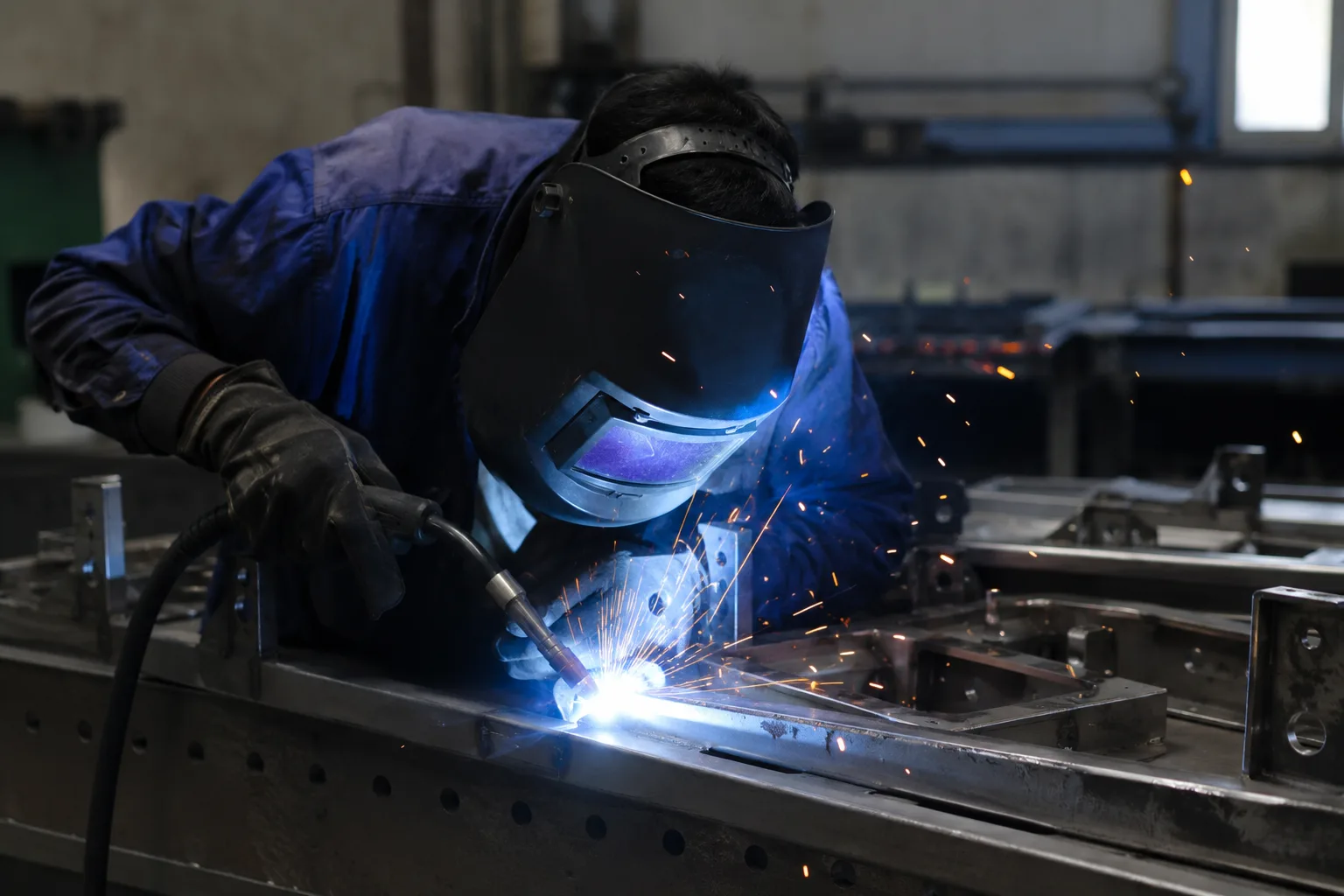
Build it in a fixture, or measure it twice
A frame welded without a fixture will be a parallelogram, a trapezium or a pretzel, depending on the sequence. A fixture holds the diagonals equal while the joints are tacked, which is the cheapest way to get a square frame. Tacking on the diagonal rather than all at once also limits how much the frame can pull before the geometry is locked.
Diagonal measurement is the check that matters on a rectangular frame. It is quick, it is total, and it catches a twist that measuring individual sides never will.
Weld sequence and distortion
Welding puts heat into a restrained structure, and the material has to go somewhere. Long seams pull the frame along the weld; the last joint welded on a closed section is usually the one that moves somewhere unexpected. Working opposite sides in short runs, letting each pass cool, and leaving the closing joint until last all reduce it — none of them eliminate it.
Where the finished frame must hold a tight dimension, the answer is usually to weld oversize and then machine the interface after welding, rather than to try to hold the dimension through the weld. Stress relief between welding and machining does the same job for frames that will be loaded hot or machined all over.
| Construction | Best for | Trade-off |
|---|---|---|
| Folded sheet frame | Light equipment, enclosures, modest loads | Cheap and fast; limited stiffness at long spans |
| Folded sheet with returns and gussets | Most machine frames | Stiffness per unit weight is high; needs the bends designed in |
| Square tube welded frame | Heavy loads, guarding, large machines | Welding distortion; end joints need coping and fitting |
| Bolted frame | Frames that ship knocked down or will be modified | Needs machined or formed interfaces and accurate hole patterns |
| Welded then machined | Frames carrying a precision interface | Most accurate, most expensive; adds a machining step and a fixture |
The interface is where accuracy is decided
Where a frame meets a linear rail, a servo mount or a bearing housing, the frame is not the accurate part — the machined pad is. Designing a frame with a machined interface means committing to a weld-then-machine sequence, and that has to be planned before the drawing is released, not after the first frame comes out of the booth.
Where no machined interface exists, the frame is a structure, and it is dimensioned as one: overall size, squareness and the positions of the bolt-on features, under general tolerance unless something genuinely needs tighter.
Finish on a frame
Frames are usually coated or galvanised, and both processes act on a welded structure differently from a single panel. Powder coating on a heavy welded frame cures at temperature and can pull on welded joints; galvanising dips at higher temperature and will move a frame unless it is braced for it. Where a frame must be galvanised, the design needs drain and vent holes, or the process will hide pockets of trapped pretreatment inside the section.
- Add drain and vent holes to any closed section that will be galvanised or dipped.
- Where the frame is coated, mask the machined pads and the earth points.
- Do not specify a tolerance on a welded frame that a welded frame cannot hold.
- Plan how the frame is lifted and transported — a frame is usually handled before it is finished.