
Sheet Metal Tooling Cost: Dies, Fixtures, NRE
Tooling is the element buyers most often forget to ask about and most often surprised by. On a laser-cut and bent part it is genuinely zero. On a stamped part it is a capital outlay that has to be earned back per piece, and the arithmetic is straightforward once the two numbers are on the table.
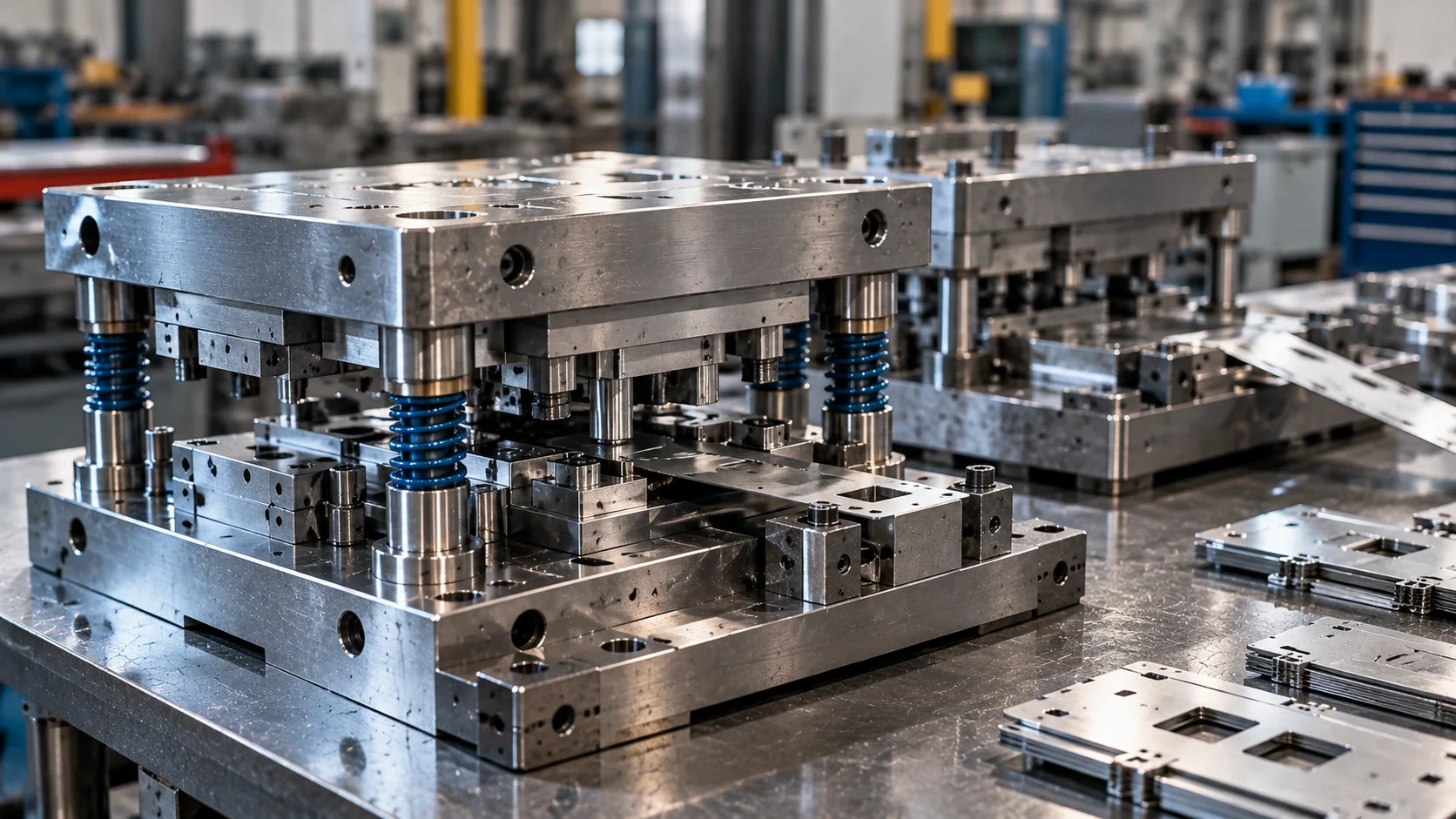
Sheet metal tooling is a one-off cost, not a per-part charge. Laser and press-brake work needs no tooling beyond programming; a stamped part needs a die, and die cost scales with part size, station count and tolerance. It only pays back above a break-even volume.
12 rows of reference data below — the summary above is the short answer, the tables are what you quote from.
When tooling applies and when it does not
| Route | Tooling | Where it makes sense |
|---|---|---|
| Laser cutting | None — the geometry lives in the programme | One-offs, revisions, complex outlines, any volume |
| Turret punching | Tooling set only if the pattern needs special tools | Repeating hole patterns at volume |
| Press-brake forming | Tooling set only if a standard punch and die cannot form it | Almost all work; standard tooling covers the majority |
| Stamping — simple die | One station, modest outlay | High-volume flat or lightly formed parts |
| Stamping — progressive die | Multi-station die, the largest outlay | High volume, small to medium parts |
| Stamping — transfer die | Die plus transfer mechanism | Large parts that cannot be fed on a strip |
What drives the cost of a stamping die?
A die is not priced by part weight. It is priced by how many operations the part needs, how much of the die has to be cut by wire EDM, how many stations the strip layout requires, and how accurately the tool has to hold the tightest feature on the drawing.
Station count is the biggest single lever, and station count is a design outcome. A part that needs five stations because two holes could not be combined, or because a form faces the wrong way for the strip, costs more to tool than the same part redesigned to run in three. That is a DFM conversation worth having before the die is cut, not after.
| Driver | Effect | Lever |
|---|---|---|
| Station count | Dominant — each station is machined, fitted and tried out | Redesign features to consolidate operations |
| Part size | Larger dies need larger presses and more material | Check whether the part fits a smaller press with a layout change |
| Tolerance on the tightest feature | Drives EDM time, hand fitting and tryout iterations | Relax anything not functionally critical |
| Material to be cut | Harder and thicker stock wears tooling faster | Correct die material and coating selection |
| Expected life | Stroke target decides insert steel and whether stations are rebuildable | Match die spec to the genuine lifetime volume |
| Trim and scrap handling | Skeleton cutting and slug removal add stations and mechanism | Design the strip layout for clean slug evacuation |
The break-even calculation
Tooling pays back when the per-part saving it unlocks, multiplied by the quantity, exceeds the tooling cost. Both numbers are knowable before committing: we quote the laser route and the stamped route on the same part and the same quantity, and the difference between the two unit prices is the saving.
The result is usually a range rather than a single figure, because the answer moves with the quantity assumption. What matters is not the exact crossover point but whether the volume you are confident about sits comfortably above it. A die that pays back at 8,000 pieces is a good decision on a 40,000-piece programme and a bad one on a programme that might end at 6,000.
Fixtures, gauges and the rest of NRE
A die is the visible tooling, but it is not the only one-off cost. A welded assembly that has to be held in position during joining usually needs a fixture. A part with a critical feature needs a gauge or a CMM programme so that inspection is repeatable rather than interpretive. A first-article inspection on a complex part is real measuring time.
These are quoted separately because they behave differently. A die is permanently tied to the part. A fixture can sometimes serve a family of parts. A gauge is only worth building when the feature is measured on every batch rather than once at approval.
Who owns the tooling
Tooling built for a customer is that customer's property, and this is stated in the quotation rather than left to interpretation. If a programme moves, the die moves with it. Buyers should treat tooling ownership as a sourcing term to agree in writing, and be wary of any quotation that treats a die as the supplier's internal asset while charging the customer for it.
Frequently asked questions
Does laser cutting need tooling?
No. The geometry is carried by the cutting programme, so there is no physical tool to build and no tooling cost to amortise. That is the main reason laser is the right route for prototypes and for parts that change between revisions.
How much does a stamping die cost?
It depends almost entirely on station count, part size and the tightest tolerance on the drawing, which is why we estimate it from the strip layout rather than from a rate card. Send the part and the expected volume and you will get the tooling estimate and the break-even volume together.
Can the tooling cost be spread across orders?
Yes, if both sides agree. Spreading it lowers the first invoice but raises every subsequent unit price, and it makes switching suppliers more complicated because the die has not been paid for in full. We will quote it either way and mark clearly which one the price reflects.
What happens to the die if we stop ordering?
It remains your property and can be shipped to you or to another press shop on your instruction. We will confirm the die condition and send it crated. The alternative — a supplier that keeps the die and quotes a "tooling transfer fee" — is a commercial risk worth checking for before you place the first order.
Is there tooling cost on a small batch of stamped parts?
There is, and on a small batch it usually dominates the price. If the volume is genuinely low, the honest recommendation is often to laser cut and form the batch instead, and revisit stamping when the annual volume justifies a die.
Send the drawing, get a real answer
An engineer reviews your model for manufacturability and returns a costed quotation — with the DFM observations that would change the price.