
How DFM Reduces Sheet Metal Cost: A Model
Design for manufacturing is often presented as a list of thirty rules. In cost terms it is much simpler: a small number of drawing decisions carry most of the price, and they can be ranked. This model ranks them by how much they move cost against how much effort they take to change.
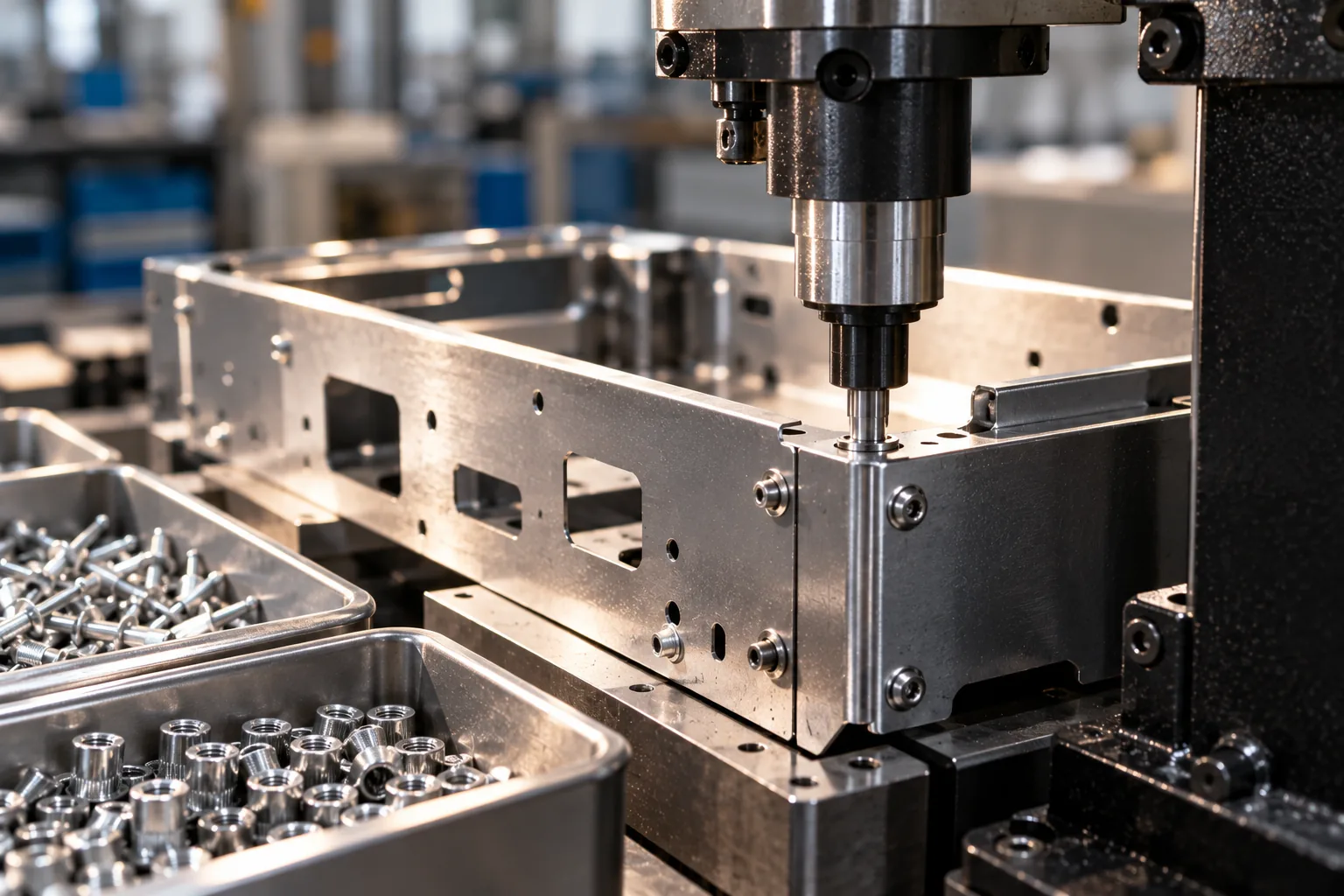
DFM reduces cost through four levers in a fixed order of usefulness: relax tolerance, remove bends, reduce cut length, and simplify finish. Tight tolerance is usually the most expensive single callout on a drawing and the easiest to relax, because most features do not functionally need it.
The ranked levers
| Lever | Cost effect | Effort to change | Where it applies |
|---|---|---|---|
| Relax an over-tight tolerance | High | Low — delete a callout | Any drawing that tightens beyond function |
| Remove a bend | High | Medium — needs structural thought | Parts with flanges that exist by habit |
| Reduce cut length | High | Low to medium — consolidate features | Hole arrays, decorative profiles, unnecessary openings |
| Simplify the finish | High on small batches | Low — standard colour, less masking | Any part with a bespoke colour or heavy masking |
| Choose a thinner gauge | Medium | Medium — often needs formed stiffness | Where thickness was guessed conservatively |
| Combine parts into one | High but situational | High — changes the assembly | Assemblies of small brackets that could be one pressing |
| Use a standard fastener | Low to medium | Low | Any assembly with mixed hardware |
| Improve nesting | Medium | Low — a layout decision | Parts with an awkward outline |
Lever one: tolerance is usually the biggest and easiest win
A drawing that carries a tight tolerance on every dimension pays for it three times: in process capability, in inspection time, and in scrap. Most sheet metal features do not need better than ISO 2768-m general tolerances, and the common case is a drawing tightened as a precaution rather than for a function.
The test is a single question per callout: what breaks if this dimension is off by more? If nothing does, the callout is cost with no benefit. Reserving tight tolerance for the two or three features that genuinely need it removes inspection and rework from everything else.
Lever two: bends are a sequence, not a count
Each bend is a setup, a stroke and a handling operation, and bends that need a tool change cost more than bends that do not. Two brackets with the same bend count can differ in price if one requires the operator to turn the part and change tooling while the other runs straight through.
Removing one bend is therefore worth more than a linear reading suggests. The cheapest bend is the one designed out: a flange that exists because the original designer assumed it, a return that duplicates stiffness already provided elsewhere, a tab that could be a pierced feature instead.
Two total columns are shown on purpose. On a part where material and cutting dominate, the same bend change moves the total less; on a part with many bends, forming dominates and the effect is larger. The lever has to be judged against what it is levering.
| Bend count | Relative forming cost | Relative total (flat part dominated) | Relative total (formed part dominated) |
|---|---|---|---|
| 2 | 0.67 | 0.90 | 0.78 |
| 3 (baseline) | 1.00 | 1.00 | 1.00 |
| 4 | 1.33 | 1.10 | 1.22 |
| 6 | 2.00 | 1.20 | 1.44 |
Lever three: cut length is a design output
Laser and punch time scale with contour length, so long decorative profiles and dense hole arrays are among the most expensive things a designer can add for free. A row of twenty small holes costs twenty pierces and twenty contours; one slot and a mesh insert may achieve the same function at a fraction of the machine time.
Corner radii matter for the same reason. A sharp internal corner cannot be laser cut as drawn — the beam leaves a radius — and if the drawing insists on sharp, the part needs a second operation. Specifying a radius of at least half the material thickness removes that second operation and costs nothing.
Lever four: finish and masking
Finishing cost is dominated by setup and masking rather than by area, particularly on small batches. A standard RAL shares a batch with other work; a matched colour needs its own. Every masked feature is handling labour, and masking is usually specified because a drawing did not think about it.
The design move is to reduce the number of features that must be masked: recess a thread rather than masking it, move an earth point to a place that can be masked in one operation, or choose a substrate and finish combination that removes a plating step altogether.
How to run a DFM review that pays for itself
- Open every tolerance callout and ask what breaks if it is relaxed. Delete the ones where the answer is "nothing".
- Count bends and ask what each one is for. Remove the structural duplicates.
- Look for hole arrays and decorative profiles and ask whether the function can be met with fewer contours.
- Check the finish specification against the environment; a bespoke colour on an indoor panel is usually cost without benefit.
- Ask the supplier what they would change. A factory sees the same expensive feature on every drawing and will name it for free.
Frequently asked questions
What is the single most common DFM recommendation?
Relax the tolerance. Drawings routinely carry tight callouts across many dimensions where only one or two features are functional, and that callout costs money three times — in process capability, inspection and scrap. Removing it is usually free.
How much does one bend cost?
Less than designers assume and more than nothing, and the answer depends on what dominates the part. A bend adds setup, stroke and handling; its effect on the total is larger on a part where forming already dominates. Removing a bend from a 3-bend bracket is worth more relatively than adding one to a 2-bend bracket.
Does DFM mean compromising the design?
Not where it is done properly. The recommendations that pay are usually about removing things nobody needed — a tolerance with no function, a flange that duplicates stiffness, a colour that serves no environment. Where a change would compromise function, it is not a recommendation.
When should a DFM review happen?
Before the design is frozen, and certainly before tooling. A review on a near-final model catches the expensive issues — short flanges, misplaced holes, unreachable welds, over-tight tolerances — while they are still a five-minute change rather than a die modification.
Send the drawing, get a real answer
An engineer reviews your model for manufacturability and returns a costed quotation — with the DFM observations that would change the price.