
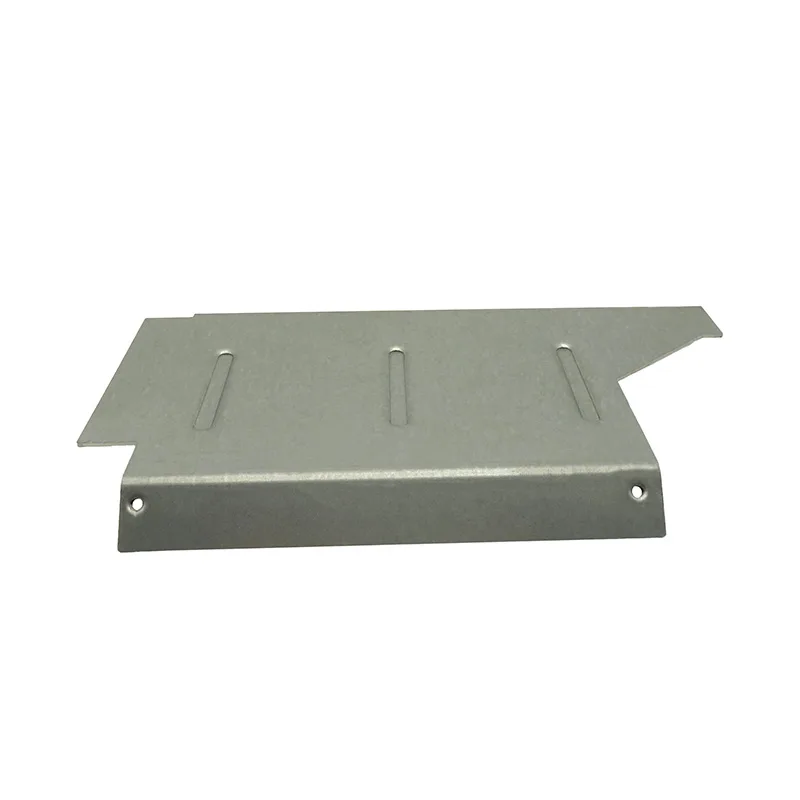
Cut or stamped: a volume decision, not a quality one
Below the tooling break-even, a bracket is laser cut and bent. The geometry lives in a programme, so a revision costs an edit, and the part is identical to a stamped one dimensionally. Above the break-even, a progressive die makes the same part faster and cheaper per piece — and locks the strip layout.
The mistake in both directions is expensive. Tooling a bracket family that never reaches volume wastes the die cost; laser cutting a million identical brackets wastes cycle time for years. The calculation is short and we will run it on your part rather than argue for a process.
Design the load path before the shape
A single folded angle bracket concentrates bending stress at the inside corner of the fold. A gusset, a wider flange at the fixing or a return that puts the fastenings in shear instead of tension all change that. On thin material the fold itself is often the weak point, not the sheet.
The other half of the load path is the fixing. A bracket bolted through a hole in thin sheet crushes or deforms unless there is a washer, an insert or enough material thickness. Where the bracket is the thing being clamped, it needs local thickness — a folded doubler or a pressed boss.
- Put fasteners in shear where the load is directional; it is far cheaper than adding thickness.
- Where two holes must line up, dimension them from the same datum rather than chain-dimensioning.
- Keep hole edges at least a sheet thickness from any edge; clamp load needs material around it.
- Bend lines and hole patterns should not fight: 2.5 × thickness plus the inside radius is the minimum hole-to-bend distance.
A bracket should not be the adjustment
Slotted mounting holes are a legitimate way to absorb tolerance — in one direction, at one joint, where someone can get a tool to it. Using them at every joint on both axes turns an assembly into a fiddling exercise.
The cleaner alternative is to allocate the tolerance deliberately: hold the locating feature on the part that is easiest to control, and let the bracket absorb the remainder through a single slot or a clearance hole rather than a stack of them.
The details that decide the price
| Feature | Cost effect | Note |
|---|---|---|
| Number of bends | Rises with each bend | Two bends is routine; eight changes the part class entirely |
| Corner radii | Free if generous | Half the material thickness minimum; smaller needs a second operation |
| Deburring | Low, if specified sensibly | "Deburr all edges" on a complex part becomes manual work |
| Finish | Batch priced | A small batch of brackets pays a minimum regardless of quantity |
| Tight tolerances | Inspection and scrap cost | ISO 2768-m covers most brackets; tolerance only what locates |
| Gussets and hems | Extra stations or operations | Worth it where they replace a thickness increase |