
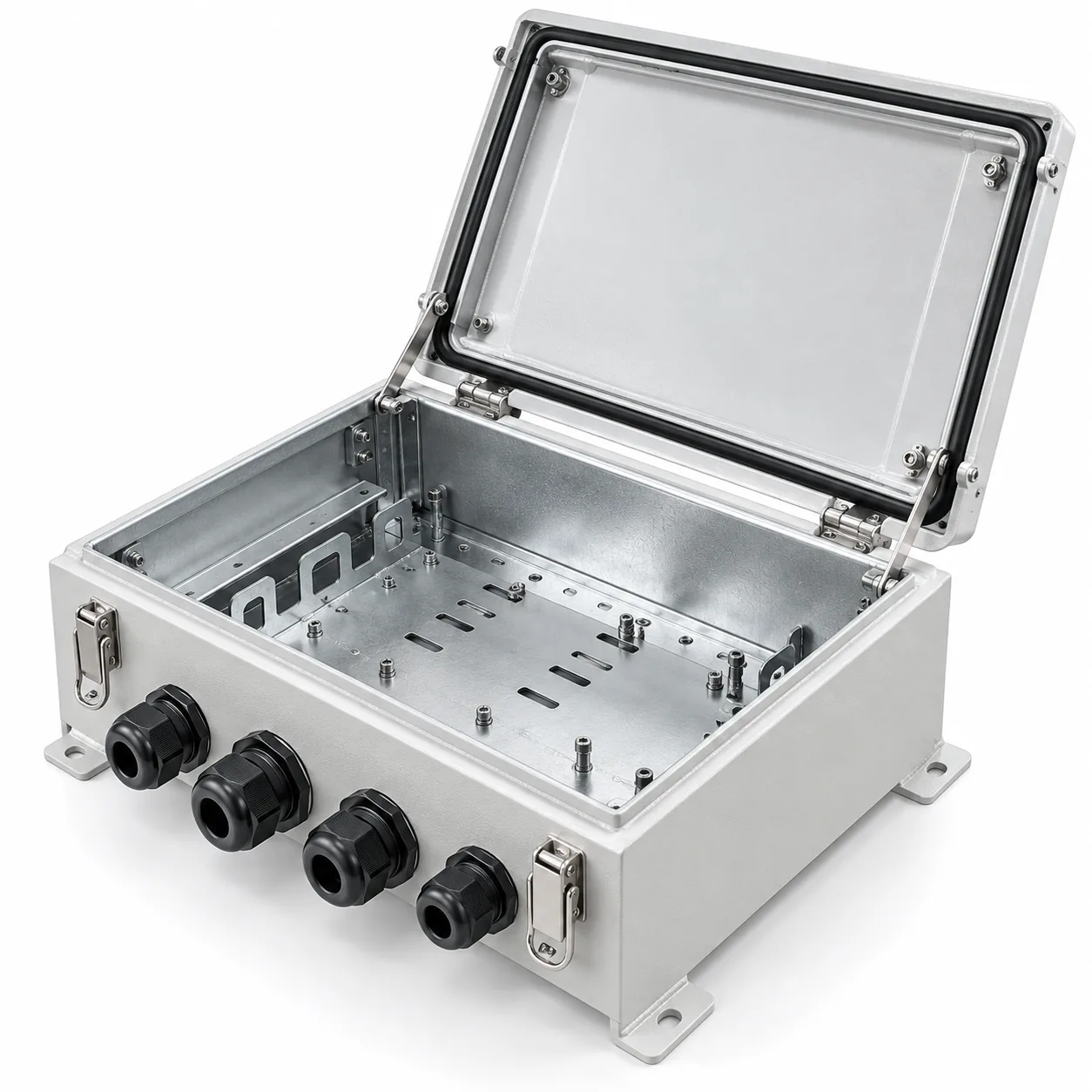
The part
Material: SGCC hot-dip galvanised steel at 1.5 mm, with a powder coat externally and the zinc protecting the interior and the sheared edges. A wall or pole-mounted closure roughly 400 × 300 × 150 mm with a removable cover and multiple cable entry ports.
The requirement was weather resistance for a multi-year service life with no scheduled maintenance, which puts the whole burden on the gasket and on corrosion protection of the cut edges.
Gasket compression is set by the groove
A gasket seals when it is compressed within a defined range. Too little and it does not seal; too much and it takes a compression set and stops recovering, which means it leaks after the first time the cover is opened. The compression is set by the groove depth relative to the gasket's free height, and that is a formed dimension with a tolerance.
The groove on this part was formed in one operation to a controlled depth, and the depth was measured on the first article along its full length rather than at one point. A groove that varies in depth seals in the middle and leaks at the corners, which is exactly where water collects.
The details that decide whether it stays sealed
| Feature | Decision |
|---|---|
| Gasket groove | Formed to a controlled depth, measured along its full length |
| Fastener spacing | Set so the gasket is compressed between fasteners, not only at them |
| Cable entry ports | Separate sealed ports rather than drilled holes, so they can be re-entered on site |
| Cover stiffness | Formed returns along the long edges so the cover does not bow between fasteners |
| Cut edge protection | Zinc on sheared edges plus a coating over; edges are where corrosion starts |
| Internal drainage | A defined low point with a labyrinth drain so condensation has an exit |
Corrosion and transit
A galvanised substrate with a powder topcoat gives both barrier and sacrificial protection, and the sacrificial part is what covers the sheared edges. That combination is chosen specifically because a closure spends its life outdoors and its edges cannot be re-coated on site.
Packaging mattered more than usual here. The gasket land is a sealing surface, and a closure that arrives with a damaged gasket land is scrap regardless of how well it was made. Covers were packed separately with the gasket land protected rather than nested against another part.
What transfers
- A seal is a compressed gasket; control the groove depth and the fastener spacing, not just the gasket material.
- Measure groove depth along its full length, not at a single point.
- Protect sealing surfaces in transit; a damaged gasket land is a scrapped part.
- On hot-dip galvanised steel, rely on the zinc for sheared edges and coat over it — that combination is what handles edges outdoors.