
Packing and Shipping Sheet Metal Parts
A part that arrives damaged has already passed every inspection you paid for. Packing is the last operation and the one most often treated as an afterthought, which is why we treat it as a design step with the part rather than a task after it.
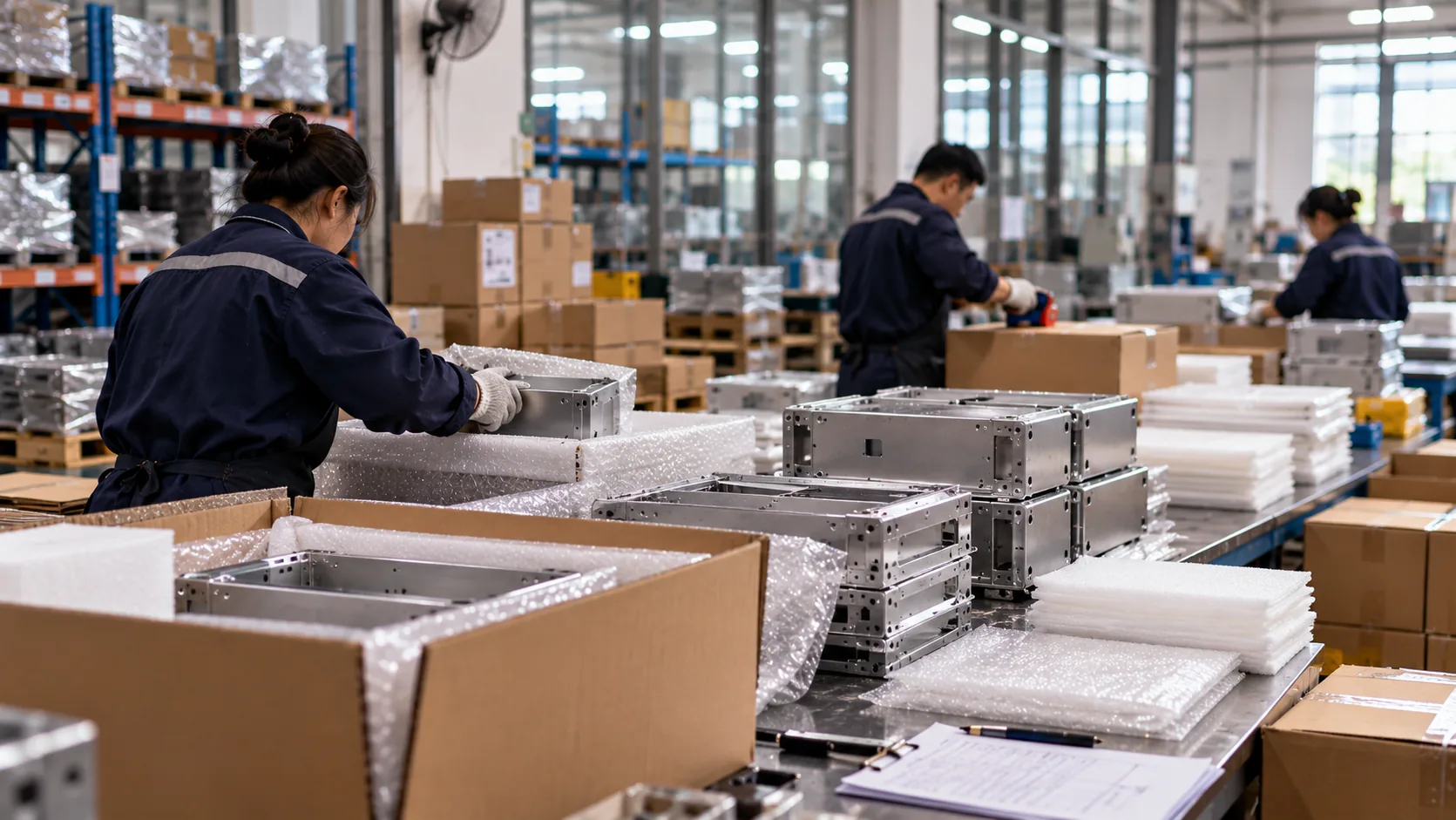
Formed and coated parts get damaged in transit in predictable ways: panels bend, doors twist, edges rub through a coating and hardware punches the part next to it. Packaging design is about stopping movement and separating surfaces, and volumetric weight is what decides the freight bill.
6 rows of reference data below — the summary above is the short answer, the tables are what you quote from.
How sheet metal parts actually get damaged
Almost all transit damage comes from relative movement. Panels bow because nothing supported them across their span; doors twist because they were stacked flat with weight on them; edges rub because two parts touched for a thousand kilometres; and hardware damages the part it was packed against.
The three controls are support, separation and restraint — in that order of importance. Support means the part rests on something that carries its span. Separation means no coated surface touches another part or a bare metal edge. Restraint means the crate or carton is sized so the contents cannot move at all.
| Part | Main risk | Packaging approach |
|---|---|---|
| Large flat panel | Bowing and edge damage | Edge protection, vertical or inclined stacking, span supported |
| Coated enclosure with a door | Door hardware punching through the coating | Door protected separately, hardware boxed, parts separated |
| Welded frame | Twist under its own weight | Braced in the crate; lifted by the frame, not the panels |
| Small brackets and plates | Edges rubbing; mixed part numbers | Layered with interleaving; kitted and labelled by part number |
| Brushed or visible-surface parts | Handling and abrasion marks | Protective film plus interleaving; film left on or removed per your instruction |
| Assembled sub-assembly | Loose items inside a closed assembly | All hardware tightened and verified before packing, not bagged loose |
Part type and the packaging that protects it
Volumetric weight is the cost driver
Air freight is charged on volumetric weight, and volumetric weight is driven by the carton, not the part. A frame that measures 1,200 mm across may need a carton whose volume costs far more to fly than its actual mass, which is why bulky-but-light parts and air freight are an expensive combination.
The design consequence is that packaging decisions belong to the part design: whether a frame can be made to knock down, whether a cabinet can ship with the door separate, whether a large panel can be split without changing function. Sea freight removes the volumetric pressure and adds transit time, which loops back to the schedule discussion.
- Decide sea or air before the packaging is drawn, not after the parts are finished.
- Where a part can knock down without affecting function, it usually ships at a fraction of the volume.
- Leave the protective film decision open until you know whether your line wants it on or off.
- Agree the crate marking — part number, quantity, handling orientation — so your incoming check can be quick.
- Where the part is lifted by crane or forklift, say so; the packaging has to survive the lifting method, not just the journey.
Incoterms and who owns the risk
The Incoterm decides where our responsibility ends and yours begins, and it is worth being explicit because it determines who carries transit damage. FOB puts the damage risk on the buyer once the goods are loaded; DAP leaves it with us until delivery. Neither is better — but a claim against a carton nobody designed for the journey is not a conversation either side wants.
Practical middle ground, where the schedule allows: agree the packaging specification jointly, packed to that specification, and photographed before the container is closed. It costs nothing and it removes most disputes about whether damage happened in transit or before it.
Frequently asked questions
How should sheet metal panels be packed?
With the span supported, a barrier between every coated surface, edge protection, and the whole stack restrained so it cannot slide. On a long thin panel the support matters more than the thickness of the barrier — a panel that can bow will bow regardless of how well it is wrapped.
Sea freight or air freight?
Volume decides it, not weight. Sea freight is economical and slow; air freight is fast and priced on volumetric weight, which penalises bulky parts hard. Where a schedule genuinely needs air, the packaging and the part design should be reviewed together to get the volume down first.
Do you supply protective film on visible parts?
Yes, and it is usually the cheapest cosmetic protection available. Tell us whether it should be left on for your assembly line or removed before packing, because removing it at our end means the part travels unprotected.
What documentation ships with the goods?
A packing list keyed to part number and quantity, and any certificates or inspection reports you specified at quotation. Where a shipment is split across several cartons, the packing list identifies which part numbers are in which carton, which makes an incoming check a matter of minutes.
Who pays for transit damage?
It follows the Incoterm. Being explicit about the term at order stage settles the question before it arises. Where we are responsible through to delivery, our interest is designing packaging that survives the actual route rather than a generic one.
Send the drawing, get a real answer
An engineer reviews your model for manufacturability and returns a costed quotation — with the DFM observations that would change the price.