
Design for the cleaning agent, not the product
Disinfectants are chemically hostile and often chlorine-based. That eliminates a lot of otherwise sensible choices: a coated steel panel fails at a scratch or a cut edge, and an aluminium surface reacts. Austenitic stainless — 304 for general use, 316 where chlorides are heavy — is the default for a reason, and it is chosen for the cleaning regime rather than for the look.
Surface finish matters as much as the alloy. A rough or blasted surface holds residue and is harder to clean than a smooth one, and a brushed finish has a direction that must run consistently or it reads as uneven wear. Where the requirement is hygienic rather than decorative, smoother is normally better.
| Decision | Good practice | Why |
|---|---|---|
| Joints | Welded and dressed, or continuous gasket | Open seams and riveted laps trap residue |
| Fasteners | Enclosed, capped or external | Exposed threads and recesses are hard to clean |
| Edge condition | Deburred and, where handled, radiused | Gloved hands and wipes both catch on an edge |
| Materials | 304 or 316; no dissimilar-metal couple in a wet area | Galvanic corrosion at the joint, not the panel |
| Finish | Smooth or fine brushed, consistent direction | Rough surfaces retain residue |
| Feet and castors | Sealed, with no unsealed cavity above the floor | Floor cleaning water reaches everything low down |
Welding, dressing and passivation
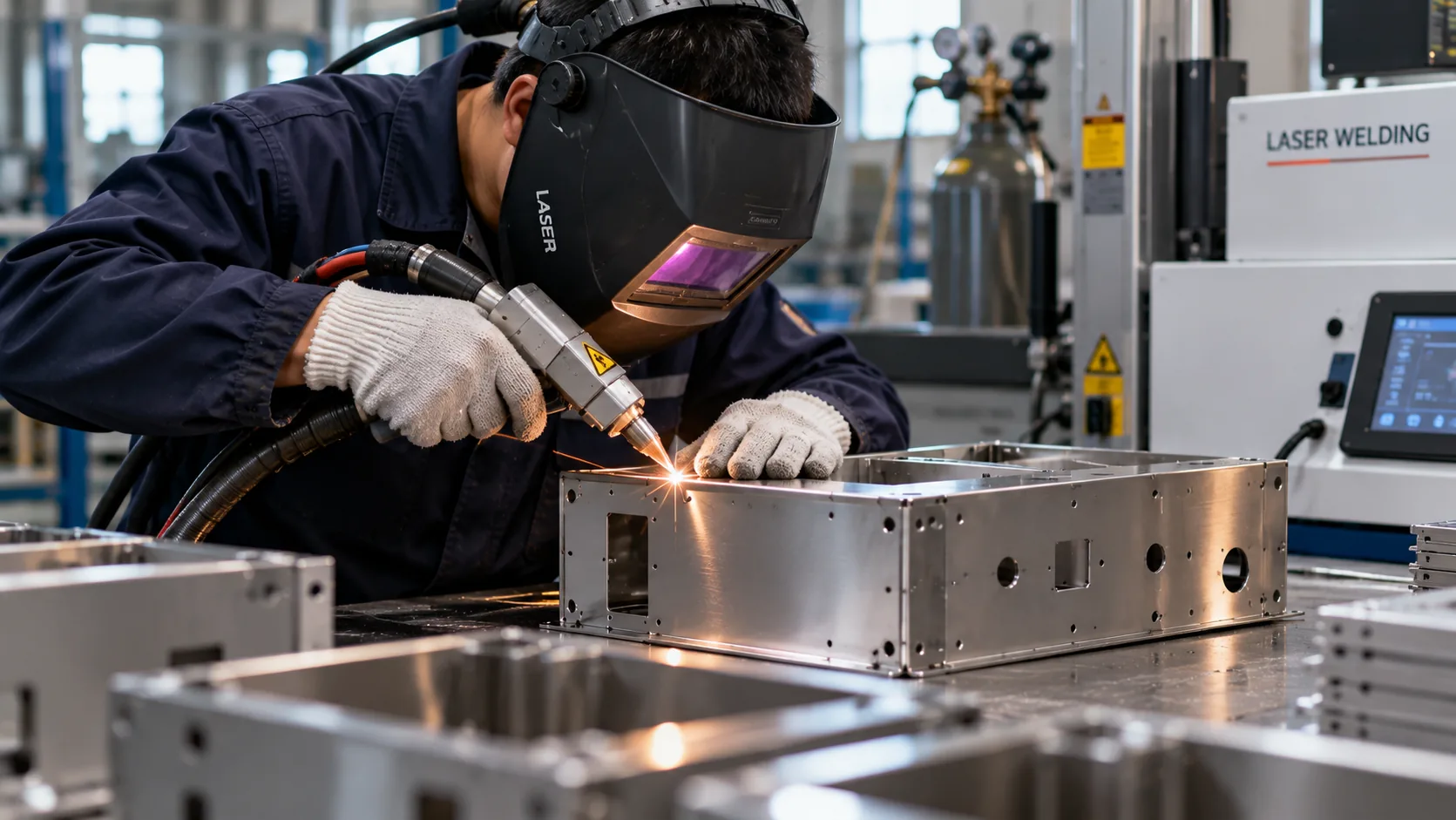
A dressed weld in stainless has to be restored, not just ground flat. Grinding removes the passive layer and leaves a polished stripe on a brushed panel, which is both a visual defect and a corrosion site. Where a weld is visible, the finish has to be restored to match its surroundings, and where it is not, the condition still matters if the area is cleaned.
Creepage of a joint is the second issue. A lap joint that looks closed can hold liquid in the seam indefinitely, and that is where a culture or a corrosion pit develops. Where a joint cannot be welded shut it should be sealed or designed so it drains.
Documentation: what we can and cannot provide
We provide material certificates, first article dimensional reports, weld and finish records, and a documented inspection plan. For programmes that need traceability to a batch, we can tie parts to the material certificate they were made from.
What we do not hold is ISO 13485 or a medical device quality management system, and we do not claim it. Where a programme requires a certified QMS as part of its regulatory submission, that requirement belongs with a supplier who holds one — and it belongs in the supplier qualification, which happens before tooling. What we can do is build to a documented process and provide the objective evidence that process generates.
- Say which cleaning agents the equipment will see, and let that drive the alloy.
- State whether a weld is visible and whether the finish has to be restored.
- Avoid unsealed laminations and open lap seams anywhere liquid can collect.
- Tell us at enquiry stage what documentation the regulatory file needs.