Sheet Metal Prototype Cost: Why Prototypes Cost More
A prototype and a production part can be geometrically identical and priced a hundredfold apart. That gap is not a penalty — it is the fixed cost of manufacturing spread across very few pieces, and understanding it tells you where a prototyping budget actually goes.
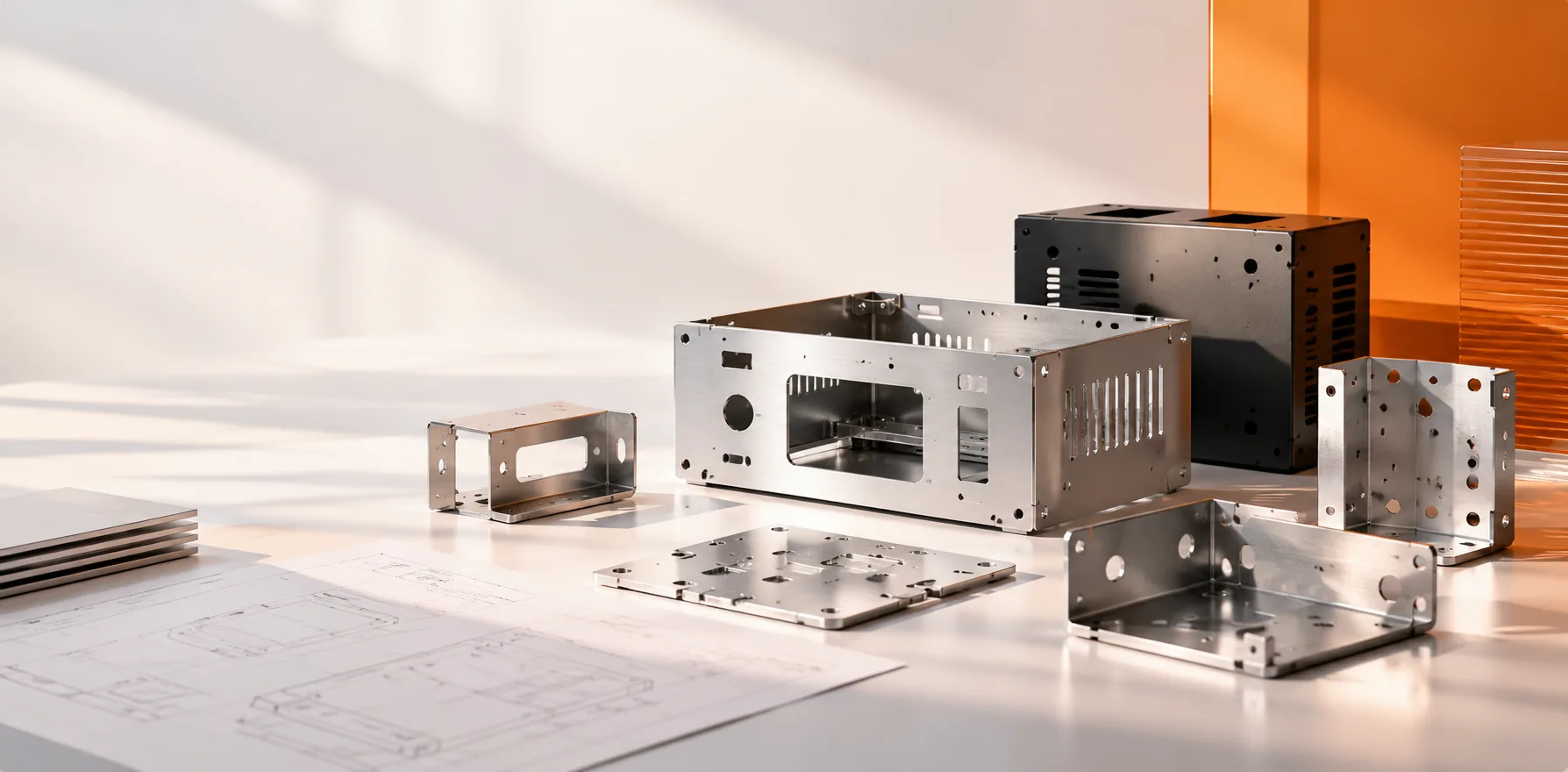
Prototypes cost more per piece than production parts because their fixed costs are spread over a handful of units. Programming, setup, first-off checks, short-run finishing batches and inspection all apply per prototype, while the same costs disappear once volume is spread across thousands of parts.
Why is the first sheet metal prototype the expensive one?
Manufacturing has fixed costs that do not care how many parts you make: programming, tooling selection, machine setup, first-off verification, and — for a finished part — a finishing batch that has a minimum charge regardless of quantity.
Divide those by one and you get the price of a prototype. Divide them by 5,000 and they vanish into a fraction of a cent per part. The prototype is not being overcharged; it is carrying the whole overhead of the run on its own.
What are you actually paying for in a prototype?
| Element | Present in a prototype | Carried into production |
|---|---|---|
| Programming and nesting | Yes — full setup for a very short run | Amortised across the run |
| Machine setup | Yes, once per process | Amortised |
| Material minimum | Often a full sheet for a small part | Shared across many parts |
| Finishing batch minimum | Yes — a small batch can cost what a large one does | Amortised, often with no minimum effect |
| First-off and dimensional checks | Yes, and proportionally heavier | Replaced by sampling and gauges |
| Packaging | Usually generic, small quantity | Engineered and priced per unit |
| Engineering time | Design review and DFM feedback | One-time, retained |
Prototype cost structure
Can you prototype sheet metal without tooling?
For sheet metal, the prototype route is laser cutting plus bending: no die, no fixture, geometry expressed entirely in the programme. That means a design change between prototype revision B and C costs a programme edit rather than a die modification, which is exactly what a development programme needs.
Typical turnaround on this route is three to seven business days, and it produces a part in the production material and the production finish, so what you test is what you get. That is a meaningful advantage over additive prototypes when the test is about stiffness, fit, sealing or finish appearance rather than pure geometry.
How should you spend a prototyping budget?
- Prototype in the production material. Testing a steel part behaviour on a plastic model wastes the iteration.
- Keep the finish realistic in one respect — the one your customer will judge — and defer cosmetic finishing on internal iterations.
- Batch revisions where possible: three variants in one run share setup and material.
- Ask for DFM feedback on rev A rather than after tooling. The cheapest change is the one made before a die exists.
- Do not tool up until the design is frozen. A die revision is far more costly than a programme revision.
What will the production run cost?
The same part at volume loses nearly all of the fixed cost above, gains the benefit of shared material and a merged finishing batch, and — if volume justifies it — moves from laser and bending to a stamping die with its own break-even. We will show you all three numbers side by side for your part rather than arguing for one route.
Frequently asked questions
Is there a minimum order for a prototype?
No minimum quantity. A single piece is a legitimate order, and it carries the full setup cost because it has to. Where the part exists only to validate geometry, we will tell you plainly which features you are paying for and which you could defer.
How long does a sheet metal prototype take?
Typically three to seven business days on the laser-and-bend route, depending on material availability, finishing requirements and whether an inspection report is included. Finishing is often the longest step, because a small batch still needs its own batch slot.
Why is the finish such a large part of a prototype price?
Because finishing is priced per batch, not per part. A dedicated powder-coat or anodise batch has a minimum that does not shrink for one piece, so on a prototype the finish can rival the metal and cutting combined.
Should I prototype in the final material?
For anything functional, yes. Stiffness, springback, weldability and finish appearance are all material-specific. Prototyping a 304 stainless part in mild steel will pass a dimensional check and fail a corrosion or appearance review.
Can the prototype tooling be reused for production?
There is normally no tooling to reuse: the laser and press brake carry geometry in the programme, so production reuses the programme. If volume later justifies a stamping die, that die is a separate investment decided at the break-even point.
Send the drawing, get a real answer
An engineer reviews your model for manufacturability and returns a costed quotation — with the DFM observations that would change the price.